
Can you imagine a Slovenian family celebration, a student party or a relaxed evening with friends without the infamous green box? It’s hard to do. Activity isn’t just a game; it’s an institution. For decades, it has reigned supreme among the most popular party games here, and is rightly regarded as the ‘queen’ of creative expression. From the moment you first pick up a pencil or start waving your arms about, it becomes clear: it’s not just about winning, but about those unforgettable moments when the whole room is shaking with laughter at your failed pantomime of an ‘electric fence’.
Why is Activity so popular?
The psychology behind Activity is simple yet ingenious. The game forces us to step out of our comfort zone. In a world where we’re constantly caught up in serious roles (employees, parents, students), Activity offers us a safe space where we can be ‘silly’, creative and childishly playful.
- The social aspect and bonding: The game is based on teamwork. Success doesn’t just depend on your talent for drawing, but on how well your partner knows you. This ‘synchronisation’ between players creates strong bonds. In Slovenia, where we value socialising over good food and drink, Activity has become the perfect extension to dinner.
- Adrenaline under pressure: The hourglass is a relentless judge. This time limit triggers a mixture of panic and creative genius within us. It’s in those final five seconds, when you’re trying to describe in words the most challenging phrase you’ve ever heard (or at least something a bit simpler), that the best stories emerge – stories you’ll be reminiscing about for years to come.
- Universality: It doesn’t matter whether you’re 12 or 80. The mechanics of drawing, explaining and pantomime are intuitive. As the game is fully localised (Slovenian edition), the concepts are adapted to our cultural context, which greatly enhances its accessibility.
Detailed instructions and gameplay
Activity is a game you can start playing in ten minutes, but you’ll be perfecting it for a lifetime.
List of components: What’s in the box?
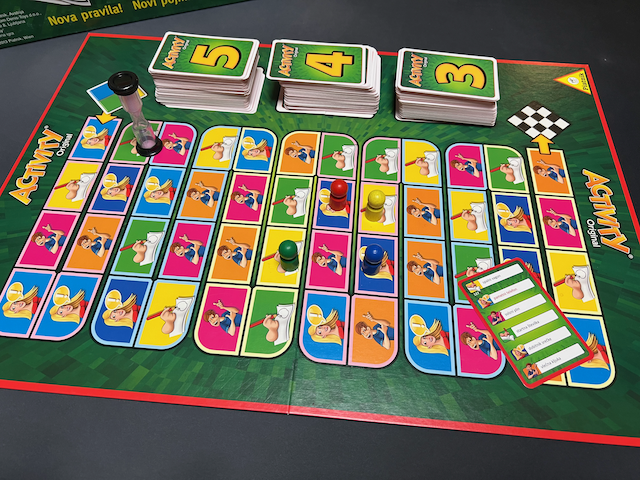
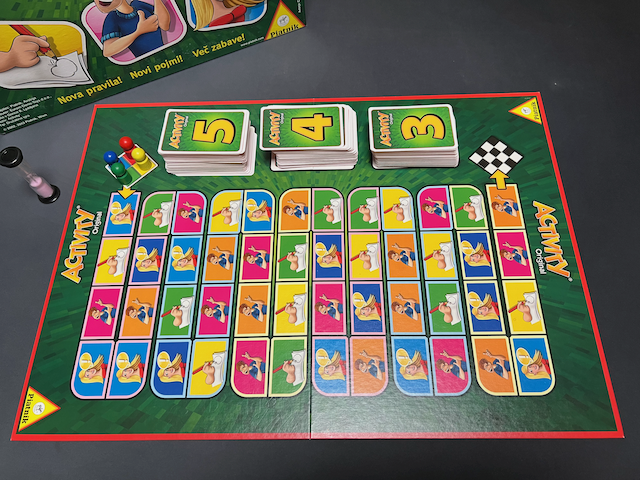
- 1 game board: The path along which your pieces move. Each square has its own colour and symbol, which determines how the concept is conveyed.
- 440 concept cards: Each card contains 6 different concepts, resulting in thousands of combinations.
- 4 playing pieces: In different colours to distinguish your team from the ‘opponents’.
- 1 sand timer: Standard 60-second timer for pure suspense.
- Game rules: Brief and clear instructions in Slovenian.
- Note: You’ll also need paper and a pencil, which aren’t usually included in the basic version but are essential for success.
Setting up the game
Setting up is as quick as ordering a pizza. Place the game board in the centre of the table. Players split into teams (at least two teams of two players each, ideally 3–4 teams). Each team chooses a token and places it on the starting square. Shuffle the cards and place them in the marked spaces on the board. Get the paper, pencil and sand timer ready.
Game mechanics
The game begins with the team that is most eager to play. One team member explains, draws or acts out the concepts, whilst the others guess.
- Choosing a concept:
The player looks at the square where their token is standing. The colour and symbol tell them which concept on the card to choose and how to present it:
- Drawing: No speaking, no writing numbers or letters. Just lines on the paper.
- Describing: Explain the concept in words without using the root of the word or its derivatives.
- Pantomime: Silence. You may only use your body and gestures.
- Action: When the caller reads out the concept, someone turns over the hourglass. The team has 60 seconds to work out the correct answer.
- Progression: If the team guesses the term correctly, they move their token forward by the number of squares indicated next to the term on the card (more difficult terms are worth more points/squares). If they fail to guess, they stay where they are.
- Open round: If the term the team is describing is coloured red, it is an ‘open round’. In this case, all teams take turns guessing. The first team to guess correctly advances.
Winning conditions
The winner is the team that is the first to cross the finish line on the game board. If several teams reach the finish line in the same round, a ‘tie-breaker’ is held using one additional card in an open round.
Analysis of strategies and tactics
Although Activity is a game of chance and skill, there are ways to gain an advantage.
For beginners:
- Co-operating with your partner: Before you start, agree on some basic signals. For example, when acting out a word, use your fingers to indicate how many syllables the word has.
- Keep your drawings simple: Don’t draw works of art. Use symbols, arrows and basic shapes. If you’re drawing a ‘house’, don’t draw curtains; just draw a square and a triangle.
For advanced players:
- Tactical choice of difficulty: On some squares, you can choose between easier and harder concepts. If you’re close to the target, take a risk with a harder concept for more points; if you’re trailing, play for ‘safe’ points.
- Psychological warfare: Whilst your opponent is explaining, remain quiet but attentive. In open rounds, you must be the one who ‘steals’ the points.
- The process of elimination: When describing, start with broad categories (“It’s a thing”, “It’s an animal”, “It’s a verb”) and then narrow down the options.
An overview of official expansions
Piatnik has ensured that Activity never gets boring:
- Activity Crime: With their hands cuffed, each player must use mime and voice impressions to fight their way through the dark world of crime to victory. The aim of the game is to rely solely on yourself in this world of crooks and be the first to score 20 points.
- Activity Junior: The Junior version is designed for schoolchildren and teenagers, with the terms already written down but adapted to their vocabulary. The game encourages teamwork and quick thinking, as players must explain more challenging words to their teammates under time pressure.
- My First Activity: This version is tailored to very young children who cannot yet read, so the concepts on the cards are illustrated with pictures. Through drawing, describing or acting out, children develop their imagination and communication skills in a fun way.
FAQ (Frequently Asked Questions)
- Is the game suitable for children? The standard version is recommended for ages 12 and over due to the complexity of some of the phrases. For younger children, we recommend Activity Junior. For the very youngest, try My First Activity.
- Do I need any special drawing skills? Absolutely not! Often, the funniest ‘works of art’ are the ones that nobody understands. It’s the idea that counts, not the aesthetics.
- What is the ideal number of players? The game can be played by three (individually), but it really comes into its own with 4 to 16 players, divided into teams.
- How long does a game last? It usually lasts between 45 and 60 minutes, depending on the number of teams and their skill levels.
- Is the game in Slovenian? Yes, our edition is fully localised, which is crucial for fluently describing and understanding the phrases.
- Do the cards repeat quickly? With over 400 cards and 2,500 terms, it will take dozens of evenings before you come across the same term twice.
Conclusion
Activity is more than just a board game; it’s a catalyst for laughter, creativity and bonding. Whether you’re a master of charades or your drawing of a cat looks like a potato with legs, this game guarantees top-notch fun. It’s an investment in countless entertaining evenings you’ll never forget.