

Imagine a classic card game where you play for tricks – such as Schnaps, Tarot or Briškula. Now imagine that all the cards in your hand are completely black, with no colour at all. You only determine the colour the moment you lay the card on the table, announcing with a loud exclamation: ‘That’s a red six!’ Does it sound like science fiction or pure magic? Welcome to the world of Cat in the Box, an innovative party game hit by designer Muneyuki Yokouchi, inspired by Erwin Schrödinger’s famous thought experiment on quantum superposition.
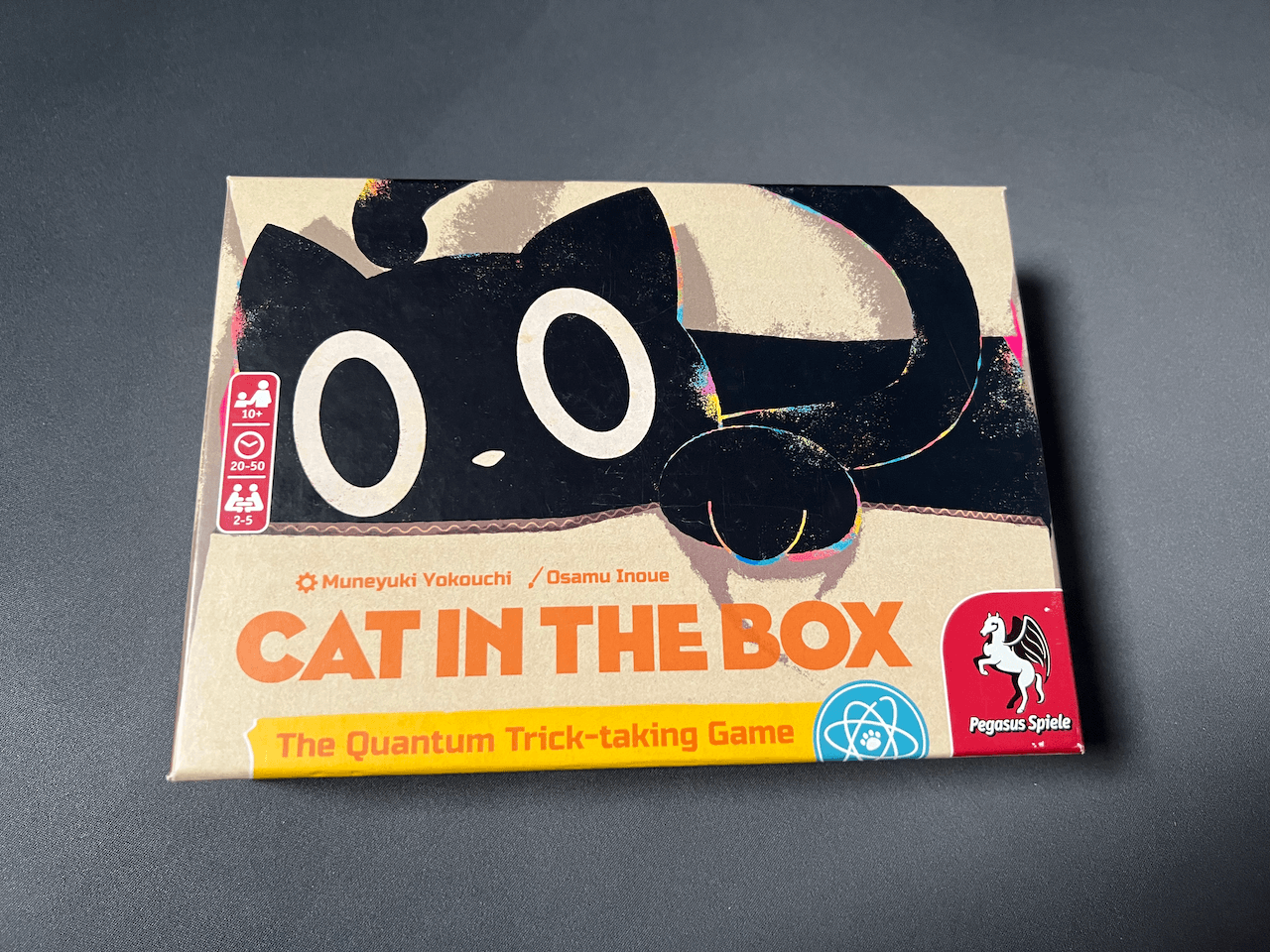
The game combines the familiar comfort of traditional card counting with incredible intellectual depth that will force you to rethink every decision. Below, you’ll find a guide that will take you through the psychology of the game, the rules, strategies and all the details you need to know before buying.
Why is the game popular?
The psychology of playing: The fascination with the quantum paradox
In most traditional card games, you’re limited by the hand that luck deals you. If you’re dealt poor suits or low cards, your fate is more or less sealed. In Cat in the Box, however, there is a complete psychological twist: the player feels a sense of total control and freedom. The cards in your hand bear only numbers, whilst their colour exists in a state of so-called ‘superposition’ – they are simultaneously red, blue, yellow and green.
However, this freedom brings with it immense psychological pressure. As you alone decide which colour your card will be, you also bear full responsibility for any mistakes. Bidding on how many tricks you will take is no longer just a blind guess based on the cards dealt, but a dynamic prediction that you must actively create by building the board.
The social aspect and building tension
The dynamics around the table in Cat in the Box are unrivalled. The game creates an extraordinary mix of quiet contemplation and loud, excited reactions. Due to the ‘following suit’ mechanic, players often decide, either voluntarily or under duress, that they ‘have no’ of a particular colour. When a player declares that they no longer have any blue cards, they open the door to using the trump suit (red), but at the same time permanently rule out the possibility of ever playing a blue card again for the rest of that round.
Each card played thus gradually reduces the range of permissible moves for everyone else. A particular tension builds at the table as players scrutinise the available spaces on the board and frantically calculate whether the inevitable ‘paradox’ will occur – a situation where someone can no longer legally play any card from their hand. When the paradox occurs, it is followed by a dramatic outburst of laughter, sighs and an immediate tallying of points!
Why does *Cat in the Box* resonate so strongly with Slovenian players?
We Slovenians are a nation of tarot and schnapps, so card games have a long and strong tradition here. All generations come together over a pack of cards – from students in halls of residence to families at the weekend. Cat in the Box combines this tradition with a modern approach to party games in an interesting way.
Players familiar with classic card games will quickly recognise the mechanics of taking tricks and trumps, whilst the game also offers considerably more strategic thinking. Pattern building, risk management and deciding which cards to play create plenty of scope for tactical manoeuvring.
This is precisely why Cat in the Box fits in so well at Slovenian games evenings – the rules aren’t linguistically demanding, individual games are relatively short, and the game is accessible enough for fans of classic card games whilst remaining interesting for experienced board game players.
Detailed instructions and gameplay
List of components: What’s in the box?
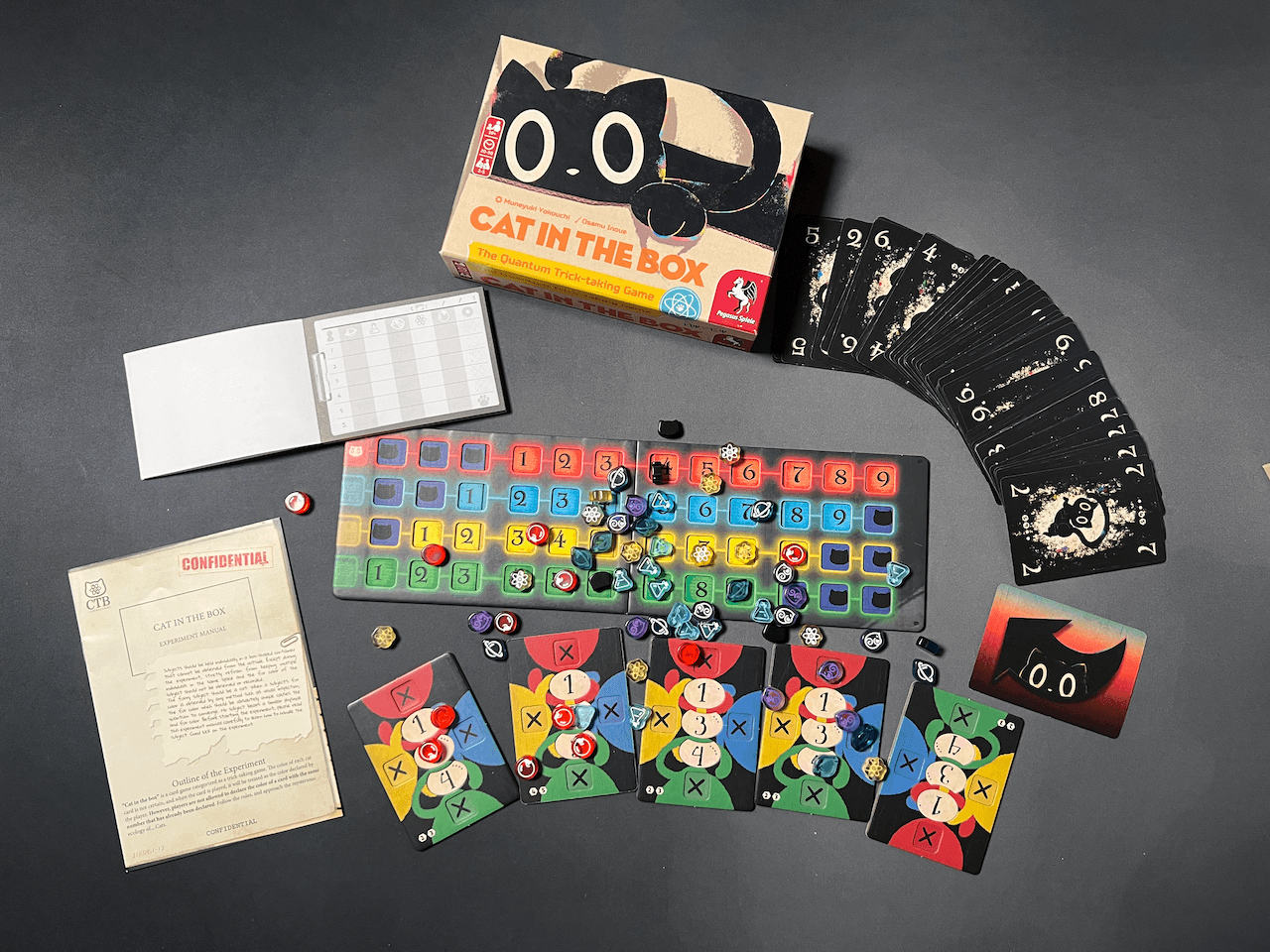
The Cat in the Box edition boasts superb build quality that will delight any board game enthusiast:
- 50 cat cards: Cards numbered 1 to 9 in neutral (black) colours with beautiful illustrations of cats.
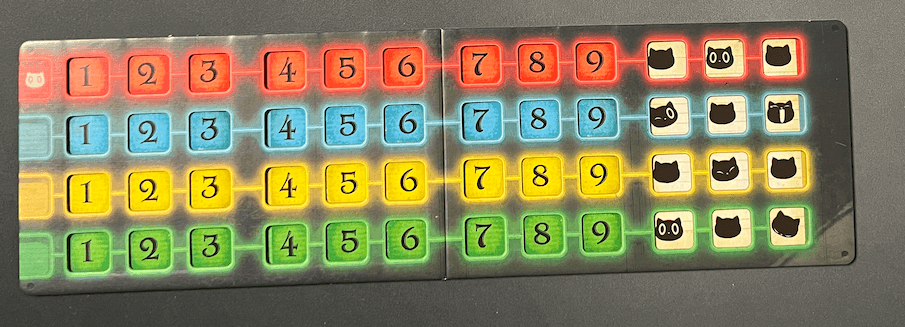
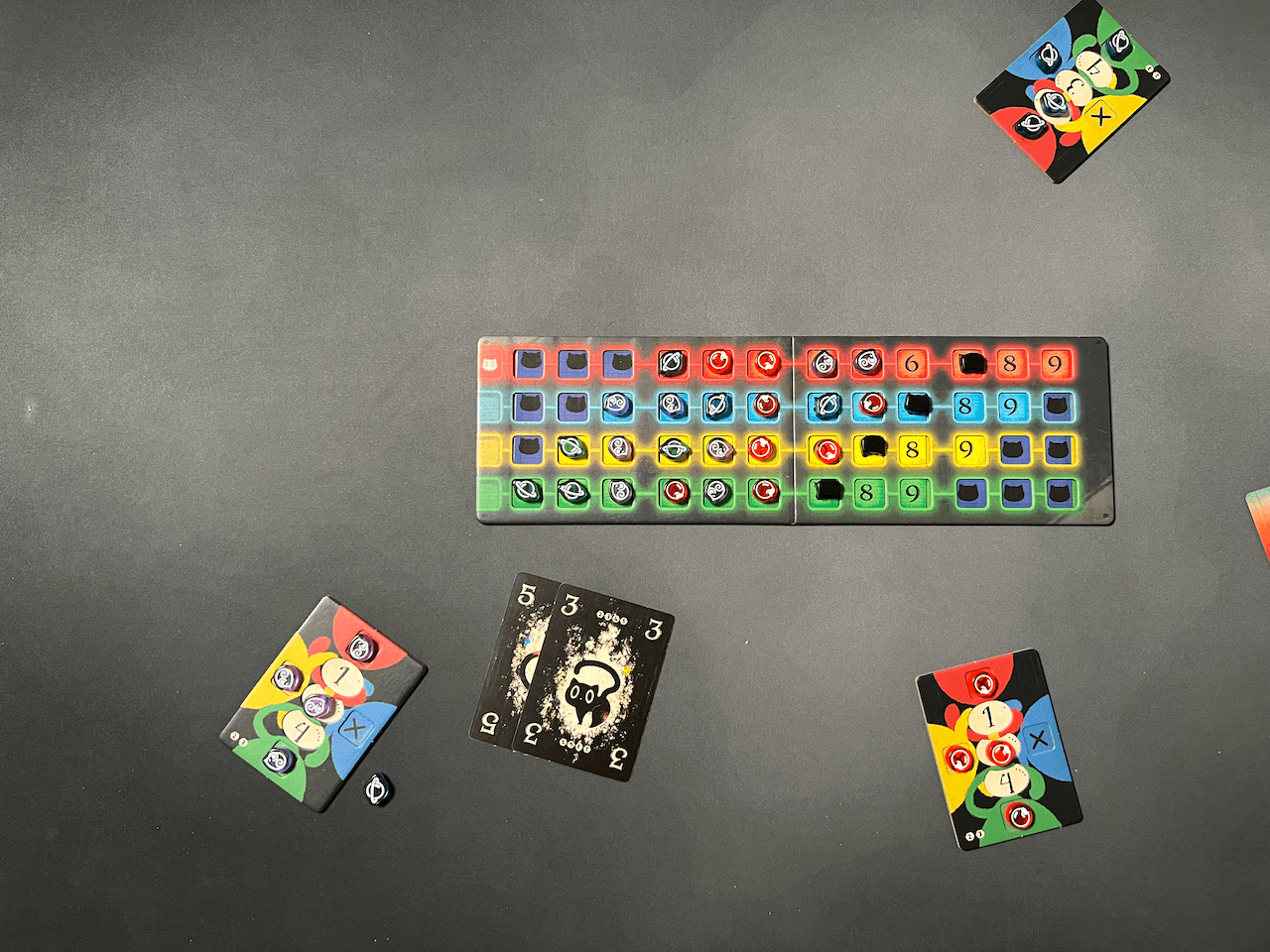
- 1 central Research Board: A grid showing all possible combinations of numbers (1–9) and four colours (red, yellow, green, blue).
- 5 player boards: Used to keep track of suit bids and mark the colours a player can no longer play.
- 64 acrylic tokens (in the 5 player colours): Transparent, smooth acrylic tokens for marking played cards on the central board.
- 1 score pad: For easily keeping track of scores round by round.
- Game instructions: Clear and concise rules in Slovenian/English.

Game Setup
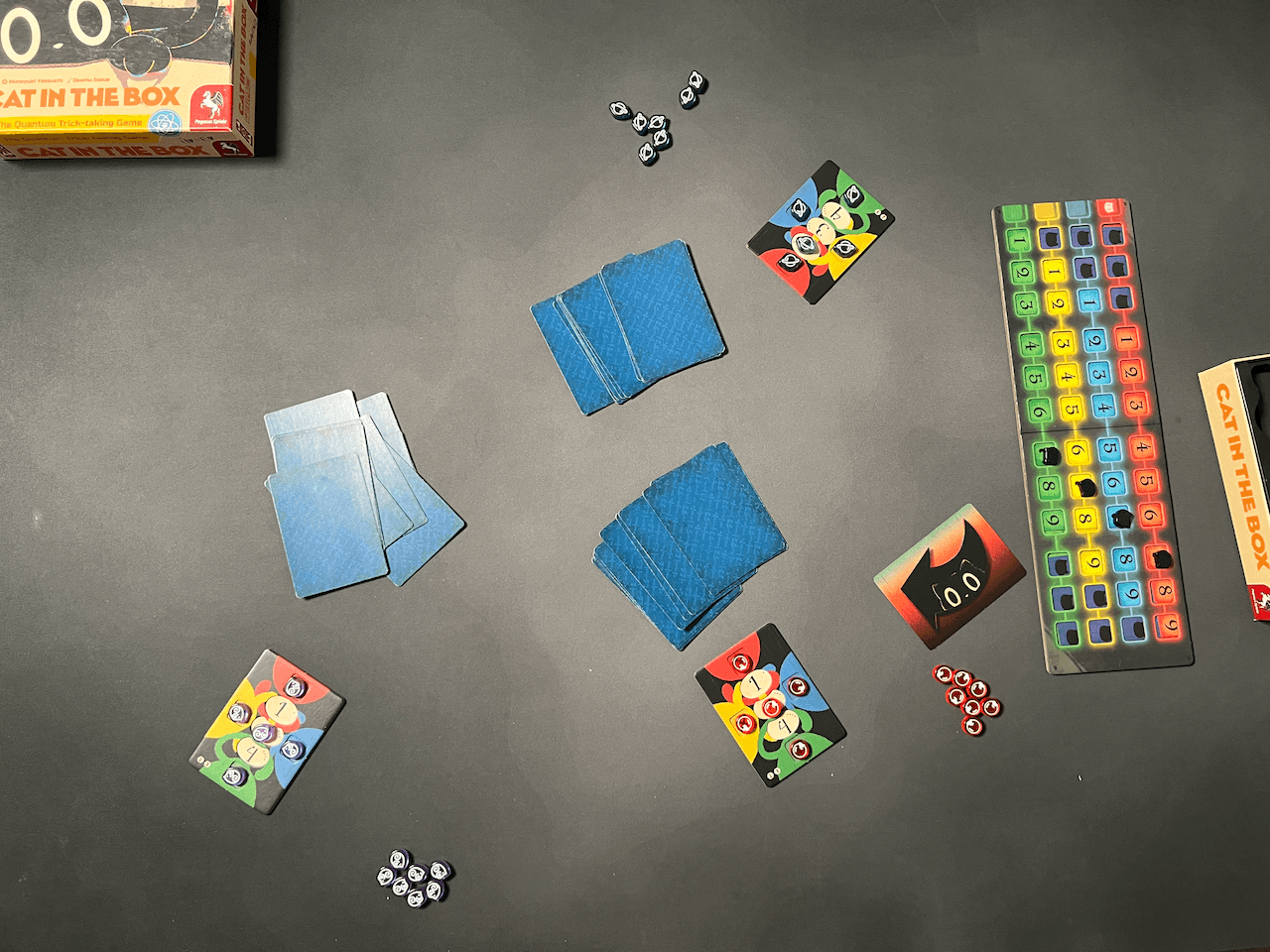
Set-up is quick and simple and takes less than three minutes:
- Placing the boards: Place the central exploration board in the middle of the table.
- Distributing tokens: Each player chooses their colour and takes all the corresponding transparent tokens and their personal game board.
- Preparing the card deck: Remove the specified number of cards from the deck depending on the number of players (fewer cards are used with 3 players than with 4).
- Dealing the cards: Shuffle the deck thoroughly and deal the appropriate number of cards to each player.
- Discarding one card: Each player looks at their cards and turns one card face down. This creates unpredictability, as not all cards will be played.
- Bidding: Based on the cards in their hand, each player uses a token on their personal board to indicate how many tricks they plan to take in this round (usually between 1 and 4).
Gameplay Mechanics
A round consists of several consecutive tricks. The first player places a card on the table and announces its suit and rank aloud.
Rules of play:
- Declaring the suit and placing the token: When you play a card from your hand (e.g. a 5), you must say aloud what suit the card is (e.g. “Blue 5”). Then immediately place your transparent token on the Blue 5 square on the central exploration board.
- No Duplicates: There can only be one token on any given space (e.g. Green 7) on the central board. If the Green 7 space is already occupied, no one else may play a 7 as green in that round!
- Following the suit (Compulsory): All other players in the trick must play a card of the same suit as that announced by the first player.
- Passing on a Colour and Using a Trump: If a player does not wish to or cannot play the required colour, they must mark that colour on their personal board. From that moment until the end of the round, that player may no longer play that suit! If they pass on the leading suit, they may declare Red (Trump) or any other remaining suit as their card.
- Determining the winner of the trick: The trick is won by the player who played the highest card in the leading suit, unless a trump (Red) was played. In this case, the trick is won by the highest trump card played. The winner of the trick covers the trick in front of them and takes the next turn.

Quantum Paradox:
If a situation arises where a player, on their turn, no longer has any legal options for playing a card (all suits corresponding to the numbers in their hand are already occupied on the exploration board, or they have blocked the suits themselves), a PARADOX occurs!
- The round is immediately ended.
- The player who caused the paradox receives no points for the tricks they have taken, but instead receives negative points (1 penalty point for each trick they took in that round).
Example of a paradox:
If a player has only cards with values of 5 and 3 left in their hand, but all the spaces for the three and the five are already occupied, or if the player has declared that they do not hold the suit that is still available, a paradox arises.
Winning conditions
The game is played over a set number of rounds (usually as many rounds as there are players). At the end of each round, the points are tallied:
- Points for tricks: Each player receives 1 point for every trick taken (except the player who caused the paradox).
- Bonus for an exact bid: If a player has correctly predicted the exact number of tricks, they receive additional bonus points from the tokens.
- Points for connecting tokens: A player who has successfully met their bid counts the tokens in their largest connected group of tokens on the central exploration board (horizontally and vertically adjacent spaces). Each token in this group is worth 1 extra point!
The winner is the player with the highest total number of points after all rounds have been played.

Analysis of strategies and tactics
A beginner’s guide: How to survive the first few rounds
If you’re new to Cat in the Box, solving the quantum puzzles might seem daunting. Here are three basic rules for beginners:
- Be cautious with your bids: In your first few games, it’s best to bid 1 or 2 tricks. Bidding 3 or more tricks requires complete control over the centre board and the trumps.
- An early suit bid is a double-edged sword: Bidding a suit allows you to play a trump (red) immediately and take a trick. But be careful! By doing so, you completely prevent yourself from playing that suit for the entire round, which dramatically increases the risk of a paradox arising in later moves.
- Keep an eye on the board: Regularly check which numbers are still available. If you have two 8s in your hand and two spaces for the number 8 are already taken on the board, you must play your 8 as soon as possible before you run out of options!
Advanced tactical refinements for experienced players
1. The art of territory building
Points for a successful bid aren’t fixed; they depend on your ability to create compact groups of tokens on the central board. Advanced players don’t just look at how to take a trick, but where their token lands. Linking tokens into a chain of 5 or 6 squares can yield a huge number of points, which completely outweigh the tricks themselves.
2. Exploiting the paradox
Perhaps the sweetest advanced tactic in the game! If you notice that your opponent has taken a lot of tricks and is likely holding high cards (e.g. two 9s), you can deliberately block the remaining spaces for 9s on the central board. If you force your opponent into a paradox, they will lose all the points for those tricks and receive negative points. Forcing a paradox is the quickest way to turn the game around.
3. Controlling the pace of discarding
As each player discards one card at the start of a round, there is always an element of uncertainty in the game. Advanced players discard medium-value cards (4, 5, 6), as these spaces on the board are the most sought-after and are filled the quickest.
Conclusion
Cat in the Box isn’t just another card game – it’s a complete reimagining of the genre, combining the charm of traditional board games with an ingenious quantum puzzle. It is a mentally stimulating, incredibly fun and visually captivating game that is sure to become a staple of your game nights.
Will you be the one to master quantum superposition and build the greatest network dominance, or will you push your fellow players into an inescapable paradox? Prove your strategic skills!