
Hello, lovers of socialising, laughter and giving your brain a workout! If you’ve ever been on the hunt for the perfect party game that brings together complete beginners and seasoned strategists, you’ve almost certainly come across a name that’s been making waves in the world of board games for years: Codenames.
This game, created by the Czech genius Vlaada Chvátil, has taken the world by storm and quickly become a staple on Slovenian tables. Why? Because it’s brilliantly simple, yet infinitely deep. You don’t need hours to explain the rules, but after every game you’ll spend hours discussing “how on earth could you have meant that with that word!”. It’s a game of word associations, deduction and – most importantly – knowing your fellow players.
We’ve put together the most comprehensive Slovenian guide to Codenames, which will take you from the basics to advanced tactics that’ll make you shine at your next games night.
Why is Codenames so popular?
Codenames didn’t become a global phenomenon overnight by chance. Its success is based on a blend of psychology, social interaction and accessibility that few games achieve so elegantly.
The psychology of association and ‘reading minds’
The heart of Codenames lies in the psychological phenomenon of free association. When the Spymaster looks at the grid of words, networks of meaning begin to form in their mind. The challenge is not simply to find a word that links, for example, ‘Dog’ and ‘Sofa’, but to find a word that their teammates will associate with these two words without thinking of ‘Cat’, which might belong to the opposing team.
This creates incredible tension and satisfaction. When the team leader gives a clue and their teammates immediately guess all the correct words, everyone feels as though they have the superpower of mind-reading. It’s that ‘Aha!’ moment that keeps players coming back. Conversely, when misunderstandings arise, this leads to comical situations and debates that are just as entertaining. The game taps into our natural desire to understand and connect with others on a deeper, symbolic level.
The social aspect: Team-building on steroids
At its core, Codenames is a team game. It requires cooperation, listening and coordination. Operatives must discuss the clue, weigh up the options and decide on a joint course of action. This process naturally encourages communication and strengthens bonds between players. It’s no wonder that Codenames is one of the most popular games for team-building sessions and family gatherings. You get to know how your friends think, what their inner thoughts are and how they interpret the world.
By its very nature, the game is extremely inclusive. It doesn’t matter whether you’re 10 or 80 years old, whether you’ve played through hundreds of complex strategies or whether this is your first board game. Everyone can contribute their own logic and associations. This low barrier to entry, combined with a high level of social interaction, is the key to its universal appeal.
Why has the game become such a hit in Slovenia?
We Slovenians are a nation that values socialising and good cheer. Codenames fits perfectly into this culture. In Slovenia, games that are fast-paced, fun and where the result isn’t always the most important thing – it’s the experience that counts – are popular. Codenames offers exactly that.
Furthermore, the Slovenian edition of the game is crucial. As the game is entirely based on words and their nuances, the English version would be too great an obstacle for many, as they would be unable to make the most of all the linguistic subtleties. The Slovenian localisation has been carefully crafted, using words that are familiar to us and evoke rich associations within our cultural context. This has made the game accessible to a wider audience, from schoolchildren to grandparents, and established it as an indispensable part of Slovenian social gatherings and family afternoons.
Detailed instructions and gameplay
Codenames is a game for 2 to 8+ players (it works best with 4 or more), in which players are divided into two teams: Red and Blue. Each team has its own Spymaster and Field Operatives.
The aim of the game is to be the first to uncover all 8 (or 9) agents of your colour in the field before the opposing team does, whilst avoiding the Assassin.
List of components: What’s in the box?
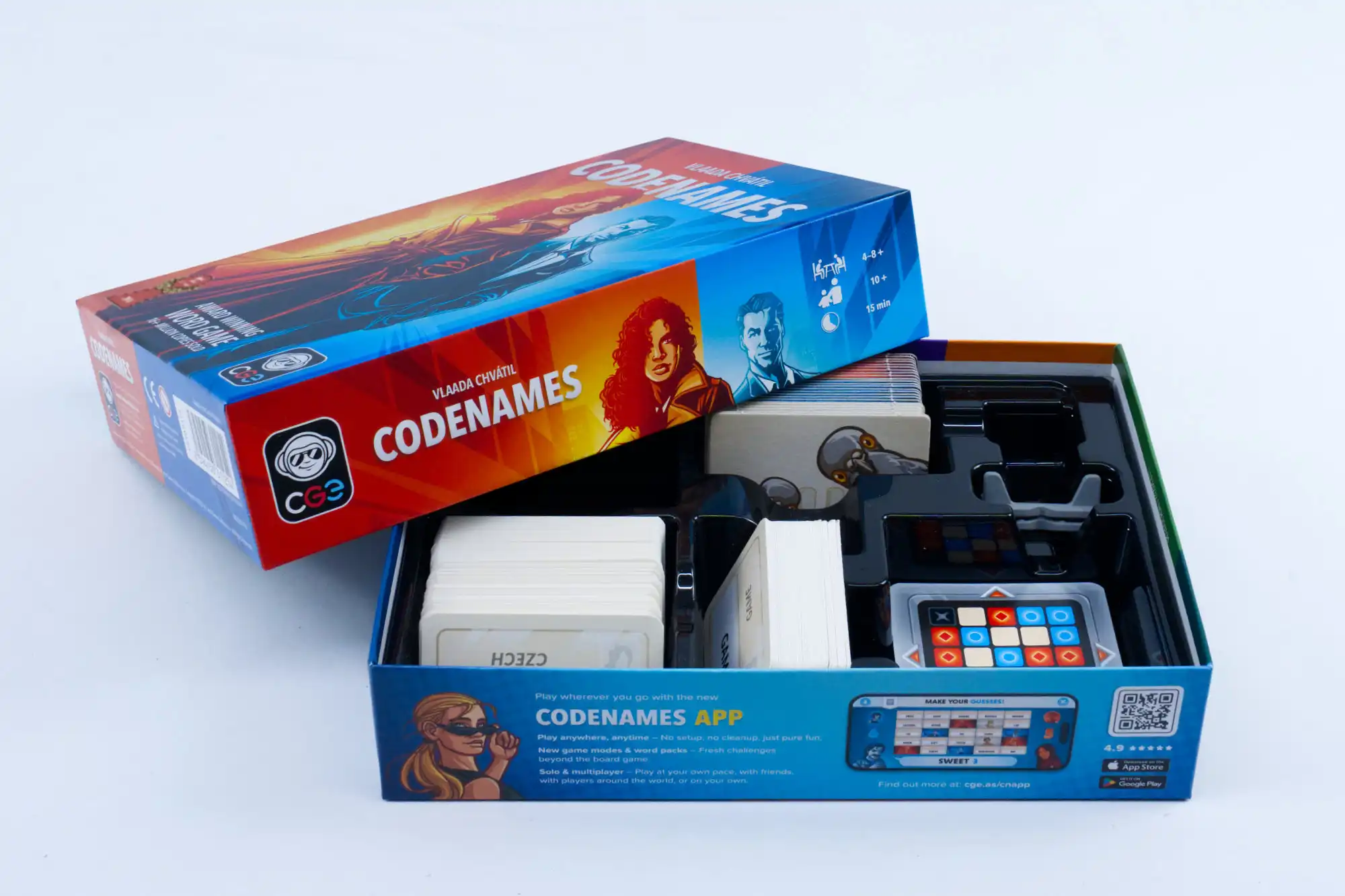
When you open the box of the Slovenian edition of Codenames, you’ll find:
- 16 agent cards (8 red and 8 blue), representing the uncovered spies.
- 1 double agent card, which is red on one side and blue on the other. This card belongs to the team that starts the game and represents their 9th agent.
- 7 innocent bystander cards, which represent incorrect guesses.
- 1 Killer card, which immediately ends the game if found.
- 40 Key Cards, which are inserted into the stand and show the spy leaders the location of the agents.
- 1 Key Card stand.
- 200 double-sided word cards representing the concepts on the table (400 different words in total).
- Game rules in Slovenian.
The components are of high quality. The word cards are clear and legible, whilst the agent cards feature fun illustrations. The overall aesthetic of the game is clean and functional, which is essential for a game that focuses on information.
Setting up the game
Setting up Codenames is quick and simple:
- Players are divided into two teams of roughly equal strength (Red and Blue).
- Each team chooses a leader. Both leaders sit on the same side of the table.
- All other players (operatives) sit on the opposite side of the table.
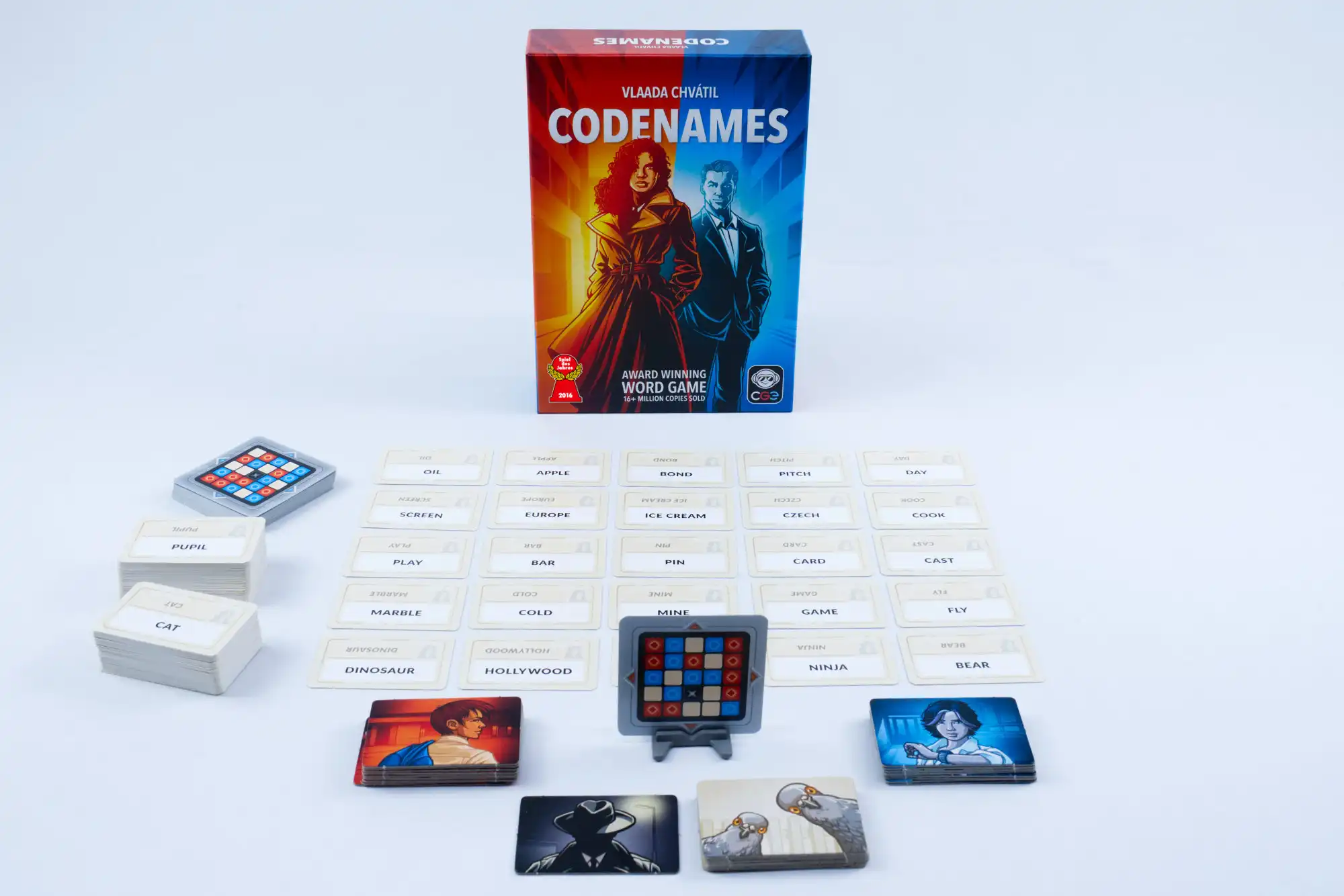
- Randomly select 25 cards from the pile of word cards and place them in the centre of the table in a 5x5 grid. These words represent the concepts that need to be guessed.
- The spy team leaders each take one key card and place it in the stand so that the operatives cannot see it. It doesn’t matter which side of the card they use, as long as they can both see it clearly.
- Look at the colour on the edges of the clue card. This colour determines which team starts the game. The team whose colour predominates on the edge goes first. That team must find 9 agents, whilst the other team must find 8. Take the double agent card and place it, with the corresponding colour facing up, on top of that team’s pile of agent cards.
The 5x5 grid on the key card corresponds to the grid of words on the table:
- The red squares are the locations of the red agents.
- Blue squares are the locations of the blue agents.
- The pale squares are innocent bystanders.
- The black square is the killer.
Game mechanics
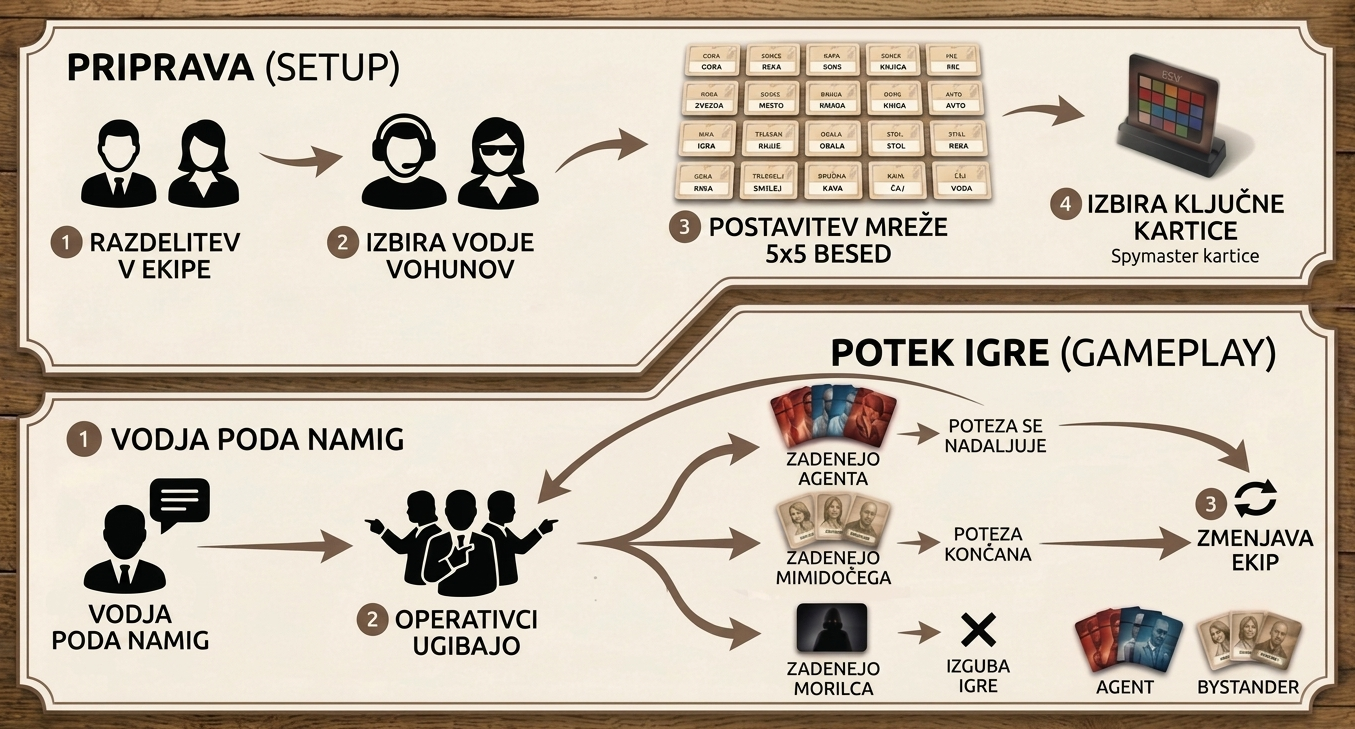
The game proceeds in alternating rounds, starting with the team determined by the key card.
The Spy Leader’s Turn (Hint)
The spy leader of the team whose turn it is looks at the locations of their agents on the key card and tries to find a single word that links as many of their team’s concepts on the table as possible.
Their clue must consist of exactly two parts:
- A single word (association).
- A single number indicating how many terms on the table are linked to that word.
Example: If the leader of the red team wants to link the words ‘Dog’ and ‘Wolf’, they can say: ‘Animal, 2’.
Strict rules for clues:
- A clue must consist of a single word. It must not be a phrase (e.g. ‘sea dog’ is not allowed, but ‘sea’ or ‘dog’ is).
- The clue must not be a word that is currently visible on the table in the 5x5 grid.
- A clue must not be part of a word on the board (e.g. if ‘table tennis’ is on the board, you must not say ‘table’ or ‘tennis’).
- A clue must not be a translation of a word on the board into another language.
- The spy leader must not give any additional verbal or non-verbal cues (e.g. winking, emphasising a particular part of a word, pointing with a finger). Their face must be as expressionless as possible (‘poker face’).
The operatives’ turn (Guessing)
When the leader gives a clue (e.g. “Animal, 2”), the operatives on his team begin to discuss which words on the table might be related to the clue. During this discussion, the spy leader must not participate, confirm or deny their ideas. However, they may listen and observe how their spies are thinking, so that they can give more precise clues in future.
Once the operatives have decided on a word, one of them touches the card with that word on the table. This constitutes an official guess and cannot be retracted.
Possible outcomes of the guess:
- They have hit their own agent: The spy leader covers the word with a card of an agent of their own colour. The operatives have been successful and may continue guessing.
- They have hit an enemy agent: The spy leader covers the word with an agent card of the opposing colour. This immediately ends their team’s turn. The operatives have helped the opponents get one step closer to victory.
- They have hit an innocent bystander: The spy leader covers the word with an innocent bystander card. This immediately ends their team’s turn.
- They’ve hit the assassin: The spy leader covers the word with an assassin card. The game ends immediately and the team that chose the assassin loses.
How many times can the operatives take a guess? The operatives must take at least one guess in every turn. After each successful guess (when they find their agent), they may choose to continue guessing. The maximum number of guesses in a single turn is the number in the clue plus 1. An extra guess is useful if they have missed an agent in previous rounds and now recall an old clue that might fit.
Example: The leader said “Animal, 2”. The operatives correctly guessed “Dog” and “Wolf”. They now have the option of one more, additional guess (2+1=3). They may decide to guess the word ‘Sofa’, as they recall the previous clue ‘Furniture, 1’, which they missed at the time. If they guess “Sofa” and that is their agent, they have uncovered three of their agents in a single turn. If they decide not to take any more risks, their turn ends.
Turns are taken in turn until one team wins or someone selects the killer.
Winning conditions
In Codenames, there are two ways for the game to end:
- By victory: The team that is the first to cover all 8 (or 9, if they started with 9) of their agents with cards of their colour wins immediately.
- By defeat: The team that touches the assassin card (the black square on the key card) immediately loses the game. In this case, the opposing team wins.
It’s that simple! The winner is the team that is quicker at uncovering their agents, or the one that manages to avoid the deadly assassin for the longest time.
Analysis of strategies and tactics
Although the rules of Codenames are simple, the game has enormous strategic depth. The difference between a beginner and an experienced player lies in their way of thinking, giving clues and managing risk.
Strategy for beginners: Reliability over risk
If you’re new to the world of Codenames, the best approach is to ‘play it safe’. Your aim is to build trust with your team and avoid catastrophic mistakes.
- Link fewer words: As the spy leader, focus initially on linking just two words at a time (e.g. “Clue, 2”). This is easier to spot and less likely to involve incorrect associations. ‘1’ clues are very safe, but slow.
- Avoid the killer at all costs: Before giving a clue, always check which word on the table is the killer. Ensure that your clue cannot possibly be associated with that word. If the killer is ‘Knife’, avoid clues such as ‘Kitchen’, ‘Sharp’ or ‘Metal’. It is better to give a weaker clue than to risk an immediate defeat.
- Be clear and literal: Use more literal clues at the start. If you want to link ‘Apple’ and ‘Pear’, ‘Fruit’ is an excellent, clear clue. Avoid overly personal or vague associations, unless you’re certain your team will understand them.
- Guess carefully: As operatives, agree on the words. If you’re not sure, it’s better to end your turn after one or two successful guesses than to take a risk and hit the opponent’s agent or assassin. Only use an extra guess if you’re very confident.
Advanced tricks for experienced players: Mind reading and network management
Once you’ve mastered the basics, Codenames becomes a game of risk, psychology and advanced information management.
- Linking 3, 4 or more words:
This is the holy grail for spy leaders. Finding a clue that safely links three or four words can give your team a decisive advantage. This requires creative thinking and identifying umbrella terms that aren’t too obvious.
- Example: You have ‘Crown’, ‘Gold’, ‘Castle’ and ‘England’ on the table. The clue ‘Royal, 4’ is risky, but brilliant if your team understands it.
- Analysing the opponents’ words: An experienced spy leader looks not only at their own words, but also at those of the opposing team. They try to find clues that are strongly linked to their own words whilst being as far removed as possible from the opponents’ words. If your clue is ‘Water’, but the opposing team’s agent is ‘Fish’ and the innocent card is ‘Boat’, this is a poor clue, even if you have ‘River’ and ‘Ocean’ on the table.
- Using ‘Limited Guessing’ (Number + 1): This mechanic is crucial. If, in the previous round, you missed the word for the clue ‘Animal, 2’ and only guessed ‘Dog’, and in the next round you are given the clue ‘Furniture, 2’ for ‘Sofa’ and ‘Table’, you can use an extra guess for ‘Wolf’ (which you missed earlier) after successfully guessing those two words. A good leader deliberately leaves clues for later rounds.
- Reading your teammates: Players must listen not only to what the leader has said, but also to how they said it (even though they’re supposed to be expressionless). Did they take a long time to think? Did they emphasise a number? Is the clue too obvious? It’s also crucial to know your teammates. Does your friend associate ‘Coffee’ with ‘Morning’ or with ‘Black’? This personal touch is what separates good teams from great ones.
- Bold clues (0 or Unlimited):
- A clue with the number 0 (e.g. ‘Water, 0’) means that no word on the board is related to water, but the players must take at least one guess (at any other word). This is useful if you want to steer the team away from the killer or the opponent’s words that are related to water.
- A clue with the word “Unlimited” (or any high number greater than the remaining agents) allows operatives to guess as many words as they like until they get it wrong. This is great for the end of the game, when you want the team to recall all the previous clues.
An overview of the official expansions
Codenames has been so successful that it has spawned a whole family of games. Each brings a breath of fresh air and new challenges, so let’s take a look at the most important ones:
- Codenames: Pictures: Instead of words, the table is laid with cards featuring unusual, surreal images. This version is more visually appealing and is often easier to play with younger children or people who aren’t keen on word games. The associations here are more visual and symbolic, creating a completely different dynamic. Is it worth buying? Yes, if you fancy a change of pace and a visual challenge.
- Codenames: Duet (Duet): This is a cooperative version of the game, designed specifically for two players. The players do not compete against each other, but work together to find all the agents on the board before they run out of time. Each player sees their own side of the clue cards, which partially overlap with their partner’s, creating an interesting challenge of communicating without revealing too much information. Is it worth buying? Absolutely, if you often play as a pair and enjoy cooperative challenges.
- Codenames: Harry Potter: This version takes you into the magical world of Hogwarts, where instead of secret agents, you’re searching for members of the Order of the Phoenix. The game uses cooperative mechanics (similar to the Duet version), meaning that players work together to defeat the Death Eaters. The cards are double-sided and feature both words and images, allowing you to adjust the difficulty and depth of the associations based on your knowledge of the films and books. Is it worth buying? Without a doubt, if you’re a Harry Potter fan (a so-called ‘Potterhead’) and are looking for a themed game that encourages teamwork rather than competition.
- Codenames: XXL: This isn’t a new game, but a version of the original with larger cards and components. It’s ideal for larger groups, where a 5x5 grid with small cards would be difficult for everyone to see. Is it worth buying? Yes, if you regularly play Codenames at parties with 8 or more players.
On the Slovenian market, the original word-based version is the most popular, but Pictures and Duet are also excellent additions to your collection if you enjoy the core mechanics.
Frequently Asked Questions
Here are the answers to some of the most common questions that arise when playing Codenames:
What is the recommended age for Codenames? The official recommended age is 10+. This is mainly due to the need for a certain level of vocabulary and the ability to think abstractly. Younger children may not understand the more subtle associations. However, with the Codenames: Pictures version, you can lower the age limit to around 7–8 years.
How linguistically demanding is the game? The game is entirely language-dependent. Therefore, the Slovenian edition is essential for playing in Slovenia. All players must have a good understanding of the Slovenian language, its nuances and cultural references, in order to fully enjoy the game. The English version is only suitable if all players are fluent in English.
How long does a game last? A game usually lasts between 15 and 30 minutes. This is one of the game’s great advantages, as it is fast-paced and allows you to play several rounds in a single evening, swapping roles and teams. If players take too long to think, you can use an hourglass to speed up the pace.
Can Codenames be played by two people? The original Codenames can be played by two people using special rules (as a co-operative version against an ‘imaginary’ opponent), but the experience is quite different and less dynamic. If you want to play as a pair, we highly recommend Codenames: Duet, which is designed specifically for this purpose and offers a much better experience.
What happens if the leader gives an invalid clue? If the leader gives a clue that breaks the rules (e.g. says two words or uses a word from the board), their turn ends immediately. The leader of the opposing team may cover one of their agents with a card of their own colour as a penalty before their team’s turn begins. This is a significant penalty, so be careful!
How many words are there in the Slovenian edition, and does the game repeat quickly? The Slovenian edition contains 200 double-sided cards, which means 400 different words. As you only use 25 words in each game, and their arrangement is always random, the combinations are practically endless. Furthermore, the key card, which determines the colours of the words, changes every time. The game takes an exceptionally long time to repeat, so its ‘replayability’ is one of its strongest points.
Final thoughts
Codenames is more than just a party game; it is a tool for bonding, laughter and mental exercise. Its simplicity means anyone can join in, whilst its depth ensures it remains engaging even after hundreds of games have been played. It is the perfect blend of word association, deduction and social interaction, which has, quite rightly, won the hearts of players all over the world and in Slovenia.
If you’re looking for a game to liven up any party, family gathering or team-building event, Codenames is an invaluable addition to your collection. Get ready for tense moments, hilarious misunderstandings and that incredible feeling when you and your team are all on the same wavelength.
Don’t delay – get your copy of this modern classic! Add the game to your basket and order the Slovenian edition of Codenames today. Let the spy word game begin!