

Why is the game so popular?
Dixit is not just a board game; it is a journey into the depths of one’s own imagination and empathy towards fellow players. Its global popularity and remarkable success in Slovenia are no coincidence. The psychology of playing Dixit differs greatly from that of most strategic or competitive games. There is no room here for dry mathematics or long-term planning of moves, but rather for intuition, associations and the subtle reading of non-verbal cues.
The central pillar of the game is the association mechanic. Players must find phrases, sentences, songs, films or even sounds for their cards that are clear enough for someone to recognise them, yet mysterious enough that not everyone will recognise them. This creates a wonderful sense of suspense and encourages creativity, reawakening a childlike spirit of discovery in many an adult player. Success in the game does not depend on knowing complex rules, but on the ability to put oneself in the minds of others – which film would my sister associate with this picture of a dragon’s wing? What would this image of a lonely cottage on a hill mean to my friend? This social aspect, based on shared memories, inside jokes and cultural references, makes every game of Dixit unique and personal.
In Slovenia, the game has also become a hit thanks to its exceptional accessibility. As it is based on images, it is completely language-independent. The box contains instructions in Slovenian, but the gameplay itself requires no knowledge of any foreign language, which is crucial for family gatherings involving different generations. Marie Cardouat’s beautiful, surreal illustrations are works of art in their own right, catching the eye and instantly creating an atmosphere of wonder and fairy-tale magic. The pace of play ensures that the game flows dynamically; players are constantly engaged, whether as storytellers, as those searching for the perfect card from their hand, or as guessers. Whilst waiting for the next move, no one gets bored, as observing the other players’ interpretations and uncovering the hidden meanings on the cards is just as much fun as winning itself.
Detailed instructions and gameplay
List of components: What’s in the box?
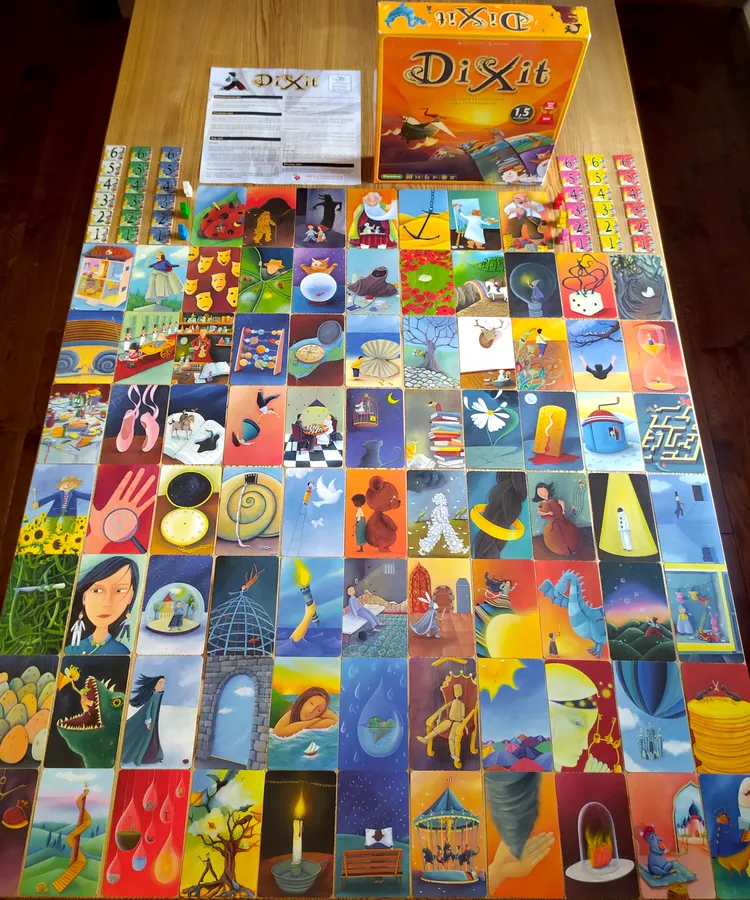
The standard edition of Dixit contains beautifully designed components. When you open the box, you’ll find:
- 84 large cards with stunning illustrations: These are the heart of the game. Each card is a unique image, full of details, symbols and dreamlike scenes, designed to inspire countless different associations. The cards are larger than standard playing cards, which emphasises their artistic value.
- A scoreboard: A cardboard board with a scale from 0 to 30, which is either integrated into the bottom of the box (in older editions) or separate, depending on the version. It is used to keep track of each player’s points.
- 6 wooden rabbit figures: Cute, colourful rabbits that move along the scoreboard. Each player chooses their own colour.
- Voting discs: In the new edition, each player has their own voting disc with numbers from 1 to 8. The player simply spins the disc to set the number corresponding to the card they wish to vote for. In older editions, these were voting tokens.
- Rulebook: Clear and illustrated instructions for the game in Slovenian.
Setting up the game
Setting up Dixit is quick and easy. Follow these steps:
- Setting up the scoreboard: Place the scoreboard in the centre of the table so that it is clearly visible to all players.
- Choosing playing pieces: Each player chooses one wooden rabbit and places it on the starting square (0) on the scoreboard.
- Distributing voting tokens: Each player receives a voting token in their own colour.
- Preparing the cards: Shuffle all 84 cards. Deal 6 cards to each player. These cards are secret and must not be seen by the other players.
- Remaining cards: Place the remaining cards in a pile, face down, in the centre of the table. This will be the draw pile.
- Determining the first storyteller: The players agree on who will start as the storyteller. This is usually the youngest player, or the choice is made at random.
Gameplay
The game is played in a series of rounds. In each round, one of the players takes on the role of the storyteller. The role of the storyteller passes to the next player in a clockwise direction after each round.
The Storyteller’s Turn:
- Choosing a card and an association: The storyteller looks at their 6 cards and chooses one that triggers an interesting association. Without showing the card to the others, they say aloud a word, a sentence, a title, a song, a sound or anything else they deem appropriate. This association is called a ‘clue’.
- Placing the card: The storyteller places the chosen card face down in the centre of the table.
Moves by the other players (listeners):
- Choosing a card: All the other players look through their 6 cards and try to find the one they think best matches the storyteller’s clue.
- Placing a card: Each listener places their chosen card face down on top of the storyteller’s card in the centre of the table.
Revealing and voting:
- Shuffling and sorting: The storyteller collects all the placed cards (their own and those of all the listeners), shuffles them (without looking at them) and then places them one by one, face up, in a row in the centre of the table. The cards are now numbered from 1 to n (the number of players). The first card is number 1, the second is 2, and so on.
- Voting: Each listener now tries to work out which of the revealed cards was the storyteller’s original card. Once they have decided, they mark the number on their voting board or take the corresponding voting token from their supply and place it face down in front of them. The storyteller does not vote.
- Revealing the votes: Once all listeners have placed their voting tiles or tokens, they turn them over simultaneously. The votes are revealed.
Scoring: Scoring in Dixit is key to the game’s strategic depth. Points are awarded as follows:
- Everyone guesses the storyteller’s card: If all listeners have voted for the storyteller’s card, it means the clue was too obvious. The storyteller receives no points, whilst all listeners receive 2 points each.
- No one guesses the storyteller’s card: If none of the listeners voted for the storyteller’s card, it means the clue was too difficult or too misleading. The storyteller gets no points, whilst all listeners get 2 points each.
- Some (not all and not none) guess the storyteller’s card correctly: This is the ideal scenario for the storyteller. The storyteller and all listeners who correctly guessed their card each receive 3 points.
- Points for deception: All listeners (except the storyteller) receive 1 extra point for every vote that other players cast for their card (these are the players who managed to mislead others with their card).
Once the scoring is complete, players move their rabbits across the scoring board by the appropriate number of spaces.
End of the round:
- Drawing cards: All players (including the storyteller) take one new card from the draw pile, so that they once again have 6 cards in their hand. If the draw pile is empty, shuffle the discard pile and create a new draw pile.
- Change of storyteller: The next player in a clockwise direction becomes the storyteller.
Winning conditions
The game ends when one of the players reaches or exceeds 30 points on the scoreboard.
The winner is the player with the most points at the end of the game (whose rabbit is furthest along the scoring track). In the event of a tie, all tied players are winners.
Analysis of strategies and tactics
At first glance, Dixit may seem like a game of pure luck and imagination, but it conceals a surprising amount of tactical depth. The difference between a beginner and an experienced player lies primarily in the ability to balance creativity with strategic thinking.
Strategy for beginners
For beginners, it is crucial to first familiarise themselves with the game’s mechanics and relax.
- Focus on imagination: Don’t worry too much about points. First, enjoy the beautiful illustrations and try to find associations that you find interesting or funny.
- Simple clues: To start with, use more straightforward clues. A word or short sentence describing the central element on the card is a good choice.
- Observing your fellow players: Try to work out what sort of associations your friends or family members have. Are they more visual types, or are they drawn to wordplay?
- Finding the right card to bluff: As the listener, focus on playing the card that best matches the storyteller’s clue, to confuse the other players and score extra points.
Advanced tricks for experienced players
Experienced Dixit players develop more sophisticated approaches that give them an edge.
- The art of balance: The storyteller’s most important skill is to find a clue that is clear enough for some players, but not for all. This is the ‘happy medium’. A clue that is too obvious (e.g. ‘the colour red’ for a card featuring a red apple) will not earn any points, nor will one that is too complicated (e.g. an obscure quote from a little-known poem). Ideal clues are often based on subtle details, atmosphere or abstract concepts.
- Choosing a decoy card: As a listener, don’t just lay down a random card that roughly matches the clue. Think about which types of cards might appeal to specific players. If you know someone likes to vote for cards featuring animals, play a card with an animal on it, even if it only vaguely matches the clue. Your aim is to get as many votes as possible for your card.
- Observing non-verbal cues: Pay attention to facial expressions, gestures and the time your fellow players take to choose a card or cast a vote. A quick choice may indicate an obvious clue, whilst taking a long time to think suggests a difficult decision or misleading cards.
- Using context and inside jokes: If you’re playing with a group of close friends or family, make the most of shared memories and inside jokes. A clue that only your brother understands is the perfect way for both of you to score points, whilst the other players remain in the dark.
- Strategic hand management: Occasionally, it makes sense to play a card that isn’t the best for bluffing, simply to get rid of it and hope you’ll draw a better one. This is particularly useful if you have cards in your hand that are very difficult to associate with others.
Overview of official expansions
The success of Dixit has led to numerous official expansions, which keep the game fresh and interesting even after many games. Most expansions simply provide a new deck of 84 cards featuring new illustrations by various artists, meaning they are fully compatible with the base game.
- Dixit 2 (Dixit Quest): The first expansion, featuring 84 new cards illustrated by Marie Cardouat, in the same style as the base game. An excellent choice for those who simply want more of the same beautiful artwork.
- Dixit 3 (Dixit Journey): Xavier Collet’s illustrations bring a slightly different, more fantastical and at times darker style. A brilliant change of pace for those who have grown accustomed to the original style.
- Dixit 4 (Dixit Origins): Clément Lefèvre brings beautifully surreal and colourful illustrations, full of unusual creatures and landscapes.
- Dixit 5 (Dixit Daydreams): Frank Dion brings a more dreamlike and at times slightly grotesque style, which inspires very unique and unexpected associations.
- Dixit 6 (Dixit Memories): Carine Hinder and Jérôme Pelissier bring a more cartoonish and playful style, which is particularly appealing to younger players.
- Dixit Odyssey: This is a standalone game, though it can also be used as an expansion. It features 84 new cards, a new scoring board and components for up to 12 players. It’s an excellent choice for larger groups.
- Dixit Disney: This standalone edition features 84 new cards based on iconic Disney and Pixar films, ranging from timeless classics to modern blockbusters. The beautiful illustrations retain Dixit’s mystique whilst introducing a sense of nostalgia and recognisable motifs that will enchant all generations of animation fans.
Are the expansions worth buying? Absolutely. If you enjoy Dixit and play it regularly, you’ll eventually become familiar with all the cards in the base set. The expansions are relatively inexpensive and offer a huge number of new cards. Mixing different decks of cards creates endless combinations and ensures that no two games will ever be the same. The variety of artistic styles across the different expansions further stimulates creativity and broadens the range of associations.
Frequently Asked Questions
Is Dixit suitable for children? Yes, Dixit is an excellent family game. Although the rules are simple, the depth of the game increases with the players’ imagination. Children aged 8 and over can usually join in, and their associations are often surprisingly creative and entertaining. The game encourages the development of vocabulary, imagination and empathy in children.
How linguistically demanding is the game? The game is completely language-independent. The cards contain only illustrations, with no text. The instructions are in Slovenian, but only one player needs to read them to explain the game to the others. This means the game can be played by people who speak different languages, or by those who cannot read. If you’ve read this article, you already know the instructions.
How long does a game of Dixit last? An average game of Dixit lasts around 30 to 45 minutes. This is the ideal length for a quick game before dinner or for several consecutive games in one evening. The playing time also depends on the number of players and how quickly they make associations.
Can I play Dixit with just two players? The official rules for the base game are designed for 3 to 8 players. However, there are unofficial two-player rule variants that can be found online. Nevertheless, the game is most enjoyable and works best with a group of at least four players, as this increases the number of cards and votes, leading to more points and greater strategic depth.
What is the difference between Dixit and Dixit Odyssey? Dixit is the original base game for 3 to 8 players. Dixit Odyssey is a standalone version that can also be played as an expansion. It includes 84 new cards, a new scoring board, new voting components and rules for up to 12 players. If you often play in larger groups, Dixit Odyssey is the better choice.
Are the cards in the various expansions of the same quality as those in the base game? Yes, Asmodee (the game’s publisher) maintains a high standard of quality across all expansions. The cards are the same size, thickness and have the same finish as those in the base game, ensuring that they can be shuffled together without any noticeable difference.
Conclusion
Dixit is a wonderful, unique board game that transcends the boundaries of conventional gameplay. It is a game of imagination, empathy and social interaction that will bring laughter, wonder and unforgettable moments into your home. Its simple rules and language-independent nature make it accessible to everyone, whilst its strategic depth ensures it remains engaging even for experienced players.
Don’t delay – set off on this magical journey into the world of imagination! Buy your copy of Dixit or one of its wonderful expansions at druzabneigre.si and discover why this game has won the hearts of millions of players around the world. Your next unforgettable board game awaits!