

Is it possible to create a tense, tactical and deeply strategic board game about something as mundane as sewing a quilt from scraps of fabric? In 2014, Uwe Rosenberg, one of the most highly regarded designers of modern board games, proved that the answer is not only ‘yes’, but that such a theme can grow into a global phenomenon. Patchwork is a game that, at first glance, seems almost therapeutic and calming. But once you sit down at the table, you quickly realise that it is a brilliant duel where every centimetre of space, every button and every second on the timer counts.
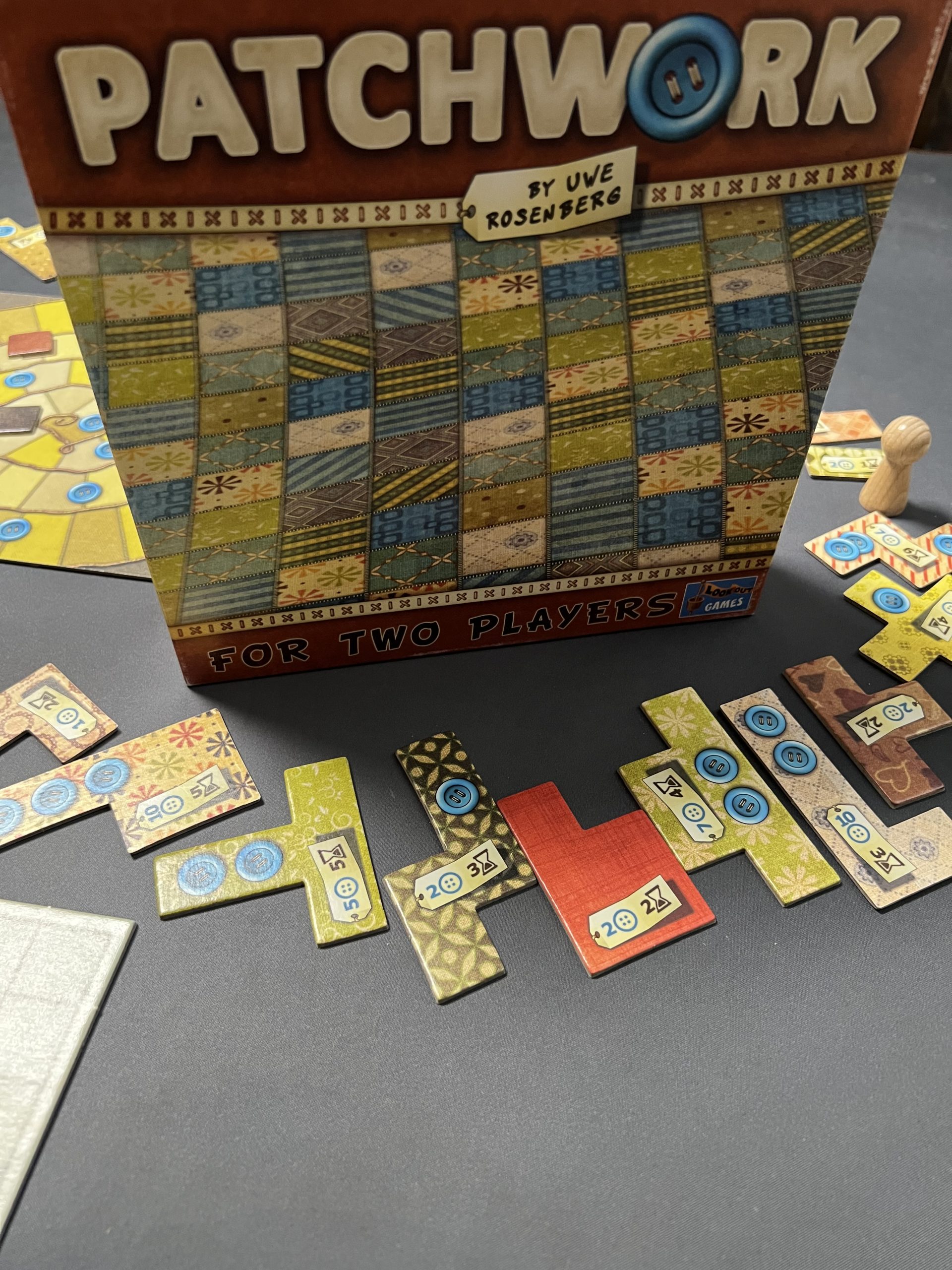
In this guide, we’ll take a detailed look at why this game has become a staple in players’ collections, go through its rules in detail, analyse winning strategies and explore why you simply must have it on your shelf.
Why is the game so popular?
Patchwork didn’t become a global hit by chance. Its success rests on the perfect blend of accessibility and depth, which is the ideal recipe for a game designed exclusively for two players.
The psychology of spatial puzzles (the Tetris effect)
We humans have an innate desire to turn chaos into order. The tile-placement mechanic used in Patchwork directly appeals to this part of our brain. When you look at the empty 9x9 grid on your game board, a strong urge is triggered to fill it as efficiently and aesthetically as possible. Each piece of fabric (which strongly resembles the legendary Tetris shapes) presents a spatial challenge. When you successfully integrate a complex piece into your quilt without leaving any gaps, your brain experiences that mini surge of dopamine that keeps you going, move by move.
The social aspect and unique two-player dynamics
Many multiplayer board games lose their magic when played as a duo, as the mechanics are often tailored to a larger group. Patchwork, however, was designed and optimised exclusively for two players from the very beginning. This creates an exceptionally intimate yet tense atmosphere. The dynamic between the players is not aggressive in the sense of directly destroying the opponent’s pieces, but is based on subtle blocking and control of the market. Your opponent’s moves constantly influence your options, meaning that the two players are engaged in a silent dialogue at all times – watching each other, calculating and trying to predict the next move.
Pace of play and the absence of boredom
One of the biggest problems with modern strategy games is so-called ‘analysis paralysis’, where players spend too long thinking about their options, whilst the others at the table lose interest in the meantime. In Patchwork, this problem is elegantly solved by the timeline system. The dynamics of the game remain lively, as the pace of play constantly maintains a high level of concentration. As the player who falls behind on the timeline takes their turn again, it often happens that one player makes two or three quick moves in a row. This means you never get bored whilst waiting; instead, you frantically analyse which tiles will be left for you once your opponent has finished their turn.
Why has it become such a hit?
Players greatly appreciate games with a high degree of language independence and top-quality components. Patchwork contains no text on the components (apart from the rulebook), which means that once you’ve learnt the rules, the game runs smoothly and without any language barriers. What’s more, it fits perfectly with a modern lifestyle. Thanks to its compact size and relatively short playing time (around 30 minutes), it’s the ideal choice for unwinding after a busy working week over a cup of tea or coffee. It is also one of the most popular games that experienced players introduce to their partners, who might not otherwise be keen on complex strategy games.
Detailed instructions and gameplay
To fully appreciate the elegance of Patchwork, we need to delve into its structure, layout and the rules that govern this textile battle.
List of components: What’s in the box?
When you open the compact and stylishly designed Patchwork box, you’ll find exceptionally high-quality cardboard components that ensure the game will last for years:
- 1 central timeline (Time board): A double-sided board with a spiral track that controls the time and flow of the game.
- 2 quilt boards: 9x9 grids on which players assemble their quilts.
- 2 time markers: One green and one yellow wooden marker, which indicate the players’ positions on the time track.
- 1 neutral token: A wooden, framed cylinder (often in a wood-coloured finish) that moves between the fabric tiles on the table.
- 33 fabric tiles (Patch tiles): Various irregularly shaped cardboard pieces depicting different fabric patterns, costs in buttons and time consumption.
- 5 special leather patches: Small 1x1 square tiles used to patch holes.
- 1 special tile: A bonus tile that awards an additional 7 points to the first player to successfully fill a 7x7 square.
- Tokens (currency and points): Cardboard tokens with values of 1, 5, 10 and 20, which act as money during the game and as victory points at the end of the game.

Setting up the game
Setting up the game is quick, but requires some space on the table, as the tiles form a large circle around the central board.
- Setting up the central board: Place the timeline in the centre of the table.
- Setting up the time tokens: Each player chooses their colour (green or yellow), takes the corresponding blanket tile and places their time token on the starting space on the timeline.
- Starting capital: Each player receives 5 buttons from the general supply. These buttons serve as your starting capital for purchasing your first goods. Place the remaining buttons next to the board to form the bank.
- Arranging the goods tiles: Randomly arrange all 33 standard goods tiles in a large circle around the timeline. It is important that all tiles are visible and accessible.
- Placing the neutral token: Find the smallest commodity tile (a 1x2 flat tile that costs 1 button and takes 2 units of time). Place the neutral token in the circle immediately behind this tile (moving clockwise).
- Placing leather patches: Place five 1x1 leather patches on the designated square spaces on the timeline.

Game mechanics
Patchwork breaks with the classic rule of taking turns in a clockwise direction. Instead, the player whose time token is last on the timeline is always the one whose turn it is. If two tokens are on the same space, the player whose token is on top takes the turn. This means that a player can take several consecutive turns until they are overtaken by their opponent.
On their turn, a player always has two options:
Option A: Move forward and collect buttons
If you do not have enough buttons to buy a tile, or if none of the available tiles suit you, you may choose to move. Move your time token to the space immediately in front of your opponent’s token. For every square you cross during this move, you receive 1 button from the bank.
Example: If you are three spaces behind your opponent, you move 4 spaces (to end up one space ahead of them) and receive 4 buttons.
Option B: Purchasing and placing a commodity tile
If you decide to buy, carry out the following steps:
- Selecting a tile: You may only choose from the three tiles located directly in front of the neutral token in a clockwise direction.
- Moving the neutral token: Move the neutral token to the space occupied by the tile you have chosen.
- Paying the cost: Pay the cost in buttons as indicated on the tile (button symbol).
- Move on the timeline: Move your time token forward by the number of spaces indicated on the tile (hourglass symbol).
- Placing on the mat: Place the tile on your mat. You may rotate and flip the tile as you wish. The only rules are that it must not overlap with tiles already placed and must not extend beyond the edge of the 9x9 board. Once placed, you cannot move it during the game.
Special squares on the timeline
As you move along the timeline, you’ll come across two types of key markers:
- Button Income: Every time your time token crosses a button symbol on the timeline, you receive income. Count all the buttons printed on the fabric tiles you currently have on your quilt board. You receive that many buttons from the bank. This is your main source of capital.
- Leather Patches (Special Patches): The first player to move their time token across a space with a leather patch immediately takes it and must place it on their quilt board straight away. This 1x1 patch is invaluable for filling awkward gaps caused by larger, awkward pieces of fabric.
Victory Conditions
The game ends for each player when their time token reaches the final square in the centre of the timeline. If your move takes you past the last space, your token simply stops at the last space, and any excess moves are lost. Once both players have reached the finish, the final scoring begins.
Scoring in Patchwork can be ruthless, as final scores are often negative, particularly in the first few games. It is calculated using the following formula:
Final score = Number of buttons in your possession + Bonus points – 2 × Number of empty squares on your board
- Buttons: Each button you have left earns you 1 positive point.
- Bonus tile (7x7): The first player to successfully fill a 7x7 square on their board completely, without any empty spaces, receives this tile, which is worth +7 points.
- Penalty for empty spaces: Each empty (unfilled) square on your board costs you -2 points. As the board has a total of 81 squares, large gaps can quickly undo all your hard work.
The winner is the player with the higher score. In the event of a tie, the player who was the first to reach the final square on the timeline wins.

Analysis of strategies and tactics
Patchwork is a game where short-term adaptation meets long-term planning. It is a mistake to think that it is merely a matter of randomly collecting pretty pieces of fabric.
Strategy for beginners: The golden rules of the textile trade
If you’re just starting out in Patchwork, focus on the following three pillars:
- Build your economy early: In the first half of the game, your priority should be to buy tiles bearing button symbols. Even if these tiles are awkwardly placed, they will provide you with a steady income every time you cross a button symbol on the timeline. Without an early investment, you’ll be forced to make empty moves in the second half of the game just to get any buttons at all.
- Be mindful of the time cost: Always compare the price in buttons against the time cost. A tile that costs few buttons but moves you 6 spaces forward on the timeline can end up costing you dearly, as you’ll be giving your opponent several consecutive turns and the chance to pick up the best pieces or leather patches.
- Placement density: Start placing tiles along the edges and in the corners of the board, and place them close together. If you place tiles randomly across the centre of the board, you’ll create unmanageable gaps that you won’t be able to fill later on.
Advanced tactics for experienced masters
Once you’ve mastered the basics, Patchwork becomes a game of tight control and managing your opponent’s options:
- Control of the neutral token: Don’t just look at what you need, but consider what your move will offer your opponent. If you notice that your opponent is frantically searching for a specific shape or has a lot of buttons, choose a tile that will move the neutral token in such a way that the next three available tiles will be unusable or too expensive for them.
- The race for the 7x7 bonus: The 7x7 bonus yields a 7-point difference, which is decisive in close games. If you spot an opportunity, optimise your purchases solely to fill this square quickly. Sometimes it’s worth taking a tile that’s less profitable in terms of income if it fits perfectly into your 7x7 plan.
- The maths of the final move: Towards the end of the game, as you approach the centre of the timeline, calculate the value of your remaining moves precisely. If you buy a tile that costs you 3 buttons but fills two squares (saving you 4 negative points), you’re 1 point in the black. If that tile also brings you additional income, the calculation is even better.
Themed variants (Patchwork Halloween, Christmas, Valentines)
These are exactly the same games in terms of rules and mechanics; only the visual design has changed. Instead of buttons, you collect sweets, Christmas presents or hearts, and the fabric tiles are replaced with festive motifs.
- Is it worth buying? If you already own the classic Patchwork, there’s no point in buying these versions, unless you’re a passionate collector or are looking for a specific gift for a particular holiday. However, if you don’t already own the game, choose the theme that appeals to you most visually.
Frequently asked questions
1. Is Patchwork suitable for children, and from what age?
The official recommended age is 8 years and over. Children around this age have no trouble understanding the basics of moving and placing tiles. However, they may not immediately grasp the deeper economic strategies and time management involved.
2. How language-intensive is the game?
The game is completely language-independent. There isn’t a single word on the game components themselves. Slovenian instructions are only needed for the initial familiarisation with the rules; after that, anyone can play the game, regardless of their language skills.
3. How long does a single game actually last?
Once players are familiar with the rules, a game lasts between 20 and 30 minutes. Thanks to its quick set-up and dynamic gameplay, the game is ideal for several consecutive games, as the loser will immediately want to try out a new strategy.
4. Does the game make a good gift for someone who doesn’t play board games?
Yes, Patchwork is one of the best entry-level games into the world of modern board games. Its theme is neutral and appealing, the rules can be explained in three minutes, and the visual progress during the game (as the quilt grows) offers a great deal of satisfaction even to complete beginners.
5. What happens if I can’t place any of the three available tiles on my board?
If you buy a tile, you must place it. If you have no space for it or cannot physically fit it, you must not buy it. In situations where you have no space or buttons to buy any of the three tiles, you are forced to choose option A: move forward to your opponent’s token and collect buttons.
6. How important is the 7x7 bonus tile for the final victory?
Extremely important, but it is not the only condition for victory. It is worth 7 points, which often decides close matches. However, a player who has focused too much on the 7x7 may have neglected their button economy and ultimately lost to an opponent who had amassed a huge stockpile of buttons, despite having more empty spaces on the board.
Conclusion
Patchwork is proof that genius lies in simplicity. Uwe Rosenberg has created a timeless masterpiece that defies trends and remains one of the best two-player games of all time. It offers the perfect blend of relaxing visual creation and tense tactical battles, where every decision carries its own weight.
Whether you’re looking for the perfect game for cosy evenings for two, a gift for a loved one, or a new strategic challenge, you can’t go wrong with Patchwork. Start piecing together your quilt today!