

Imagine the following scenario: you’re sitting at a table, with heavy, gleaming chips in five different colours glistening before you, whilst your opponent is staring intently at a row of cards, feverishly calculating his next move. The tension in the air is almost palpable, even though no one is speaking aloud. This is the magic of the world of Splendor – a world where you become a Renaissance merchant dealing in precious stones, striving to build the mightiest trading empire, purchase mines, organise transport and charm the nobility, who will bring you eternal glory.
When the original Splendor was released in 2014, no one could have imagined what a lasting impact it would have on the board gaming community. It has become the definition of a modern classic and the ideal entry point for anyone wishing to enter the world of strategic gaming. Almost a decade later, it gained a younger, yet incredibly sharp, sibling: Splendor Duel, which was created specifically with two players in mind.
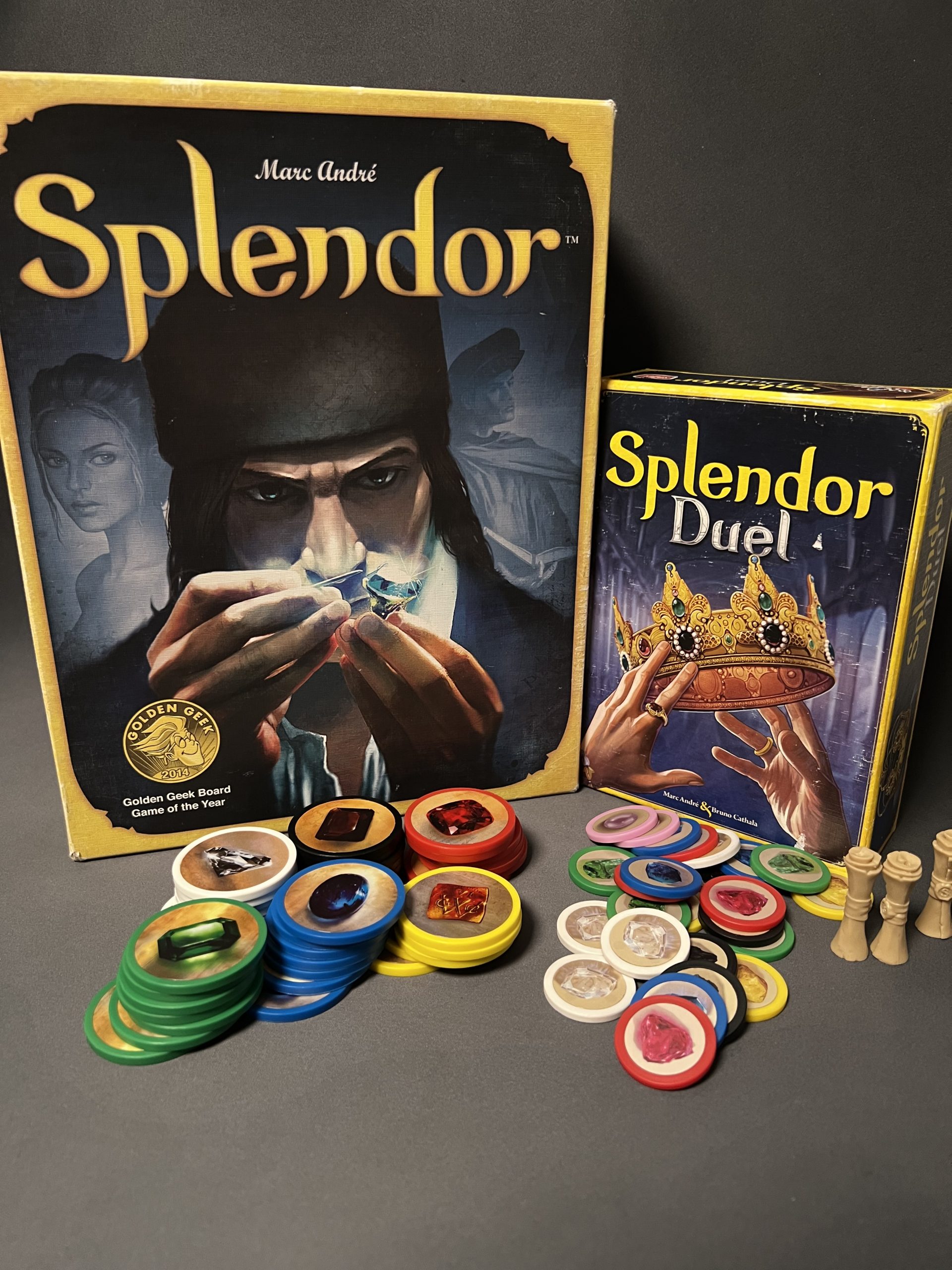
In this guide, we’ll take a detailed look at both games, analyse their psychological appeal, break down the rules and strategies, and help you decide which gem will shine brightest on your club table.
Why have Splendor and Splendor Duel become such hits?
Splendor’s success on the market is no coincidence. People love games that are elegant, quick to learn, yet offer plenty of scope for tactical thinking and quiet competition. Splendor is a perfect example of the ‘easy to learn, hard to master’ mechanic.
The psychology of ‘resource gathering’ and instant rewards
The human brain loves the feeling of progress. Splendor exploits this psychological mechanism to the full through what is known as ‘engine building’ (a chain of combinations). At the start of the game, you’re poor, and your moves are limited to collecting basic gem tokens. But once you buy your first card, it becomes a permanent discount on all future purchases. The feeling of buying a card that previously cost five tokens completely for free, thanks to your past investments, triggers a powerful surge of dopamine. The game gives you a constant sense that you are becoming stronger, richer and more influential.
The social aspect and the quiet drama at the table
Unlike some aggressive games where you directly destroy each other’s achievements, Splendor is a game of elegant sabotage. There’s no direct attack, but there’s constant scrutiny of your opponents’ eyes. Can you see which card your friend is looking at? Will you snap it up right under their nose and ruin the plan they’ve been building over the last three rounds? This quiet drama creates an incredible dynamic where all players are constantly involved in the action. As the moves happen extremely quickly – a player takes chips or buys a card in a matter of seconds – there’s no time to get bored whilst waiting for your turn. You’re constantly analysing the changing selection on the table and adjusting your tactics.
Detailed instructions and gameplay
Both versions share the same basic theme and a love of jewels, but their gameplay and set-up differ significantly. Let’s look at the details for each game separately.
1. The Classic: Splendor (for 2 to 4 players)
List of components: What’s in the box?
When you open the box of the original Splendor, you’ll first be impressed by the premium feel of the components. The game contains:
- 40 gem tokens (heavy poker chips): 7 tokens for each of the 5 colours (emerald/green, sapphire/blue, ruby/red, diamond/white, Onyx/black) and 5 gold tokens (wild cards).
- 90 development cards: Divided into three levels (Green/Level 1 – 40 cards, Yellow/Level 2 – 30 cards, Blue/Level 3 – 20 cards).
- 10 noble tiles: Square tiles made of sturdy cardboard that award prestige points.
Game Setup
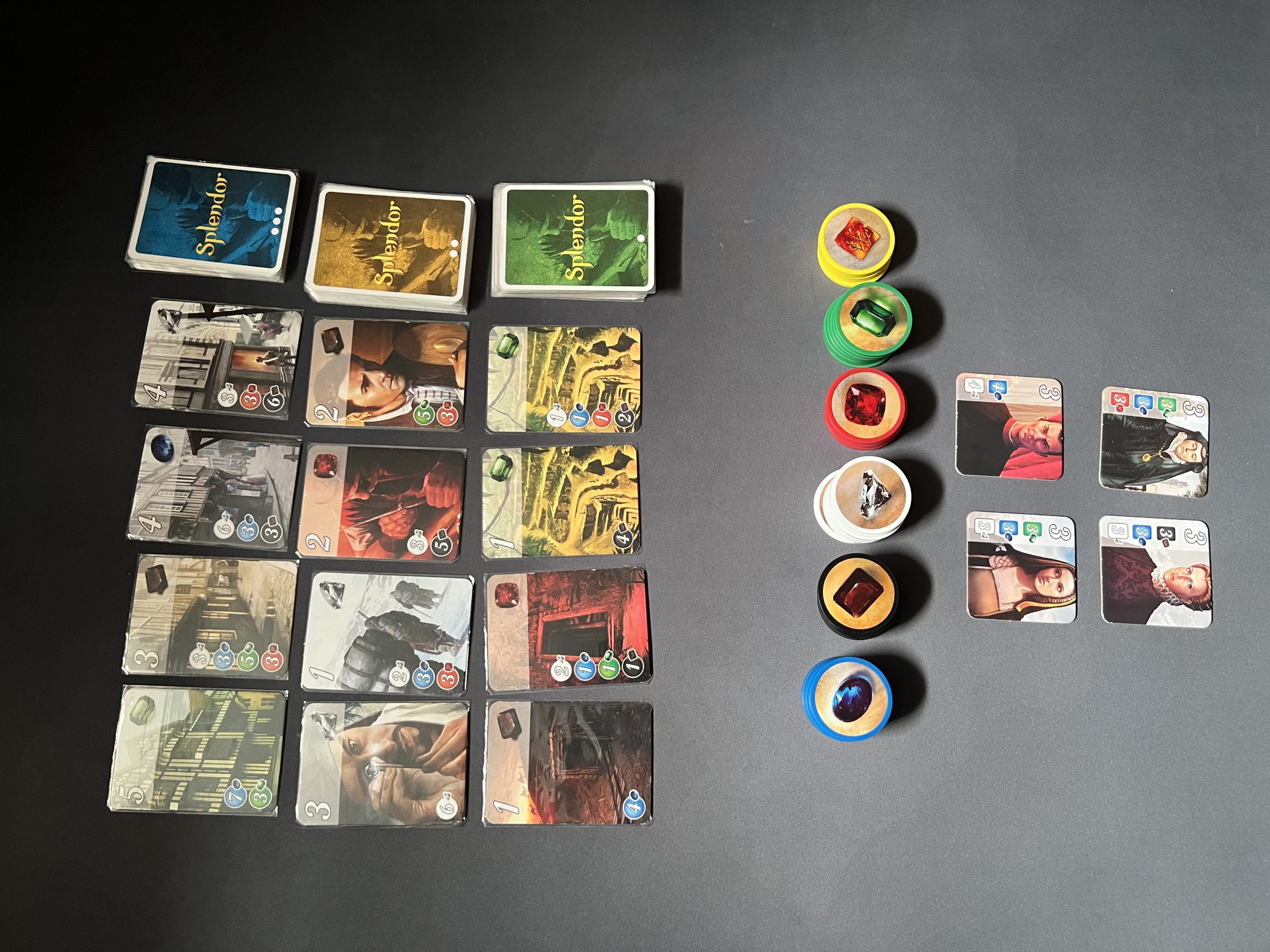
- Cards: Sort the cards by level (according to the background colour and the number of dots on the back). Shuffle each pile and place them in a vertical column in the centre of the table (Level 1 at the bottom, Level 3 at the top). From each pile, reveal 4 cards to the right, forming a 3 x 4 grid.
- Nobles: Shuffle the noble tiles and reveal them at random above the grid of cards. The number of nobles revealed is always equal to the number of players + 1 (e.g. with 3 players, reveal 4 nobles). Return the remainder to the box.
- Tokens:
Prepare the tokens according to the number of players:
- For 4 players: Use all the tokens.
- For 3 players: Remove 2 tokens of each gem colour (leaving 5 per colour). All gold tokens remain (5).
- For 2 players: Remove 3 tokens of each gem colour (leaving 4 per colour). All gold tokens remain (5).
Gameplay
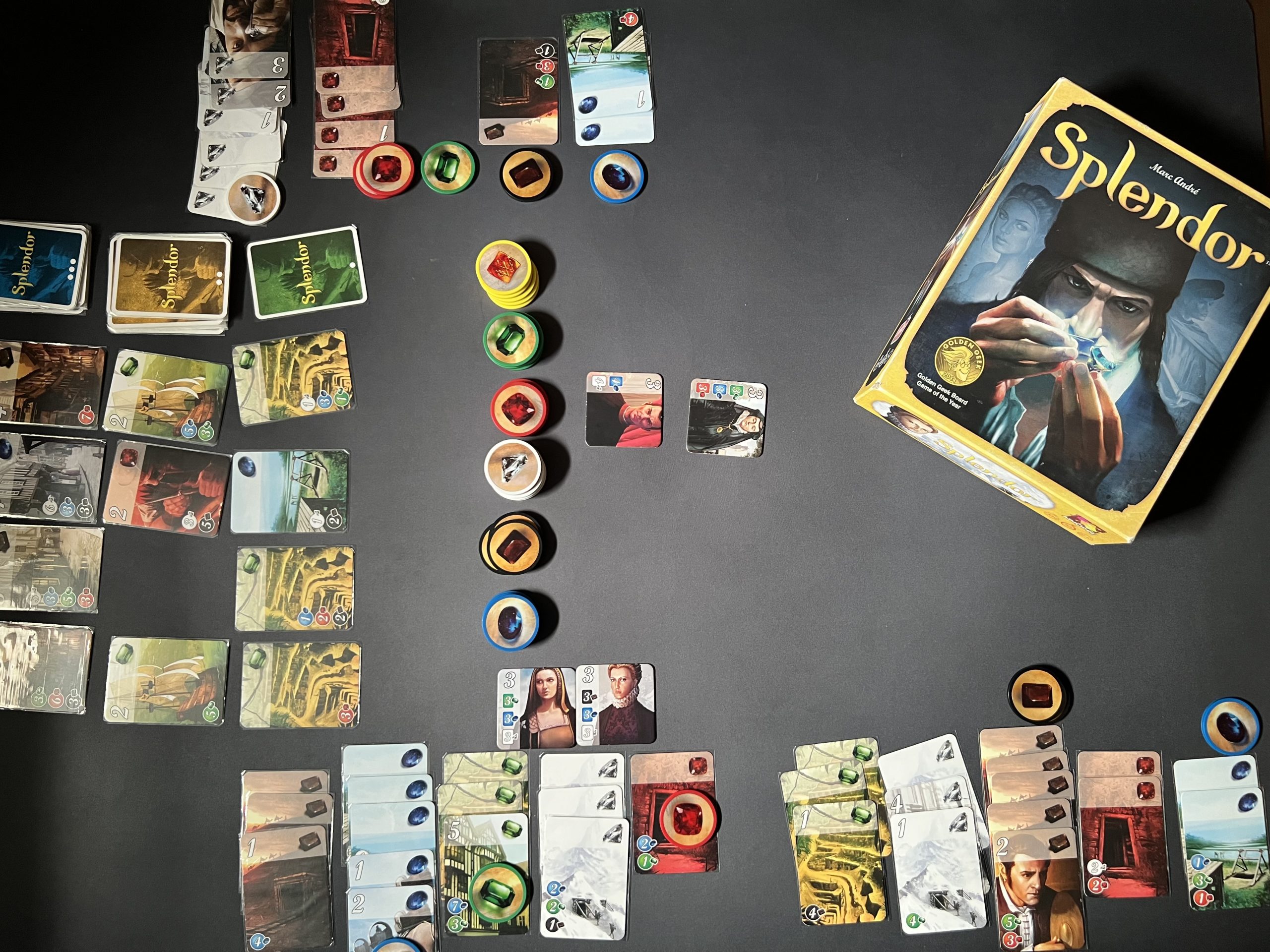
The youngest player starts the game, and play proceeds clockwise. On your turn, you must perform exactly one of the following four actions:
- Take 3 gem tokens of different colours from the common supply (gold tokens do not count towards this).
- Take 2 tokens of the same colour, but only provided there are at least 4 tokens of that colour left in the supply.
- Reserve 1 development card from the table (or from the top of any pile) and take it into your hand. You also receive 1 gold token (joker) when you do this. You may hold a maximum of 3 reserved cards in your hand at any one time.
- Buy 1 development card (from the table or from your hand) by paying its price in tokens back into the common stock.
Important rule regarding the token limit: At the end of your turn, you may hold a maximum of 10 tokens (including gold tokens). If you exceed this limit, you must return the excess tokens to the common supply at your discretion.
How do permanent discounts work?
Every development card you purchase has a gem printed in the top right-hand corner. From that moment onwards, this gem serves as a permanent discount when purchasing future cards. If you already have two blue cards in front of you and wish to buy a new card that costs three blue tokens, you only need to pay one more blue token from your supply.
Noble visits:
At the end of your turn, check whether the cards you have purchased meet the conditions of any of the revealed nobles (e.g. a noble requires 4 green and 4 blue cards). If you meet the requirements, the noble will visit you – take the tile. This does not count as an action and earns you an additional 3 prestige points. Only one noble may visit you per turn.
Victory conditions
The game ends when one of the players reaches or exceeds 15 prestige points (the points are shown in the top left-hand corner of the cards and noblemen). The round is played to the end, so that all players have the same number of turns. The winner is the player with the most points. In the event of a tie, the player who has purchased more Level 3 development cards wins.
2. Duel: Splendor Duel (for 2 players only)
Splendor Duel brings a whole new level of depth, as the mechanics are tailored to a relentless one-on-one battle on a special game board.
List of components: What’s in the box?
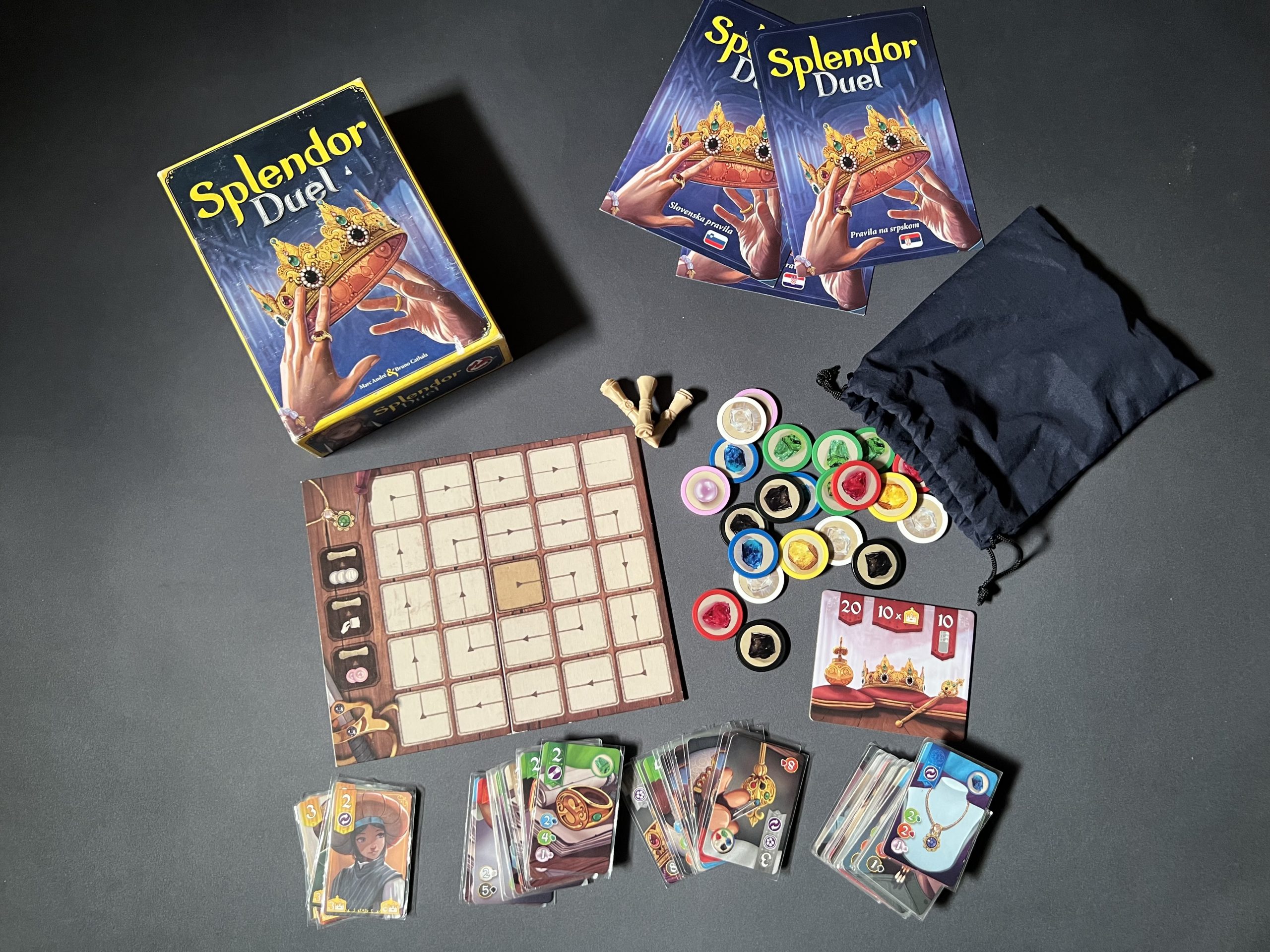
- 1 game board (shared token pool): A 5x5 grid.
- 25 tokens: Smaller than in the original, but still pleasantly weighty. Includes 4 tokens of each of the 5 basic colours, 2 pearl tokens (the new pink currency) and 3 gold tokens.
- 67 development cards: Divided into three tiers.
- 4 Royal Aid cards: In the form of small plastic scrolls.
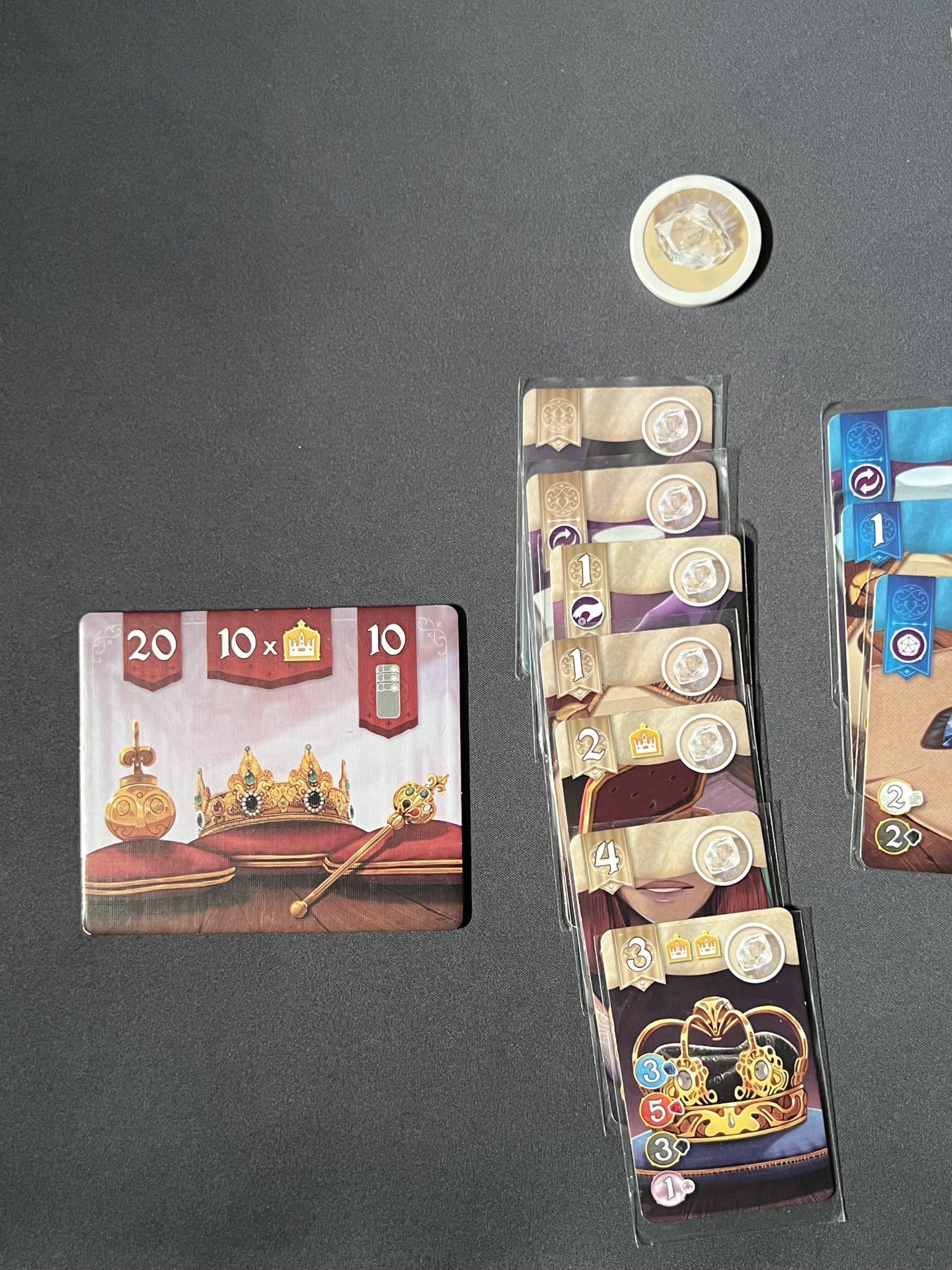
- 1 Victory tile: Shows three different conditions for ending the game.
Game Setup
- Board: Place the square board between the two players. Shuffle all 25 tokens thoroughly in the bag provided and distribute them randomly across the spaces on the board, starting in the centre and continuing outwards in a spiral pattern.
- Cards: As in the original game, place three stacks of cards vertically, but this time reveal a different number of cards from each stack: Level 1 (5 cards), Level 2 (4 cards), Level 3 (3 cards).
- Privileges: Place the plastic scrolls next to the board.
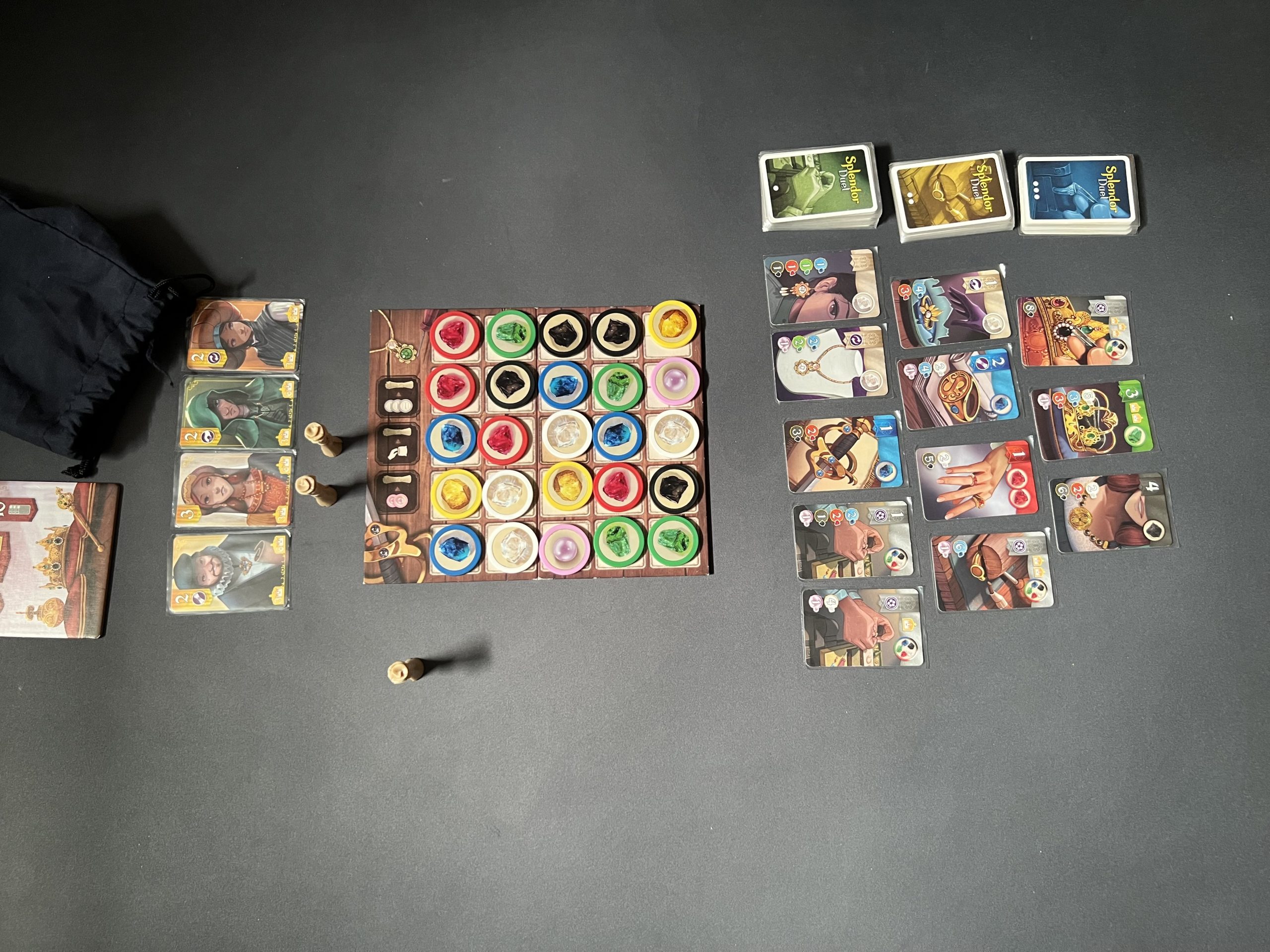
Gameplay
On your turn, you may first carry out optional actions (using a privilege to remove a token from the board or manually replenishing the board with tokens from the bag, thereby granting your opponent a privilege).
You must then carry out exactly one main action:
- Take up to 3 tokens from the board: The tokens must lie in a continuous straight line (horizontally, vertically or diagonally) and there must be no empty spaces between them. There must be no gold tokens amongst them (if you wish to take more than one).
- Take 1 gold token: You take it from the board and reserve one development card.
- Buy a development card: You pay the price in tokens. Some cards in Duel have special symbols that trigger an immediate bonus (e.g. an extra turn, stealing a token from your opponent or gaining a privilege).
Key new feature – Pearls: Pearls are the rarest resource in the game (there are only 2 in the entire game) and are essential for purchasing some of the most lucrative cards. As there are no permanent discounts on pearls, the competition for them is fierce.
Victory Conditions
Splendor Duel offers three different paths to victory. The game ends as soon as one of the players fulfils one of the following conditions (the round is not played to the end!):
- A player accumulates 20 or more prestige points in total.
- A player collects 10 or more prestige points on cards of the same colour (e.g. 10 points on red cards only).
- A player collects 10 crowns (crown symbols are found on certain development cards and trigger royal bonuses).
Analysis of strategies and tactics: How to become a master of jewels
Regardless of which version you play, winners are distinguished from losers by how well they can anticipate the dynamics of the game.
Strategy for beginners: ‘Laying the foundations’
Beginners often make the mistake of wanting to buy expensive cards with high point values straight away. The right approach for your first few games is to focus on Level 1.
- Buy cheap: For the first 5 to 7 turns, focus on collecting cards that cost just 3 tokens. This will help you build a base of permanent discounts.
- Diversify your discounts: Try to have at least one discount in every colour. This allows you to be flexible and prevents your opponents from easily blocking you by hoarding tokens of a specific colour.
Advanced tactics for experienced players
Once you’ve mastered the basics, the game turns into a game of chess.
- Reservation as a weapon: Keep an eye on what your opponent is building. If you see that they need a specific Level 2 card that will give them a noble or a huge number of points, reserve it with a gold token. Even if you never build it yourself, you’ve disrupted your opponent’s rhythm and robbed them of a crucial advantage.
- The ‘Quick Stampede’ strategy: This is an advanced strategy in the original Splendor, where you completely ignore the nobles. You simply collect tokens and target Level 3 cards directly, which cost a lot (e.g. 7 tokens of one colour) but are worth 4 or 5 points each. This strategy can end the game in fewer than 25 turns, before anyone even manages to build a chain of combinations.
- Royal dominance in Duel: In Splendor Duel, never lose sight of your opponent’s crowns. If they start collecting cards with crowns, they may surprise you with a victory at 10 crowns, whilst you’re frantically counting your points. Always have a privilege or a card that allows you to steal a token ready in your hand to break their streak.
FAQ – Frequently Asked Questions
1. Is Splendor suitable for children?
Absolutely. The official age rating is 10+, but with parental help, much younger children (around 8 years old) can easily play it. As the game is based on recognising colours, numbers and basic addition, it is an excellent tool for developing logical thinking and basic maths skills.
2. How language-intensive is the game?
The game is completely language-independent. There isn’t a single word on the components (cards and tokens), just symbols and numbers. The instructions are available in Slovenian, but once you’ve learnt the rules, you can play the game with someone from anywhere in the world without exchanging a single word.
3. How long does a game actually last?
The original Splendor takes between 30 and 45 minutes. Once players are experienced and no longer need to think about the basic rules, you can finish a game in as little as 20 minutes. Splendor Duel is usually a bit quicker and lasts between 20 and 30 minutes.
4. I already own the original Splendor – do I need Splendor Duel as well?
If you mostly play as a pair, the answer is YES. Although the original works well for two players, Splendor Duel is designed specifically for this purpose and offers much greater tactical depth, intensity and opportunities for comebacks, making the two-player experience incomparably better.
5. Which version is better for beginners to the world of board games?
The original Splendor. Its rules are simpler and more elegant. Splendor Duel has more intricate rules (privileges, three victory conditions, special powers on cards) which might confuse a complete beginner a little.
6. Do the tokens in the game wear out over time?
The tokens in the original Splendor are made from extremely durable plastic with a metal core (similar to casino chips). They are practically indestructible and will last for hundreds of games without any visible signs of wear. However, as the cards are shuffled frequently, it is advisable to protect them with clear sleeves.
Conclusion
It’s no coincidence that Splendor has become a global phenomenon. Whether you choose the classic version for family evenings or embark on a tense strategic duel with Splendor Duel, you’re in for top-class entertainment, full of strategic decisions and unforgettable moments around the table.