
Imagine the following scenario: you’re sitting at a table with your closest friends or family members. There’s a palpable tension in the air; everyone is staring intently at the centre of the table, their hands trembling as they brace themselves. Someone lays down a card, utters the word ‘Goat’, and a picture of a goat appears on the card. In a fraction of a second, the table is swept by a wave of laughter, shouts and chaotic clapping on the pile of cards.
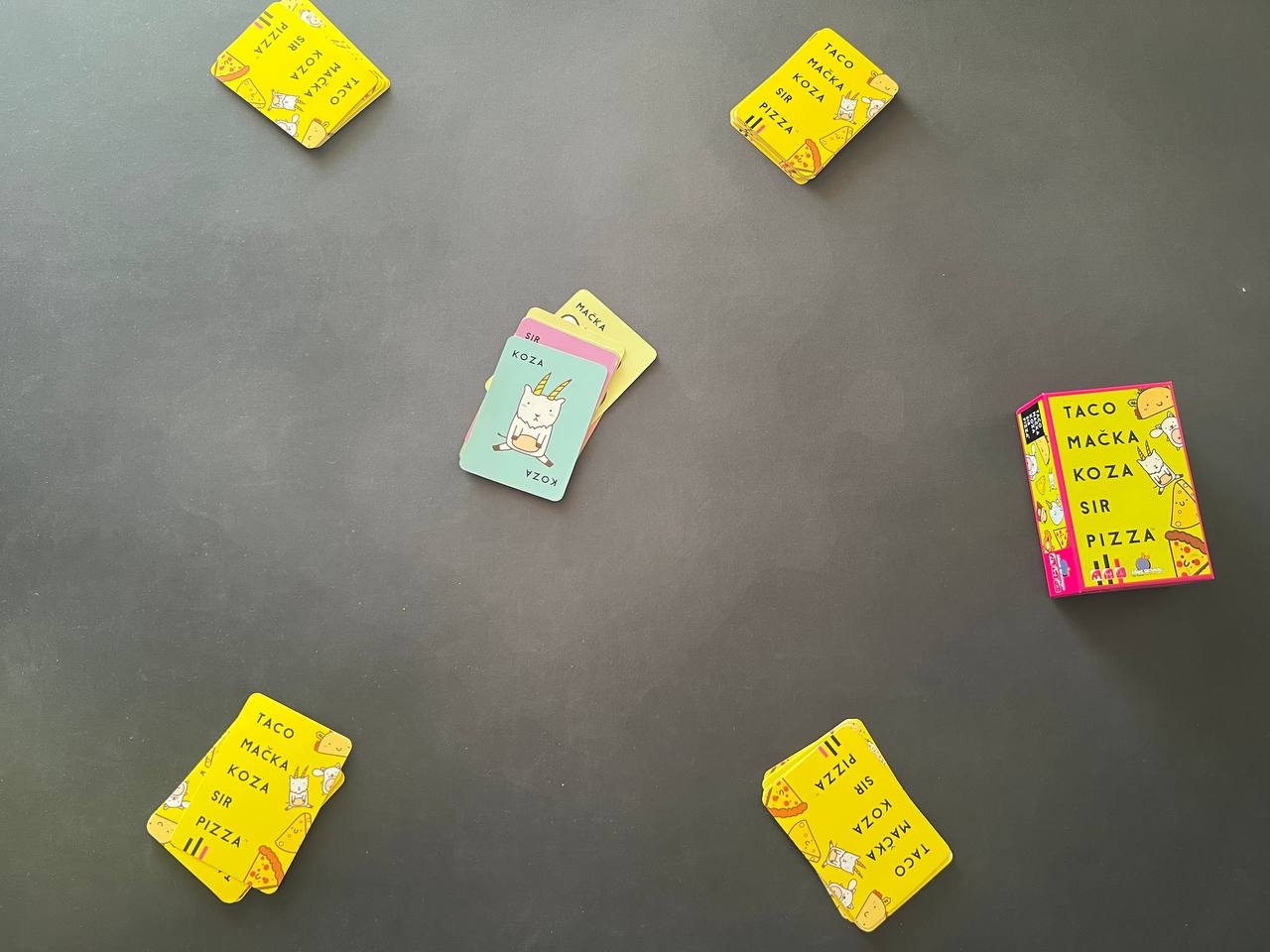
This isn’t a scene from some bizarre ritual, but a perfectly ordinary Friday evening spent playing the global hit Taco Cat Goat Cheese Pizza. This seemingly simple and compact card game, created by Dave Campbell, has taken gaming tables by storm all over the world in recent years and is also enjoying a remarkable boom in Slovenia. It’s a game that defies the classic conventions of board gaming; here, you won’t be spending hours pondering complex economic strategies, but rather honing your concentration, reflexes and ability to handle pressure. The result? Utterly addictive fun that leaves no one able to keep a straight face.
Why is the game so popular?
To understand the phenomenon of this game, we need to delve into the psychology of human perception and the social dynamics it creates. At its core, the game plays on cognitive dissonance – a state where our brains receive two conflicting pieces of information at the same time. When you say the word ‘Goat’ out loud, but your eyes see ‘Pizza’ written on the card, a brief short-circuit occurs in your brain. It is this cognitive lag that makes the game immensely entertaining and, at the same time, challenging. Players have to fight against their own subconscious impulses, which often leads to the funniest moments: when someone flinches even though there’s no match, or when, in a panic, they slap the table and end up grabbing the whole pile of cards.
From a social dynamics perspective, the game is perfect for relieving tension. Because the rules are so simple that you can explain them in under thirty seconds, there’s no need for that initial phase of tedious instruction-reading, which quickly puts off many casual players. The game immediately throws everyone into the same pool of intense interaction. It doesn’t matter whether you’re an experienced board gamer with a shelf full of strategic gems or someone who only picks up a board game once a year – the chances of winning are completely equal. This inclusivity ensures that no one feels left out.
But why has the game become such a hit in Slovenia in particular? We Slovenians love socialising over good food and drink, where a relaxed atmosphere and laughter take centre stage. Traditionally, games played with classic playing cards (such as tarot or rummy) have reigned supreme here, but these require a great deal of silence and concentration. Taco Cat Goat Cheese Pizza has brought a much-needed breath of fresh air – a game that encourages noise, movement and emotional outbursts. What’s more, the Slovenian edition has ensured a perfect localisation. The rhythm of the words “Taco-Cat-Goat-Cheese-Pizza” flows incredibly smoothly and naturally in Slovenian, until it is interrupted by wild clapping. The compact packaging means players can easily pop it into their rucksack for a trip to the hills, a picnic by the river or a summer holiday by the sea.
Detailed instructions and gameplay
Although the game is based on speed and intuition, it has a precisely defined structure and set of rules that ensure a fair (yet chaotic) flow. Let’s take a closer look at what’s inside this charming little box and how the game is played.
List of components: What’s in the box?
When you open this warmly and attractively designed box, you’ll find that the game prioritises minimalist elegance and high durability. The contents include:
- 64 playing cards:
The cards are made from high-quality, laminated material, which is crucial as they’ll be subjected to rapid shuffling, rubbing and sweaty palms. The illustrations are charming, colourful and deliberately designed so that the animals look slightly similar at a glance, which adds to the confusion.
- Classic cards: Taco, Cat, Goat, Cheese, Pizza (multiple copies of each).
- Special action cards: Gorilla, Narwhal and Marmot.
- Rulebook: Concise, clear and illustrated with examples in Slovenian.

Setting up the game
Setting up the game is one of the quickest in the world of board games and takes less than a minute:
- Shuffle all 64 cards thoroughly.
- Divide the cards evenly amongst all players (the game is suitable for 2 to 8 players). With fewer players, each will receive more cards; with more, fewer – this is perfectly normal. If the cards are not dealt out completely evenly, simply divide the remainder amongst the players.
- Players place their cards in a pile in front of them, face down.
- Important rule: Players must not look at their cards! The cards must remain a secret to everyone, including the owner of the pile.
Gameplay mechanics
The game begins with the player to the left of the dealer and proceeds clockwise. The gameplay is based on two parallel actions: saying a word and playing a card.
Throughout the game, players continuously repeat a precisely defined sequence of words in a continuous loop:
- Taco
- Cat
- Goat
- Cheese
- Pizza
The first player places the top card from their pile in the centre of the table (with the picture facing away from them so that all players can see it at the same time) and says aloud: “Taco”. The next player to his left places their card on top of the central pile and says: “Cat”. The third player places a card and says: “Goat”, the fourth “Cheese”, the fifth “Pizza”. When the round is over, the sixth player starts again with “Taco” and so on.
The key moment: A match!
The main twist comes when the word spoken matches the illustration on the card just played. For example, if a player places a card depicting a goat and simultaneously says the word “Goat”, all players must, at that very moment, place their palm on the pile of cards in the centre of the table as quickly as possible.
The slowest player (the one whose hand lands right on top of the pile of cards) loses that round. As a penalty, they must pick up all the cards that have accumulated in the centre of the table up to that point and add them to the bottom of their own pile of cards. This player then starts a new round by saying “Taco”.
Strict rules during play to ensure discipline:
- No dawdling: You must place the cards at a steady pace. If a player takes too long or loses their rhythm, they must pick up the central pile as a penalty.
- False start (Jerking): If a player jerks their hand towards the centre of the table when there is actually no match, or starts to say the wrong word, they immediately lose the round and must pick up all the cards. Your brain will often let you down, so stay focused!
- Looking at a card: When you draw a card from your pile, you must turn it face up (towards your fellow players). If you look at the card yourself before the others see it, you are penalised by having to take the pile.
Special action cards: Extra confusion
To prevent the game from becoming too monotonous, three special animals are mixed into the deck. When one of these cards appears, players do not need to look at the word that has been called out; instead, everyone present must immediately perform a specific gesture and only then hit the central pile of cards:
- Gorilla: All players must bang their chests hard with both hands (like a monkey) and only then hit the pile of cards.
- Narwhal: All players must cup their hands above their heads to form a narwhal’s horn and then hit the pile of cards.
- Marmot: All players must tap the table quickly with both hands (as if a marmot were digging a hole) and only then hit the pile of cards.
Whoever performs the gesture last and hits the pile (or performs the gesture incorrectly) must, of course, pick up all the cards from the centre of the table. As long as the last player hasn’t hit the pile, it’s still possible to correct the gesture!
Winning conditions
The aim of the game is simple: to get rid of all your cards. However, simply emptying your own pile does not automatically mean victory.
When a player runs out of cards, the game is not yet over for them. They must still take part in saying the words when it is their turn, and above all, they must pay very close attention to what is happening. For this player to finally win, they must be among the first to correctly tap the pile of cards at the next match (or when a special action card appears). However, if the player with no cards makes a mistake (e.g. flinches at the wrong time or is the slowest to tap), they must pick up the central pile of cards again and return to the game with a full hand. The game only officially ends when the player with no cards is the first to successfully and correctly strike the pile during a match.
Analysis of strategies and tactics
It may seem that Taco Cat Goat Cheese Pizza is a game of pure luck and reflexes, but after playing a few rounds, you’ll realise that there are certain psychological tricks and tactical approaches that can give you a crucial advantage over your opponents.
Strategies for beginners
If you’re playing the game for the first time, focus on the following three basic pillars of success:
- Maintain a steady gaze: Beginners often make the mistake of fixing their gaze on the mouth of the player who is speaking. Instead, keep your eyes focused at all times on the very centre of the table, where the cards land. The image on the card will be processed more quickly by your brain if you are not distracted by the speaker’s facial expressions.
- Control your micro-movements: To avoid being penalised for a false start, keep your hands relaxed but slightly away from your body. The most common mistake made by beginners is holding their hand just above the centre pile, which automatically leads to reflexive twitches when the wrong cards are dealt.
- Speak clearly and loudly: When it’s your turn, say your word decisively. This will set a pace for the game that suits you, and might just unsettle the opponent on your left a little.
Advanced tricks for experienced players
Once you’ve mastered the basics, you can start using more sophisticated tactical elements:
- Manipulating the rhythm (Pacing): If you notice that your fellow players have fallen into a fast, almost automatic rhythm of speaking, you can deliberately slow it down slightly (within the limits of the rule on constant rhythm). This slight change in tempo often throws the next player off balance; expecting a quick move, they may make a mistake or flinch.
- The ‘Safe Hands’ strategy: When it comes to the race for the pile, you don’t necessarily have to be the fastest in the world – the key is simply not to be last. If you see that three hands have already shot towards the pile, don’t force your way in with all your might (you risk injuring your nails or fingers), but calmly and carefully place your hand on top. Safety and precision are sometimes more important than sheer speed.
An overview of official expansions and variants
Due to the exceptional global success of the base game, the designers and publishers have produced several standalone variants and themed spin-offs, ensuring the game remains fresh even after hundreds of games have been played.
Taco, Cat, Goat, Cheese, Pizza: On the Back
This variant takes the mental workout to a whole new level. The basic principle remains the same, but some cards are drawn with their backs facing up. When a ‘reversed’ card appears, players must tap the pile with the back of their hand instead of their palm. It also introduces three new special animals (the Panda, the Moose and the Seal), which require entirely new gestures.
- Is it worth buying? Definitely, if you’ve practised the basic version so well that you can play it with your eyes closed. This version will really give your brain a proper workout.
FAQ (Frequently Asked Questions)
- What age group is the game suitable for? Can younger children play it? The official recommended age is 8 years and over, but with a little patience, children from the age of 6 can easily play it. For younger children, the game is an excellent tool for practising reflexes, pattern recognition and concentration; of course, adults need to be a little more lenient regarding the speed of the taps at the start.
- How long does a game last? A game usually lasts between 10 and 15 minutes. Because of this pace, the game is perfect for playing multiple rounds (“let’s have another one!”), as the losers immediately demand a chance for a rematch.
- How language-dependent is the game? Is there a Slovenian edition? The game is completely language-independent, as the cards contain only illustrations with no text instructions. Nevertheless, it is extremely important to have a Slovenian edition to ensure consistency in the words used (Taco, Cat, Goat, Cheese, Pizza), as all players must use the same Slovenian terms during the game.
- What happens if two players tap the pile of cards at the same time? In practice, this happens all the time. The deciding factor is whichever hand is physically lower (closer to the cards). If both hands are held completely parallel to the sides, the player whose hand is in greater contact with the cards takes precedence. In the event of a complete tie, the other players can decide the outcome by a vote, or a quick ‘extended’ move can simply be played.
- Do the cards get ruined quickly during the game due to the vigorous slapping? The cards are made from exceptionally durable material with a protective coating that withstands regular play well. Nevertheless, due to the nature of the game (rapid slaps with the palms), it is recommended to play on a flat surface with no sharp objects nearby. If you’re particularly careful, you can slip the cards into protective sleeves, though this may slightly reduce grip when placing them.
- Is the game still fun with just two players? The two-player game works a little differently and becomes an extremely intense battle of reflexes and psychological attrition. The real charm, chaos and genuine fun, however, come to the fore when the game is played by at least four players or more, as a larger number of players exponentially increases the likelihood of mistakes and comical situations.
Conclusion
Taco Cat Goat Cheese Pizza isn’t just an ordinary board game; it’s an instant laughter factory, packed into a handy pocket-sized box. Whether you’re planning a family evening, a wild student party or looking for a gift that’s simply a sure-fire hit – this game won’t let you down. It’ll bring out your fellow players’ most primal reflexes and ensure unforgettable moments of fun.
Don’t let others tell you all about the laughter-induced bruises and nimble fingers. Get your copy of the Slovenian edition of Taco, Cat, Goat, Cheese, Pizza today.