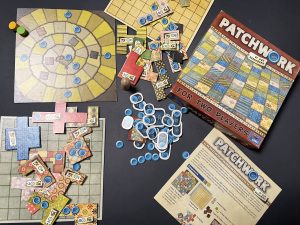
In the board game Patchwork, two players compete to build the most aesthetic (and high-scoring) quilt on a personal 9×9 game board. To start the game, all the fabric patches are laid out randomly in a circle. Each player takes five buttons and someone is chosen as the starting player.
In the board game Patchwork, two players compete to build the most aesthetic (and high-scoring) quilt on a personal 9x9 game board. To start the game, all the fabric patches are laid out randomly in a circle. Each player takes five buttons and someone is chosen as the starting player.On their turn, a player can buy one of the three patches standing clockwise from the marker, or choose to pass and gain buttons. To buy a patch, they pay the button cost shown on the patch, move the marker to that patch's place in the circle, add the patch to their game board and then move their time token the number of spaces shown on the patch. They can place the patch anywhere on their board where it doesn't overlap other patches, but it's best to fit things together as tightly as possible. If your time token is behind or on top of the other player's time token, you get another turn; otherwise your opponent continues. Instead of buying a patch, you can choose to pass; you do this by moving your time token to the space directly in front of your opponent's time token and then taking one button from the bank for each space you moved.Besides the button cost and time cost, each patch also has 0-3 buttons on it, and when you move your time token past a button on the time board, you earn "button income": add up the number of buttons shown on your personal game board and take that many buttons from the bank.In addition, the time board shows five 1x1 patches, and during setup five actual 1x1 patches are placed on those spaces. Whoever is first to pass that patch on the time board immediately takes it and places it on their game board.Additionally, the first player to completely fill a 7x7 square on their game board gets a bonus tile worth 7 extra points at the end of the game.When a player takes an action that moves their time token to the centre of the time board, they receive one last button income from the bank. When both players are in the centre, the game ends and scoring takes place. Each player gets one point per button they own and then loses two points for each empty space on their game board. Scores can be negative. The player with the most points wins.



 Patchwork – The art of sewing that has won over the tables and hearts of board gamers
Ali je mogoče ustvariti napeto, taktično in globoko strateško namizno igro o nečem tako vsakdanjem, kot je šivanje…
Read post →
Patchwork – The art of sewing that has won over the tables and hearts of board gamers
Ali je mogoče ustvariti napeto, taktično in globoko strateško namizno igro o nečem tako vsakdanjem, kot je šivanje…
Read post →
 Patchwork
Igrali so: 7-letnik, odrasel Igra "Patchwork" je res čudovita za mlajše igralce, saj ponuja preprosta, a hkrati strateška…
Read post →
Patchwork
Igrali so: 7-letnik, odrasel Igra "Patchwork" je res čudovita za mlajše igralce, saj ponuja preprosta, a hkrati strateška…
Read post →