
Have you ever found yourself in the middle of a room full of friends, frantically waving your arms about and trying to explain the word ‘carousel’ without actually saying the word? If you have, then you’ve already experienced the magic of Alias. This Finnish classic from Tactic isn’t just a game; it’s a social phenomenon that has become synonymous in Slovenia with unforgettable parties, family evenings and team-building events, where even the most reserved individuals let their hair down.

Why has Alias become such a massive hit?
The psychology behind Alias is rooted in that fundamental human instinct: the desire to understand and connect. Why has the game become so popular here?
1. Social dynamics and breaking the ice
Alias acts as the perfect catalyst for socialising. In a world where we’re often trapped in digital bubbles, Alias requires direct eye contact, the interpretation of body language and an understanding of how your fellow players think. When trying to explain the word ‘perseverance’ to your partner, you don’t just use words; you look for shared memories, inside jokes and associations that are unique to the two of you. This creates a strong bond between players.
2. The adrenaline rush of the sand timer
The time limit in Alias plays a crucial role. As the sand runs out, the ‘fight-or-flight’ response is triggered in the brain, which, instead of a physical sprint, results in incredibly creative (and often hilarious) linguistic acrobatics. This time pressure prevents the game from becoming too long or boring. The group dynamics remain high, as teammates are constantly on their toes, either guessing or keeping an eye on the opposing team to ensure they don’t make a mistake.
3. The Slovenian cultural context
The Slovenian edition of Alias is not just a dry translation. It has been adapted to our cultural context, meaning that the words have been chosen to reflect our everyday life, customs and phrases. This allows players to identify with the content, whilst at the same time making the game an excellent tool for expanding the vocabulary of younger generations or those who are just learning Slovenian.
Detailed instructions and gameplay
At first glance, Alias seems simple, but its elegance lies in its strict rules, which ensure a fair and thrilling game.
List of components: What’s in the box?
When you open Tactic’s distinctive red-and-white box, you’ll find:
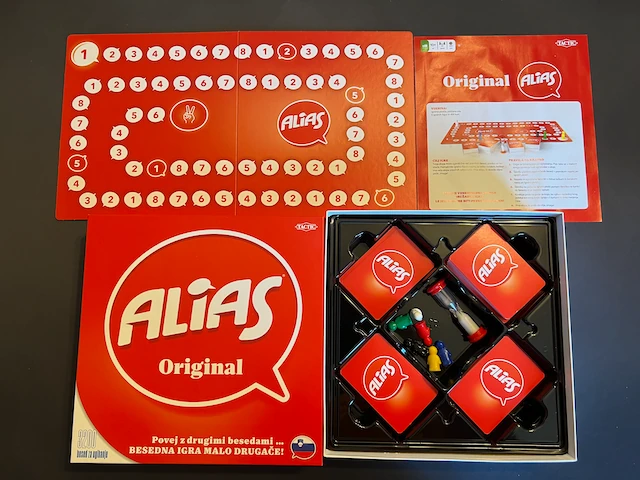
- Game board: A clear path with numbered squares leading to the finish.
- 400 word cards: Each card features 8 numbered words, totalling 3,200 words to explain!
- An hourglass: A classic timer (approximately 60 seconds).
- 6 pawns: In different colours, representing the teams.
- Game instructions: Clearly written rules in Slovenian.
Setting up the game
Set-up is quick, meaning you can start playing in less than two minutes:
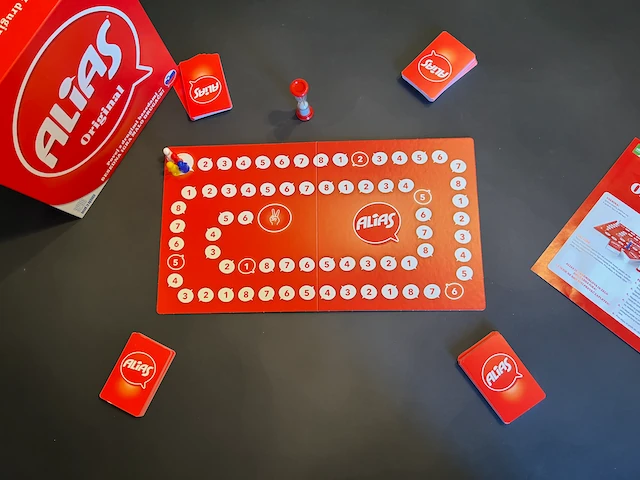
- Teamwork: Players are divided into teams (at least two players per team). Ideally, play with 3 or 4 teams of two or three members each.
- Placing the pieces: Each team chooses its own piece and places it on the ‘START’ square.
- Preparing the cards: Shuffle the cards and divide them into several piles that are accessible to all players.
- Determining the order of play: The teams agree on who will go first (usually the youngest player or the team that most recently bought the game).
Gameplay: The Art of Guessing
The game is played in rounds. In each round, one person from a team gives clues, whilst the other members of that team guess.
- Square number: The number on the square where your team’s token is standing determines which word on the card you will describe (e.g. if you are on square 5, you describe the word under number 5).
- Giving clues: The clue-giver picks up a pile of cards and begins to explain the words one by one. They must not use the root of the word, a partial translation into another language, or point to objects in the room.
- Example: If the word is ‘meteorologist’, you must not say ‘weather’. However, you may say: ‘The person on the television who tells us whether we’ll need an umbrella.’
- Scoring: For every word guessed correctly, the team scores one point (and moves one square forward). For every mistake (if the clue-giver uses a forbidden word) or a word skipped, the team moves back one square.
- Word theft (Heist): If a team lands on a marked square on the board, a ‘heist’ round follows. There is no sand timer for this, and all teams may guess the word. The first to guess correctly scores a point.
Winning conditions
The winner is the team that is the first to reach the finish square at the end of the game board. If several teams reach the finish in the same round, the team that scored the most points in the last round wins.
Analysis of strategies and tactics
Many people think that Alias is just a game of chance, but experienced players know that there are strategies that separate the winners from the losers.
A strategy for beginners
- First, the most obvious: don’t get bogged down in philosophical definitions. Use synonyms and antonyms. (‘The opposite of big’ for the word ‘small’).
- Pace: Try to find a rhythm with your opponent. If you see that your opponent isn’t responding to a particular description, immediately change your angle of explanation.
- Don’t hesitate to skip: If a word is too difficult (e.g. a specific technical term), it’s sometimes better to lose one point and move straight on to the next card than to waste 30 seconds on a single word.
Advanced tricks for experienced players
- Associative links: Make the most of shared experiences. If you and your partner both know about a particular holiday event, use that as a clue.
- Grammatical clues: Instead of describing the meaning, focus on the structure. “It’s a noun, masculine, ending in -ar.” (Although in some groups it’s a matter of agreement as to whether this is allowed).
- Psychological pressure: When the opposing team is explaining, remain quiet but attentive. Spotting their mistakes can earn you points in the ‘looting’ round.
An overview of official expansions and variants

The original Alias is just the tip of the iceberg. Tactic has developed a whole range of variants that adapt the game to different target groups:
- Junior Alias: Adapted for younger children who cannot yet read. The cards feature pictures, and the words are simpler. Excellent for speech development.
- Alias Slovenia: Featuring words and names from popular children’s fairy-tale and literary characters, from Martina Krpan, Radovedni Taček and Ciciban, right through to learning about Slovenian cultural monuments, places, special features, the most popular TV series, books, dishes and famous people. Alias Slovenia tests your vocabulary and knowledge of everything Slovenian!
FAQ – Frequently Asked Questions
Conclusion
Alias is more than just a party game; it’s a workout for your brain and, at the same time, the best fun you can imagine with your closest friends. It forces you to think outside the box, to laugh at your own (and others’) linguistic slip-ups, and to go home at the end of the evening feeling connected.
Whether you’re a strategist keen to outwit the competition or simply looking for a relaxed evening full of laughter, Alias is a must-have for any home board game collection.