

Imagine standing in the midst of a magnificent ancient building site, where the air is filled with the scent of fresh clay and mighty columns rise all around you. King Nebuchadnezzar II has summoned you with a clear objective: to build something so breathtaking for his young queen, Amytis, that it will eclipse all previous architectural achievements. Before you lies Babylon, an exceptional board game from Geek Attitude Games (designed by Olivier Grégoire), which takes board gaming into a whole new, three-dimensional realm.
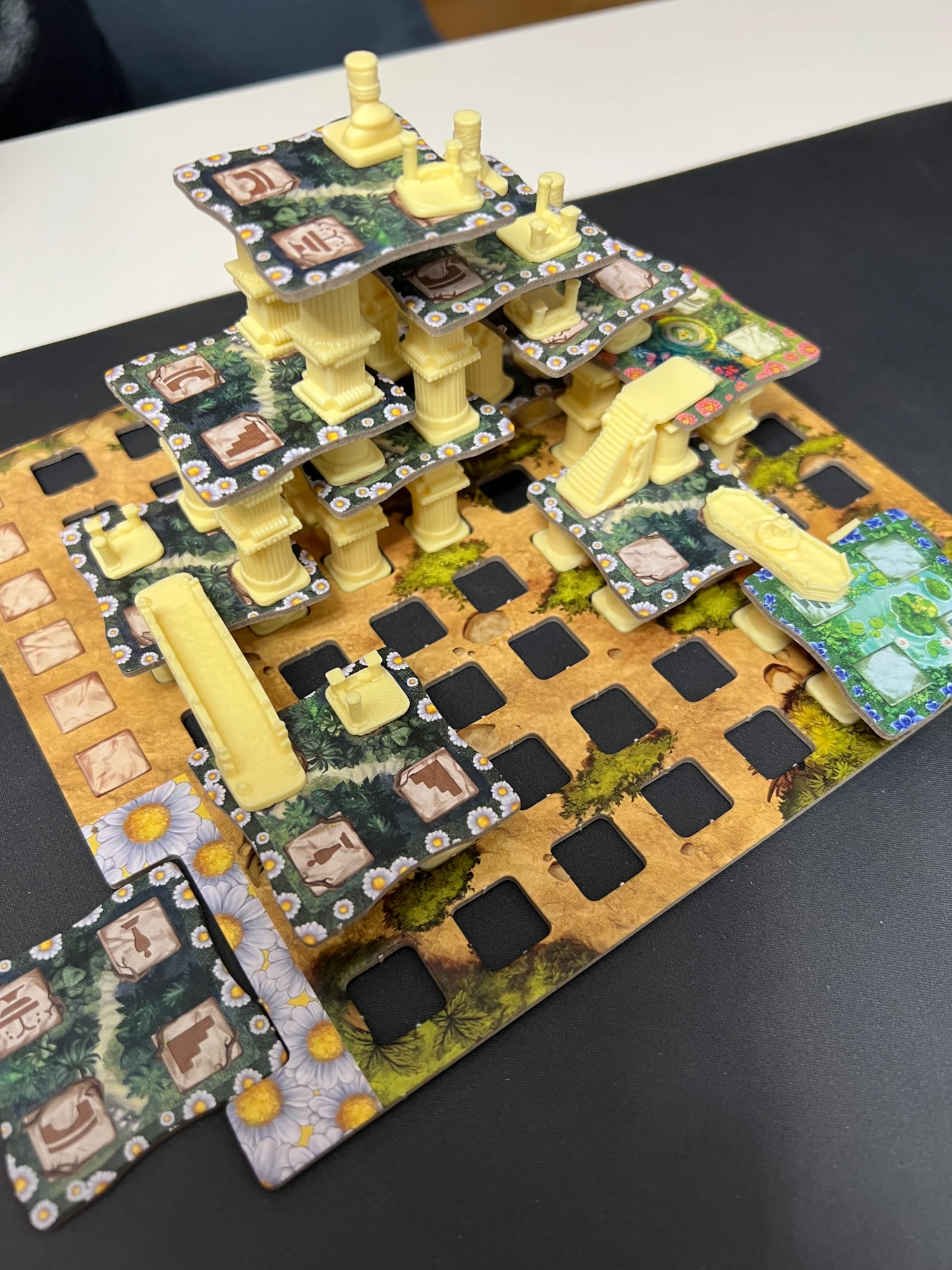
Babylon is not just your average tile-laying game. It is a visual and tactical experience where you literally build upwards, carefully stacking columns and terraces whilst hoping your hand doesn’t tremble at the slightest careless move. In this guide, we’ll take a detailed look at how the game is played and which strategies will lead you to the title of supreme royal architect.
Why is the game popular?
If we look at the modern board game market, we notice an interesting trend: players are looking for something more than just moving pieces around on a flat surface. They want an experience that engages all the senses. And this is precisely where Babylon really ‘clicks’.
The psychology of spatial planning and risk
We are visual creatures, and our brains love creating tangible structures. When you place the first level of pillars in Babylon and lay a massive terrace on top of it, that pleasant sense of satisfaction we know from our childhood days of building with blocks kicks in. However, the game quickly adds a layer of psychological pressure. As higher levels yield significantly more points, you’re constantly faced with the dilemma: ‘Should I play it safe and expand my gardens at ground level, or should I take a risk and build high?’ This tension keeps players focused from the first minute to the last.
The social aspect and ‘Silent Tension’
Unlike aggressive games where you directly destroy each other’s armies, Babylon relies on the mechanics of open drafting in the quarry. When your opponent takes the very terrace you’d planned three moves ahead, you can feel that genuine, authentic sigh of relief around the table.
Why has it become a hit?
The gaming community greatly appreciates games with high production values that don’t require three hours to read through the rules. Babylon strikes the perfect balance: the rules are accessible even to children aged 8 and over (easy to understand), whilst the depth of optimisation appeals to experienced strategists (so-called ‘heavy gamers’). Furthermore, the game offers a high degree of language independence – there is no text on the components, meaning you can enjoy playing seamlessly within a family or international group without the need for constant translation.
Detailed instructions and gameplay
To fully understand this architectural masterpiece, we must first delve into the contents of the box itself and examine the precise steps that lead you from an empty building plot to magnificent hanging gardens.
List of components: What’s in the box?
The engineering-driven approach to production is evident the moment you lift the lid. Each component has its own weight and purpose:
- 1 central quarry: The base box of the game itself serves as a three-dimensional storage tray for the resources.
- Player Boards: Special boards with 64 precise slots, ensuring that the columns stand firmly and vertically.
- Terrace Tiles: Divided into three materials: clay, granite and basalt.
- Plastic Pillars: Small pillars that serve as supports for building upwards.
- Decorative elements: Fountains, Statues, Galleries, Bridges and Stairways.
- Tokens for marking rounds and scoring.

Game Setup
Setting up the game is quick but requires precision, as it directly prepares the terrain for dynamic resource gathering:
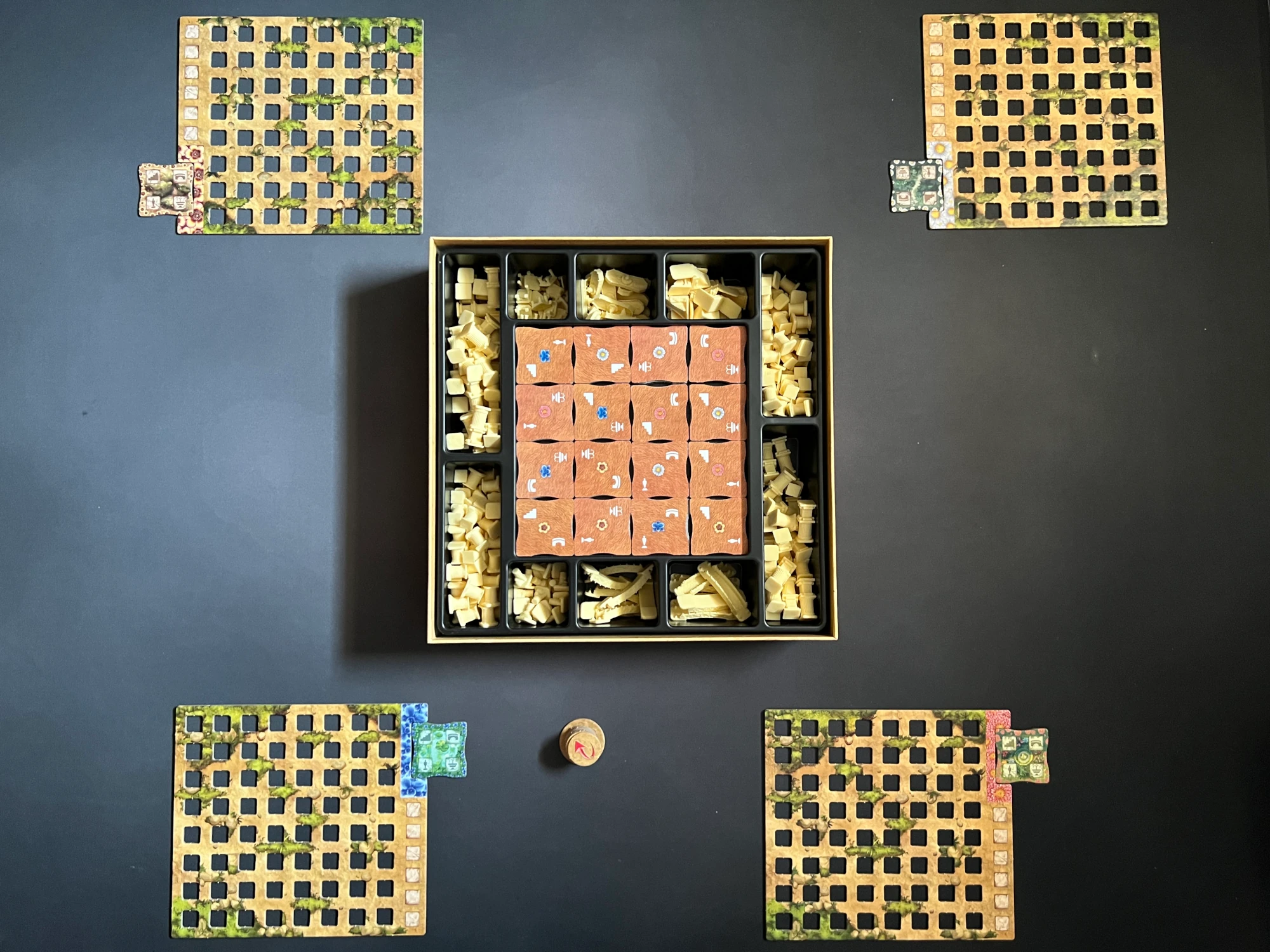
- Setting up the quarry: Place the bottom part of the box in the centre of the table. Arrange the terrace tiles inside it by level (basalt, granite, clay). This forms your shared quarry. When playing with 2 or 3 players, some tiles need to be removed.
- Distribution of tiles: Each player receives their own building tile and places it in front of them.
- Stock of columns and decorations: All the columns and beautiful decorative elements (statues, fountains, etc.) are conveniently placed in the box around the quarry.
- Determining the playing order: Choose the starting player. Place the round bonus tokens between the first and last players.
Gameplay
The game is played over a predetermined number of rounds, depending on the number of players (15 rounds with two players, 13 with three, and 11 rounds with four players). Each player’s turn consists of two key phases, which follow one another in strict sequence.
1. Digging Phase (Digging Action): Mandatory at the start of a turn.
The player must select and take one terrace tile from the central quarry. Depending on the exact location of the tile and its relationship to neighbouring tiles, the player receives a certain number of pillars from the shared supply. If the flower motif on the tile matches your personal flower, you receive additional pillars.
2. Building Phase (Building Action): Immediately after excavation.
With the terrace tile they have acquired, a player may do one of three things: place it directly in their garden, store it in their storeroom for later, or discard it in exchange for keeping the pillars. When building, the tile must rest on exactly 3 or 4 pillars. The player may then place decorative elements on the placed tile, provided they match the symbols on the tile.
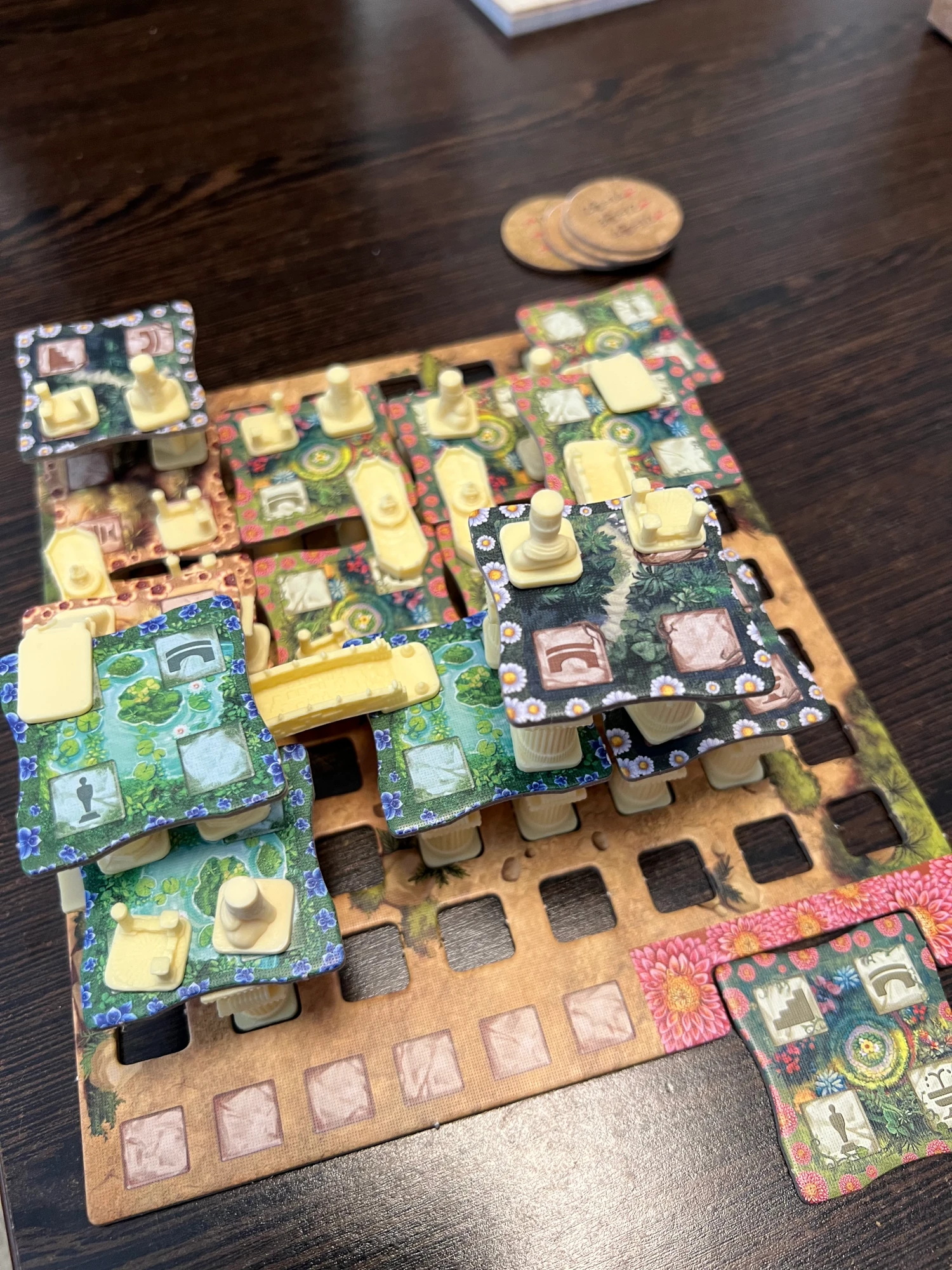
The dynamics of placing decorations require careful planning of the space. For example, a staircase (Stairway) must connect two staircase symbols that are adjacent but located on two different levels. Bridges and fountains connect adjacent terraces on the same level, whilst statues must be aligned with other statues.
Winning conditions
The game ends when the final round is complete (once all round tokens have been used). That is when the moment of truth arrives – the final scoring, based on a top-down view.
King Nebuchadnezzar surveys the gardens from the balcony of his palace, which means that anything hidden below does not score points:
- Any decorative element visible from above scores points.
- Level multiplier: The value of a decoration is multiplied by the level (height) at which it is located. A statue on the first level is worth significantly less than the same statue on the third level!
- Any decorations that have been covered by higher terraces during the game are permanently lost and do not score any points.
The winner is the player with the highest number of points. In the event of a tie, the size of the garden’s visible area is the deciding factor: the winner is the player with the larger visible garden area (i.e. the one with fewer visible empty slots for pillars remaining on the base board).
Analysis of strategies and tactics
Babylon is a game where beginners quickly learn the rules, but masters win through precision and foresight.
Beginner’s strategy: Stable foundations
If you’re playing the game for the first time, your natural tendency will be to want to climb as high as possible as quickly as possible. But be careful – building rapidly up to the third level without a broad base means you’ll run out of space to connect pieces.
- Build horizontally at the start: Create a strong base on the first level. The more terraces you have on the first level, the more options you’ll have later on for building taller structures.
- Don’t neglect the storage area: Storing a tile for your next move allows you to execute a complex combination in a single step (e.g. placing two terraces and immediately connecting them with a bridge).
Advanced tactics: Architectural chess
Experienced players do not just look at their own board, but constantly analyse the quarry and their opponent’s needs.
- Control of pillars as a weapon: The number of pillars you obtain from the quarry varies. Sometimes it makes sense to take a terrace that you do not necessarily need yourself, simply because it yields a greater number of pillars. After all, without columns, you cannot build upwards.
- Maximising multipliers: As higher levels multiply decoration points, try to plan the most difficult and valuable decorative elements (such as galleries) for the second or third level. Connecting two terraces on the third level with a bridge offers a huge advantage.
- Visual block: If you notice your opponent is building a magnificent series of linked fountains, keep an eye on which tiles they need from the quarry to complete the chain, and snatch them right from under their nose.
FAQ (Frequently Asked Questions)
Conclusion
Babylon is more than just a board game; it’s an architectural spectacle on your table. It combines stunning tabletop aesthetics, easy accessibility for family evenings, and a deeply tactical experience for experienced players who love to optimise every move. If you’re looking for a game that will wow your friends with its visual presentation alone and keep them on the edge of their seats right up to the final scoring, then it’s time to become the royal architect.