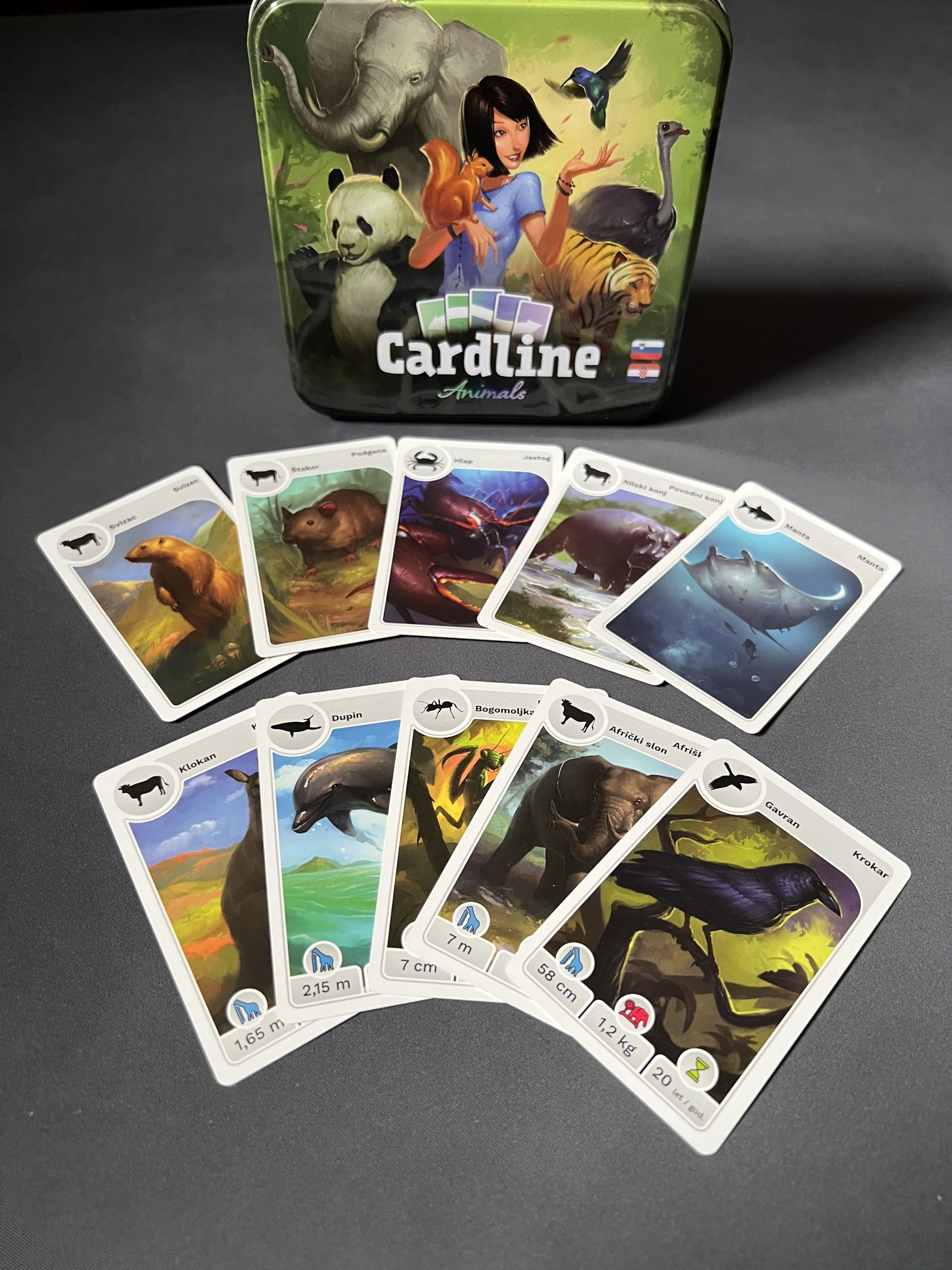
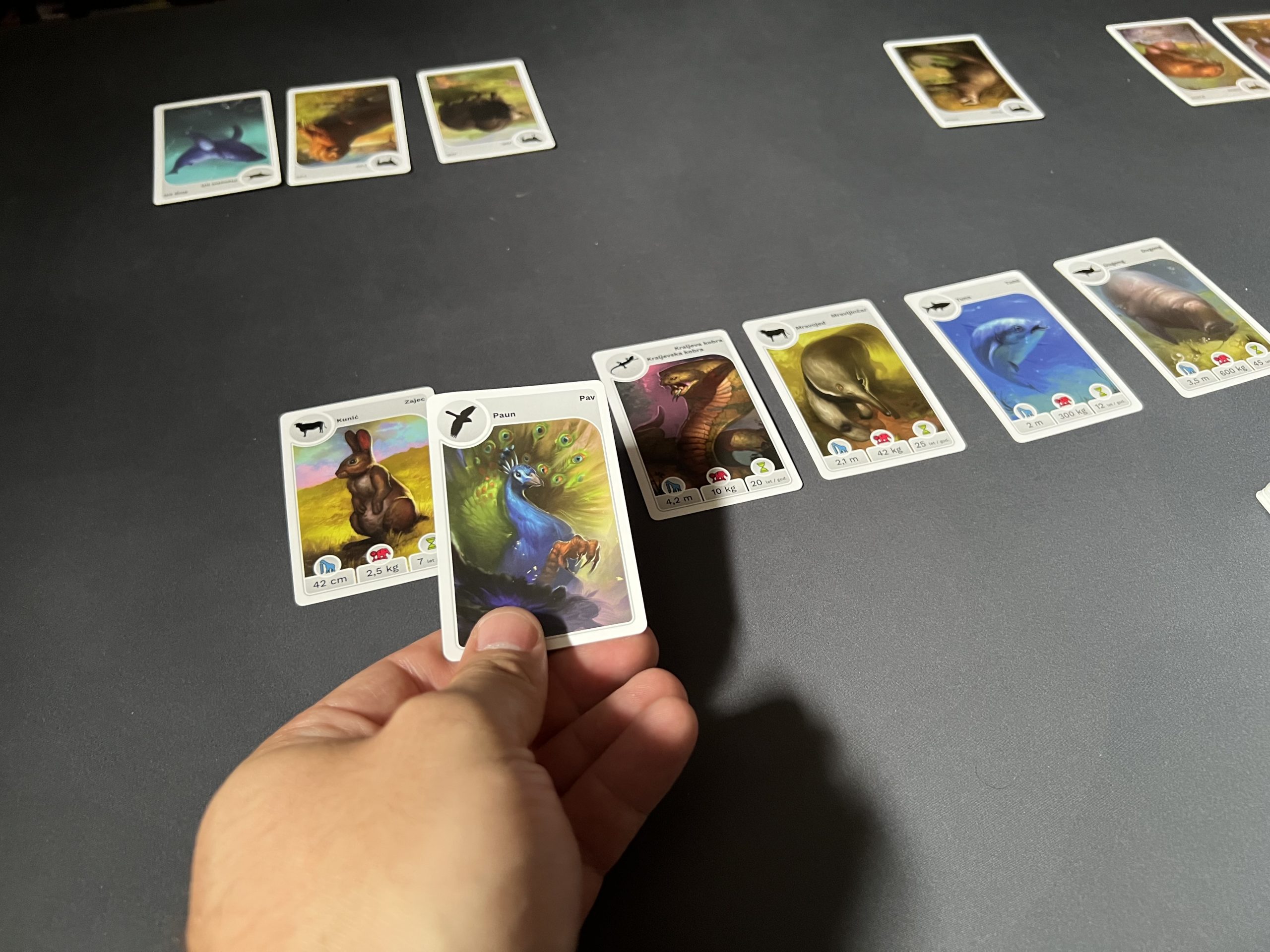
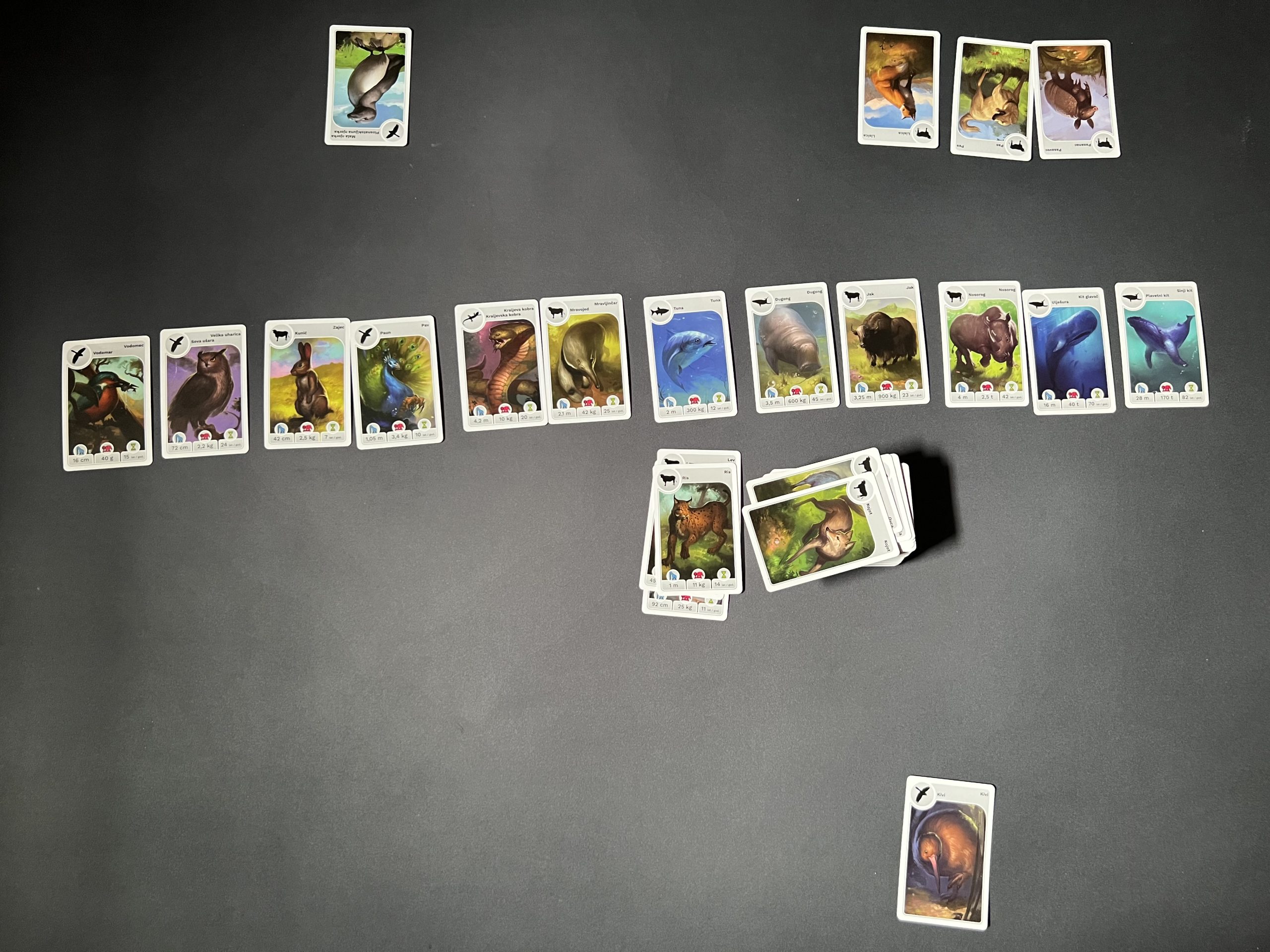
Cardline: Animals – A mysterious animal kingdom on your table
Welcome to a world where you’ll realise that your general knowledge of nature has more gaps than you dare admit! Did you know whether the average king penguin is heavier than an adult peacock? Or which animal boasts a longer lifespan – the wild lynx or the elegant swan? If you hesitated for a moment when faced with these questions, you’re not alone. It is precisely this blend of curiosity, surprise and healthy competition that forms the basis of the board game Cardline: Animals, one of the most popular educational hits in Slovenia.
In this guide, we’ll take a detailed look at why this compact tin box regularly graces the tables of Slovenian homes, go through the rules of the game in detail, analyse advanced tactics, and discover how you can use your intuition to beat even the most knowledgeable biologist.
Why do we derive such pleasure from guessing?
At the heart of Cardline: Animals lies a brilliant psychological twist: bridging the gap between what wethink we know and the harsh reality of the numbers. The game doesn’t work like a classic school quiz, where you’re penalised if you don’t know the exact year or definition. Instead, it forces you to deduce and make relative comparisons. Your brain isn’t searching for the fact ‘how much a tarantula weighs’, but rather ‘is a tarantula heavier than this beetle, yet lighter than a field mouse?’.
This shift from pure memorisation of facts to the realm of assessment and logical reasoning drastically lowers the barrier to entry. Whilst playing, players constantly experience mini dopamine spikes when they realise their intuition was correct, or they laugh out loud when their view of the world is turned on its head (for example, when they realise just how surprisingly light some seemingly massive birds are).
A game that bridges the generation gap
It’s not uncommon for modern board games to leave children out in the cold due to overly complex rules, or for adults to start getting bored after just two rounds because the game has been oversimplified. Cardline: Animals, however, acts as the perfect social catalyst. As the rules can be explained in under two minutes, a seven-year-old Year 1 pupil, a biology student and a grandmother can all sit at the same table.
The group dynamic during the game becomes incredibly chatty. Instead of the quiet calculation of moves typical of complex strategy games, Cardline sparks debates. “It’s impossible for that tortoise to live that long!” or “Are you sure that cat’s tail doesn’t count towards its length?” are the phrases echoing through the room. The game creates shared moments of amazement, where learning becomes a by-product of pure fun.
Why has it become a hit in Slovenia?
We Slovenians are considered a nation that loves nature, the mountains and animals, whilst at the same time, within family circles, we greatly value educational games with high added value. The Slovenian edition of Cardline: Animals has been a resounding success, as it has removed the only real barrier to the original – language accessibility. Its compact packaging means you can easily pop it into your rucksack for a trip to the seaside or a mountain hut, whilst the sturdy tin ensures the game will survive countless journeys.
Detailed instructions and gameplay
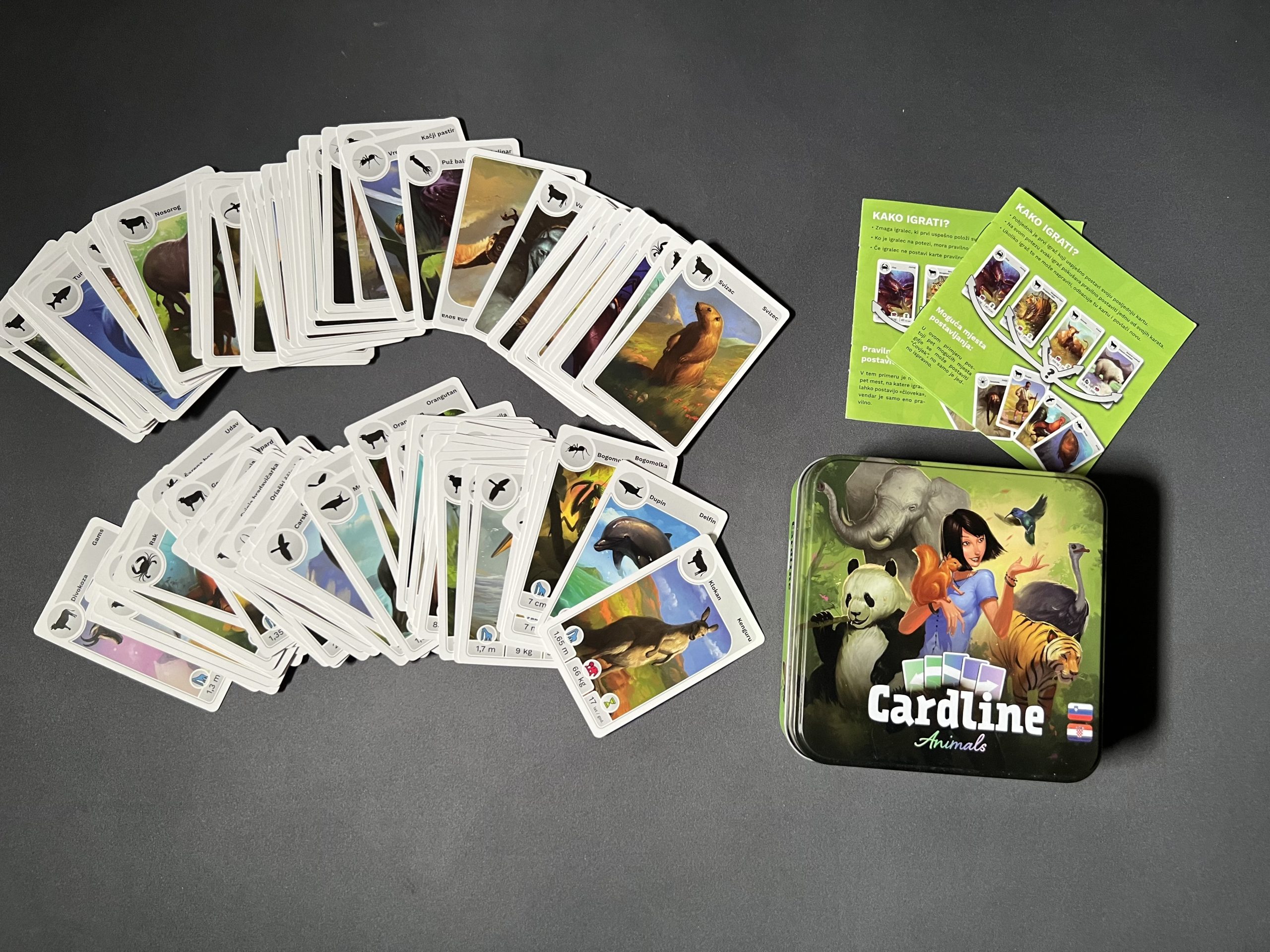
List of components: What’s in the box?
When you open the elegant, embossed tin box, you’ll find that the game is exceptionally minimalist, yet superbly crafted. The contents include:
110 unique animal cards: Each card features a beautiful, colourful illustration of an animal on the front, along with its Slovenian name and the corresponding biological class (mammals, birds, amphibians, insects, etc.).
A booklet with the Slovenian rules: Concise, clear and illustrated with examples.
Card layout:
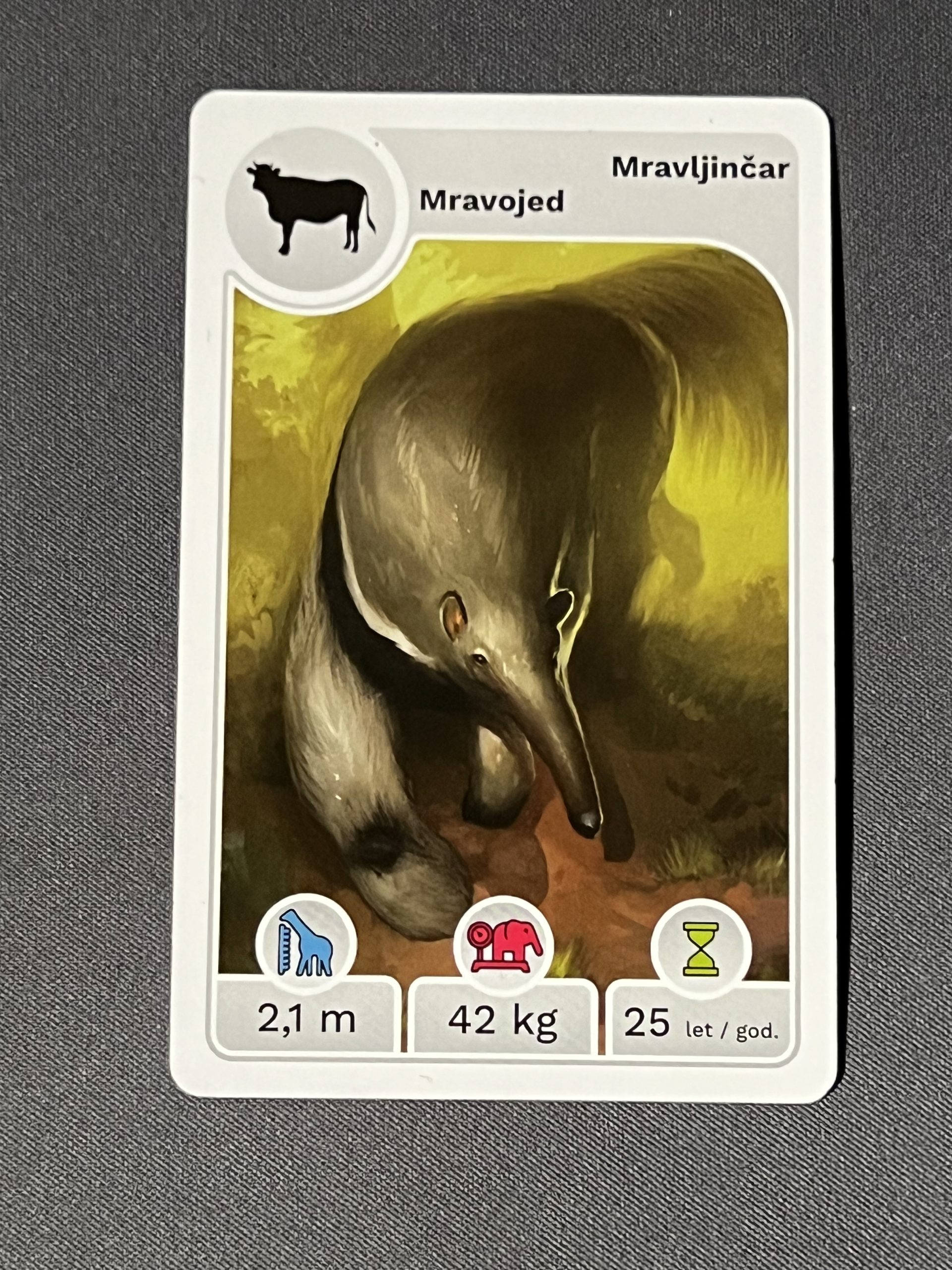
The cards have two key sides. The front (visible to players) contains only the illustration and the animal’s name. The back (hidden), in addition to the same visual information, reveals three key numerical values:
Average length/size (measured excluding the tail; for birds, from foot to head, not wingspan).
Average weight (in appropriate units ranging from grams to tonnes).
Average lifespan (in days, months or years).
Setting up the game
Preparing the game is quick and does not require a lot of space:
Before the game begins, the players agree unanimously on which animal characteristic they will compare in this round: length, weight or lifespan.
Shuffle all 110 cards thoroughly, ensuring that the cards are face down so that the numerical data (statistics) are hidden (facing downwards towards the table).
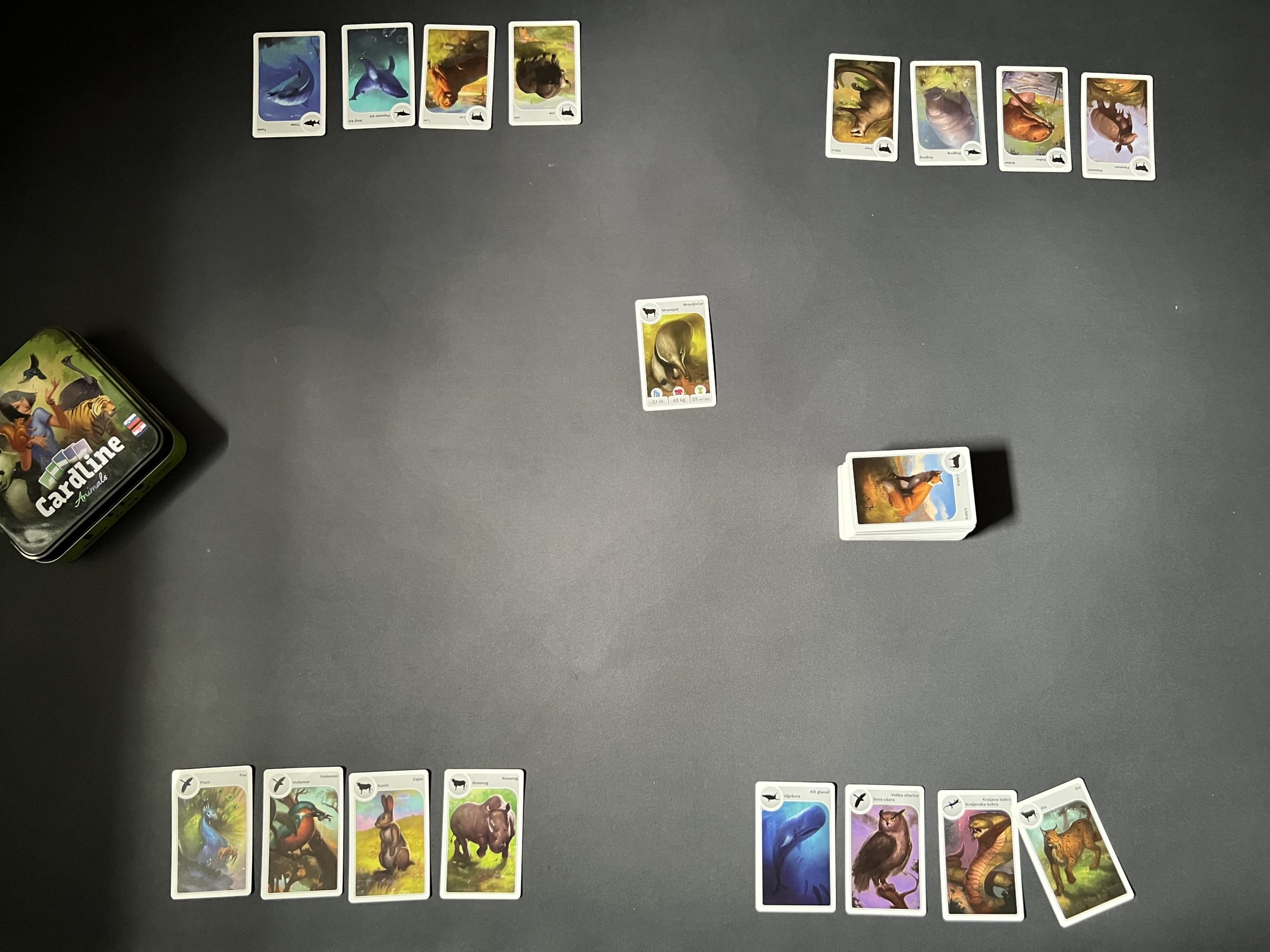
Deal 4 to 6 cards to each player (depending on the desired playing time; the standard is 4 for a quick game, 6 for a slightly greater challenge). Players place their cards in front of them on the table without turning them over. The numbers must remain strictly hidden!
Place the remaining cards in the centre of the table as a draw pile (with the information also hidden).
Take the top card from the draw pile, turn it over so that the information is visible, and place it in the centre of the table. This card represents the starting point of your game.
How does a round work?
The game is started by the youngest player or the one who last visited the zoo, and play proceeds clockwise.
When it is your turn, choose one of the cards lying in front of you and try to place it correctly in the ascending sequence in the centre of the table.
Depending on the chosen characteristic (let’s say you’re playing by weight), you have several options:
If you think your animal is lighter than all those currently on the table, place it at the far left of the row.
If you think it is heavier than all the others, place it at the far right of the line.
If you think its weight falls somewhere in between, place it in the appropriate gap between two cards already on the table.
Once you have physically placed the card in the desired position, turn it over to reveal its details. Now comes the moment of truth:
Correct placement: If the numerical value of your card confirms that the sequence is still in perfect ascending order from left to right, you have succeeded. The card remains on the table, your turn is over, and you have one fewer card. The sequence on the table is now longer, and the next player has a harder time of it.
Incorrect placement: If the number indicates that the animal does not belong in that position, remove the card from the game immediately (it goes back into the box). As a penalty, you must take a new card from the draw pile and place it in front of you (the number of your cards is not reduced). It is the next player’s turn.
Important rule regarding matching values: If your animal has exactly the same value as a card already on the table, the placement is correct regardless of whether you place it directly to the left or right of that card.
Winning conditions
The aim of the game is simple: to be the first player to successfully play their last card and run out of cards.
However, the game maintains a high level of sportsmanship through the rule governing the end of a round. If you manage to play your last card, the round is nevertheless played to the end, so that all players have the same number of turns. If, in the same round, another player also manages to run out of cards, the victory is shared or a sudden-death round is played: the two remaining opponents are each dealt one new card and continue playing; the first to make a mistake, whilst their opponent plays correctly, loses.
Analysis of strategies and tactics
Although Cardline: Animals may at first glance seem like a game of chance and pure knowledge of biology, after playing a few rounds you’ll notice that experienced players win considerably more often. Here’s a breakdown of how to take your game to the next level.
Strategy for beginners
Play the ‘extremes’ as late as possible: At the start of the game, the row on the table is short (just one or two cards). This is the ideal moment to get rid of any cards you’re unsure about. If you have an elephant or a whale in your hand, play them at the end, as you know they are heavier than all the other animals. If you have an ant or a mosquito, place them on the left at the end, as you know they are very light. Waiting until the end of the game to play these cards is a tactical move, as when only these cards remain in your hand, you can be sure of the correct placement.
Pay close attention to the biological classes: the icons on the cards tell you whether it is a mammal, an insect, a reptile or a bird. If you’re playing for lifespan, the general rule is that insects live extremely short lives (often just a few days or months), whilst larger mammals and some birds (e.g. parrots, swans) live to a ripe old age. Use these biological principles as your guide.
FAQ – Frequently Asked Questions
1. Is the game suitable for children who cannot yet read or count very well?
The game is officially recommended for children aged 7 and over. If a child can already recognise numbers and understands the concept of ‘bigger/smaller’, they can easily play it. Although the text on the cards (animal names) is written out, the wonderful, clear illustrations mean that children will immediately know which animal is meant, even if they are not yet fluent readers. The game is actually an excellent tool for learning numerical relationships and decimal numbers.
2. How challenging is the game in terms of language?
Thanks to the Slovenian edition, the language difficulty is perfectly tailored to the local market. There are no complicated descriptions or instructions in foreign languages on the cards, so you can enjoy playing without having to constantly consult a dictionary or translate for younger family members.
3. How long does a game actually last?
A game usually lasts between 15 and 20 minutes. This means it’s ideal as a ‘filler’ game – a game to fill the time between two bigger activities, to play after lunch, or whilst waiting for the whole group to gather for an evening get-together. Because of the fast pace, it rarely ends after just one game; players usually demand a rematch straight away.
4. Do the cards wear out quickly, and do I need protective sleeves?
The cards are made from high-quality, laminated material that withstands daily play well. However, as the game involves constant shuffling, placing on the table and turning over, we recommend that serious enthusiasts purchase protective sleeves.
5. What happens if none of the players know anything about exotic animals?
That’s perhaps the best part of the game – nobody needs to be an expert! In fact, the game is more fun when everyone is guessing based purely on intuition and logic. Once you’ve made a mistake and discovered the correct facts, remember that animal for next time. The game broadens your horizons in a subtle way.
6. Can the game be played with just two players?
Yes, the game works brilliantly as a two-player game too. The dynamics change slightly – it becomes more tactical and direct, as you’re constantly keeping an eye on just one opponent and trying to make things difficult for them. The game officially supports up to 8 (or even 10) players, which means it works brilliantly at larger parties too.
Conclusion
Cardline: Animals proves that a top-class board game doesn’t need a 300-page rulebook or thousands of plastic figures. Sometimes, all it takes is a clever idea and a pile of cards to spark our natural curiosity. Whether you’re looking for a birthday present, an educational tool for your children, or simply a fun game to keep your friends laughing at the weekend, you can’t go wrong with this tin-box classic.