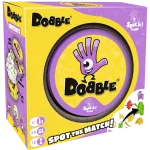

Dobble (also known as Spot It! in some countries) isn’t just a game – it’s a global phenomenon that has redefined the concept of a ‘party game for everyone’. When you first pick up this small, round metal box, you might find it hard to imagine how 55 cards with a few simple pictures can cause so much laughter, shouting, competitiveness and pure adrenaline. And yet, Dobble regularly takes centre stage at family gatherings, student parties, beach holidays and even serious board game tournaments.
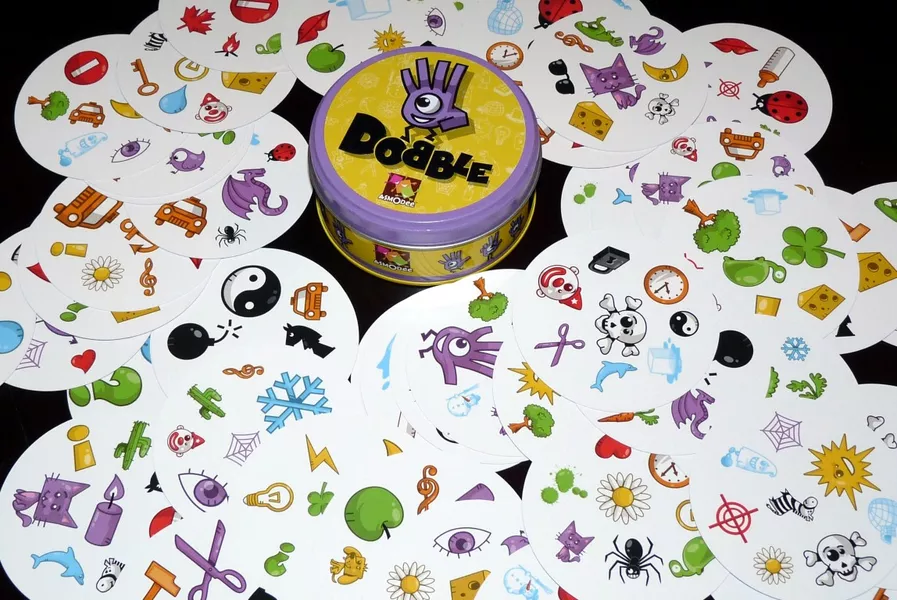
Its genius lies in a single, mathematically perfect rule: between any two cards in the game, there is exactly one matching symbol. Your task? To find it faster than the others. It sounds simple, but once the game begins, your brain often gets tied in knots, your tongue gets tied, and your fingers start tapping frantically on the table.
In this comprehensive guide, we’ll take a detailed look at why this game has become an indispensable part of every home collection, how its mechanics work, and how, with a few strategic tricks, you can become an unbeatable champion at finding matching symbols.
Why is the game so popular?
To understand why Dobble has achieved such success both globally and in Slovenia, we need to look beneath the surface of its simple exterior. The game isn’t based on complex strategy or hours of planning your moves; instead, it taps into basic human reflexes and psychological mechanisms.
The psychology of visual perception and cognitive blocking
The central appeal of Dobble stems from a phenomenon that psychologists call visual processing under pressure. The symbols on the cards vary in size and are oriented in different ways. As your brain searches for a match, it must ignore differences in size (e.g. a huge green dragon on one card and a miniature green dragon on another) and focus exclusively on shape and colour.
The moment competitive pressure comes into play – when you hear that your fellow players are on the verge of calling out their symbol – that familiar ‘mental short-circuit’ is triggered in your brain. We’ve all experienced that moment when we’re staring at two cards, we know the match is there, but our mouths simply can’t form the word. This mini cognitive block creates incredible tension, which, the moment someone finally blurts out the right word, bursts into general laughter or a dramatic sigh.
The social aspect and complete inclusivity
Dobble is one of the few games that truly breaks down generational barriers. As the game requires no prior knowledge, reading skills or complex strategic thinking, a six-year-old child, a thirty-year-old passionate board game enthusiast and an eighty-year-old grandmother can all sit at the same table on a completely equal footing. What’s more: thanks to their exceptional visual perception and quick reflexes, children often even have the edge over adults, which gives them a huge boost to their self-confidence and creates a wonderful family dynamic.
Why has it become such a hit in Slovenia?
We Slovenians are a nation that loves spending time outdoors, picnics, trips to the hills and camping. Dobble has fitted into this lifestyle like a glove. The metal box is practically indestructible, and the cards are durable enough to withstand being played with on a lawn, at the beach or in a mountain hut. Thanks to its language-independent nature (there is no text on the cards), the game is suitable for mixed groups, and it has also become a staple in Slovenian nurseries and primary schools, where teachers use it to develop concentration, reflexes and motor skills.
Detailed instructions and how to play
Although the basic principle is always the same, Dobble offers incredible variety. Let’s take a detailed look at what you get in the box, and how to set up and play the game.
List of components: What’s in the box?
When you open the distinctive round metal tin, you’ll find:
- 55 round cards: Each card features 8 different symbols (there are 57 different symbols in the game in total, distributed across the cards according to a precise mathematical formula).
- Instruction booklet: Brief, clear and illustrated instructions in Slovenian, describing 5 different mini-games.
Setting up the game
Setting up the game is one of the quickest in the world of board games and takes less than 30 seconds. Shuffle the cards thoroughly. Depending on which of the five mini-games you choose, deal the cards out to the players or place them in the centre of the table. It is essential that all cards are face down before the game begins, so that no one has an advantage at the start.
Game mechanics
The core mechanic is simultaneous play. Forget the classic clockwise turn-taking where you wait patiently for your turn. In Dobble, everyone plays at the same time, all the time. This makes for an incredibly fast-paced group dynamic; there’s never a dull moment or any ‘downtime’, as you have to keep a close eye on what’s happening on the table at all times.
The official rules include 5 different mini-games. Let’s take a look at the two most popular ones:
1. Mini-game: The Tower
- Objective: To collect as many cards as possible.
- Set-up: Each player is dealt 1 card face down. The remaining cards are placed in the centre of the table as a face-up pile.
- How to play: On the signal ‘Start’, all players turn over their card at the same time. Players try to find a matching symbol between their card and the top card of the central pile as quickly as possible. The first player to find a match calls out the symbol, takes the card from the centre and places it on top of their own card. This reveals a new card from the central pile and the game continues immediately.
2. Mini-game: The Well
- Objective: To get rid of all your cards.
- Set-up: Place 1 card face-up in the centre of the table. All remaining cards are dealt face-down evenly amongst the players.
- Play: Players simultaneously turn over their personal pile of cards. The first player to find a matching symbol between their top card and the card in the centre of the table calls out the symbol loudly and places their card on the central pile. This card now becomes the new reference point for all players.
Important rule of interaction: As all players reach for the cards at the same time, there are often moments of a tie. The rule states that the card is won or discarded by the player who was the first to call out the symbol, not necessarily the one who touched the card first. This prevents mere rough jostling and encourages verbal quickness.
Winning conditions
The winner is determined according to the mini-game chosen:
- In ‘Tower of Hell’-type games, the winner is the player who has collected the most cards by the end (when the central pile is empty).
- In ‘Poisoned Well’-style games, the winner is the player who is the first to get rid of all their cards.
- If you are playing a full tournament, the instructions suggest a scoring system for each mini-game played. The overall winner is the player who has accumulated the most points after five rounds have been played.
Analysis of strategies and tactics: How to become a Dobble master?
Many people think that Dobble is simply a game of pure luck and innate reflexes. This isn’t entirely true. As with any skill, you can significantly improve your results here with the right approach and technique. Let’s look at the difference between a beginner’s and an advanced approach.
Strategies for beginners: Laying the foundations
- Focus on one area: Beginners often make the mistake of letting their eyes dart all over the card. Choose one large or prominent symbol on your card (e.g. a red lip or a yellow exclamation mark) and immediately check whether that specific symbol is present on the target card. If it isn’t, quickly move on to the next one.
- Standardise your terminology: Agree with your fellow players (or decide for yourself) on what you’ll call the symbols. Is that green thing a ‘drop’, a ‘stain’ or ‘slime’? If you have a short, clear word ready in your head, you’ll be able to blurt it out much faster in the heat of the moment than a long description: “That green blob over there!”
Advanced tricks for experienced players
- Peripheral vision and soft focus: Instead of focusing on individual symbols one by one, try using what’s known as ‘soft focus’. Look at the card as a whole and let your brain subconsciously recognise matching colours and shapes. This takes a bit of practice, but it drastically reduces your reaction time.
- Tactical hand position: Always keep your hand close to the cards, but in such a way that you do not block your own or others’ view. Experienced players begin the hand movement within a millisecond, just as their brains are starting to recognise the match, and utter the word whilst their hand is still in flight towards the card.
- Mental pressure on opponents: Calling out the symbols loudly and confidently, and placing the cards down quickly in front of your opponents, causes them slight stress. When an opponent sees that you have taken the initiative, their cognitive block increases, giving you an advantage in the following seconds of the game.
An overview of official versions and themed editions
Due to its immense popularity, Dobble has undergone numerous transformations. Although the basic mechanics remain the same, the various editions bring a breath of fresh air, customised symbols and sometimes even specific additional rules.

Dobble Animals
This version is perfect for younger children and nature lovers. Instead of the classic, sometimes slightly unusual symbols from the original game, this version features pictures of various animals (lion, elephant, parrot, giraffe, etc.).
Dobble Disney Princess
A magical version steeped in nostalgia and fairy tales. The symbols include the princesses themselves (Cinderella, Ariel, Little Red Riding Hood, Snow White...) as well as their iconic props or friends (glass slipper, apple...)
Dobble Dinosaurs
Perfect for palaeontologists of all ages. On the cards you’ll find various types of dinosaurs (T-Rex, Triceratops, Stegosaurus, Pterodactyl) as well as fossils, footprints and prehistoric plants.
Dobble Super Mario
One of the most popular ‘gaming’ versions. The symbols are taken straight from the Mushroom Kingdom. On the cards, you’ll find Mario, Luigi, Princess Peach, Bowser and Yoshi, as well as iconic items such as the red mushroom, a coin and a star.
Are these versions worth buying?
If you already own the classic Dobble at home, buying a themed version (e.g. Super Mario) makes sense mainly if you’re a big fan of this franchise, as recognising specific characters adds a whole new level of fun and challenge to the game.
FAQ – Frequently asked questions about Dobble
Why should you have Dobble in your collection?
Dobble is one of those rare party games that never gathers dust on the shelf. It’s the perfect ice-breaker when meeting new people, a brilliant way to pass the time whilst travelling, and an invaluable source of family laughter. Its affordable price, durable packaging and endless replayability place it right at the top of the list of the best investments in entertainment.
Get your copy of Dobble today and make sure your next get-together is full of laughter, excitement and unforgettable moments.