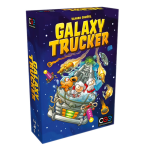

Imagine the following scenario: you are a space transporter employed by Corporation Incorporated. Your task is incredibly simple – you must build a spaceship out of drainpipes, cabin modules and second-hand engines, load it with precious cargo and transport it safely to the other side of the galaxy. Sounds easy, doesn’t it?
But when meteors start flying at you, when you’re attacked by interstellar pirates, or when you realise you’ve forgotten to connect the engine to the power source, you’ll quickly realise that Galaxy Trucker is one of the most chaotic, fun and thrilling board games of all time.
This cult hit by Vlaada Chvátil, published by the renowned Czech Games Edition (CGE), is the perfect blend of frantic, high-speed building and a relentless struggle for survival that you’ll be happy to play again and again.
Why is the game so popular?
To understand the phenomenon of Galaxy Trucker, we must first analyse its unique two-phase nature, which is based on the psychology of stress and relief (or laughter in the face of disaster). Most strategic board games offer a safe environment where players carefully plan their moves. Galaxy Trucker, however, turns this concept on its head with its real-time building mechanics.
The psychology of stress and amusing disaster
In the first phase of the game, you’re under immense time pressure. The hourglass ticks relentlessly, whilst you frantically rummage through a pile of face-down tiles on the table with one hand, searching for that one crucial piece – perhaps a shield or an extra laser. This phase triggers an adrenaline rush and encourages quick decision-making under pressure. Once the construction phase is over, however, the dynamic changes completely. The stress gives way to pure fun as you watch your carefully laid plans crumble under the influence of relentless events from outer space.
This party game has become a real hit, mainly due to its accessibility and high level of interaction, which isn’t based on direct ‘teasing’ between players, but on the shared experience of misfortune. When a meteor tears half your friend’s ship away, taking all their precious cargo with it, you’ll laugh until you cry – though only until the next event card destroys your only engine, of course. The game creates unforgettable stories that you’ll be talking about long after the game has ended. Due to its low language barrier (the components are language-independent), it is extremely popular with both casual players and more demanding groups.
Detailed instructions and gameplay
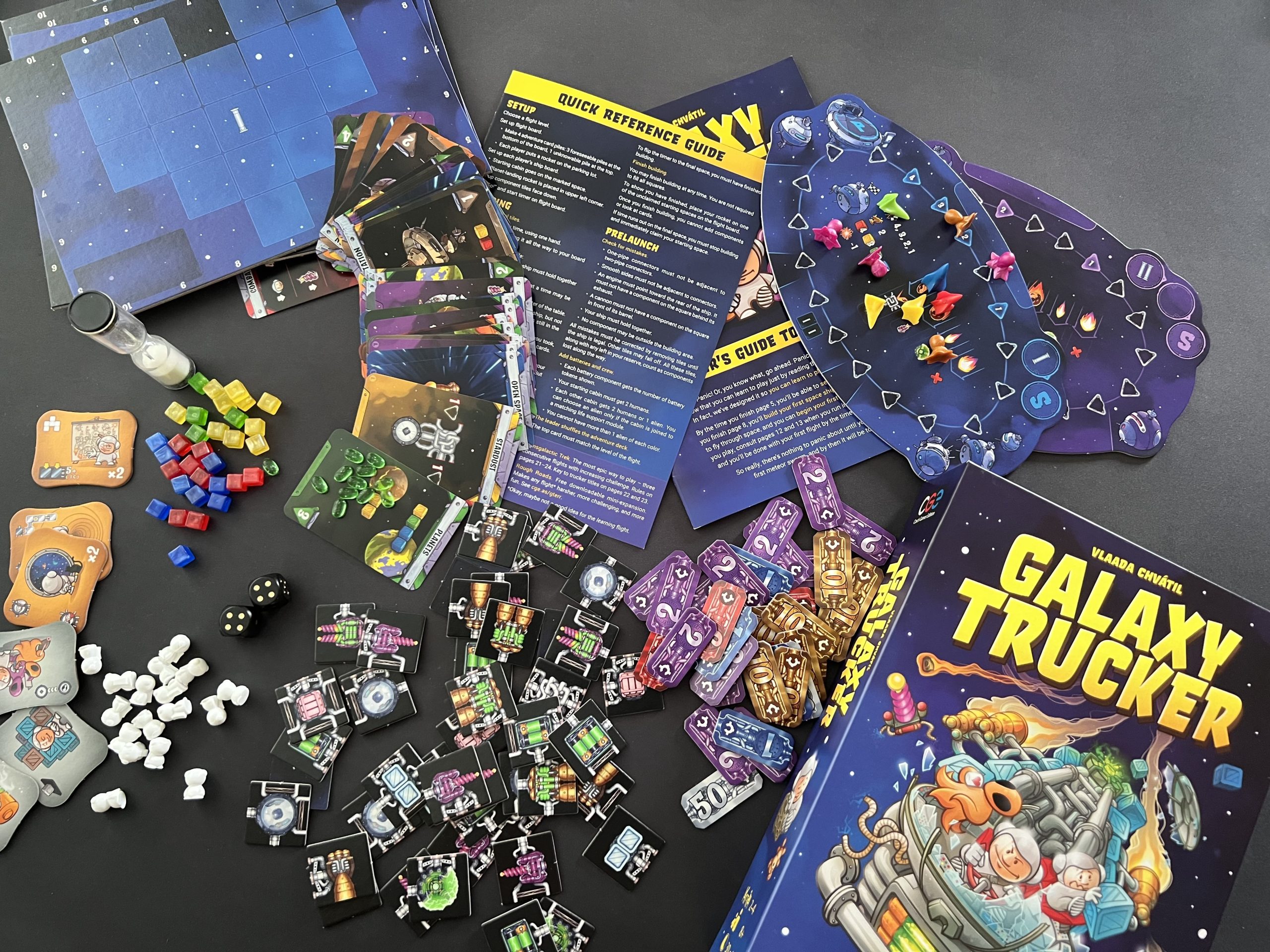
List of components: What’s in the box?
When you open this colourful box, you’ll find a rich selection of high-quality components:
- Double-sided game boards (for different ship sizes: Class I, II and III)
- Component tiles (cabin, engines, lasers, shields, batteries, storage compartments, pipes)
- Plastic figures of space travellers (brown and purple) and crew members (astronauts)
- Plastic energy tokens (green batteries)
- Goods cubes (red, yellow, blue and green)
- Event cards (divided by difficulty level)
- Cosmic credits (cardboard money)
- Dice and an hourglass
- Flight ladder (for tracking the order of ships in space)
Setting up the game
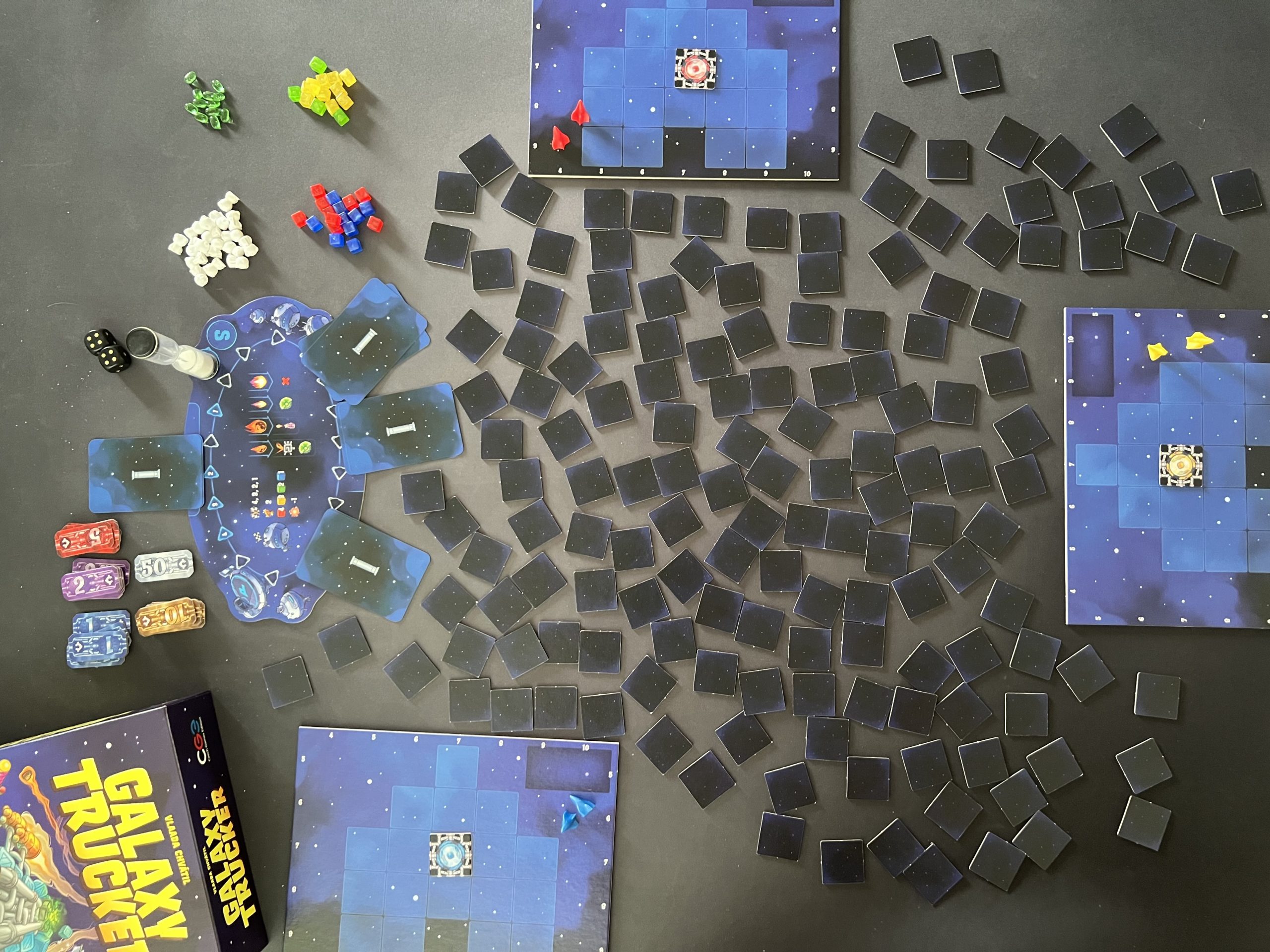
- Choosing a ship: Each player receives a ship board of the appropriate class (starting with Class I).
- Setting up the construction site: All component tiles are shuffled and placed face down in the centre of the table.
- Preparing the event deck: Prepare a small pile of event cards for the current round (the cards are marked with the numbers I, II or III depending on the round). A few cards are removed at random so that the course of the flight is never entirely predictable.
- Setting up the remaining components: Batteries, cargo, cosmonauts and dice are placed within reach of all players. The hourglass is placed next to the flight track.
Game mechanics
The game consists of two main, completely different phases:
Phase 1: Building the ship
At the signal “Let’s go!”, all players simultaneously begin to pull tiles from the centre of the table with one hand. When you pull a tile, you may:
- Keep it and fit it onto your ship (you must follow the rules for connecting pipes).
- Place it back in the centre of the table, but this time face-up so that others can see it (and take it).

Golden rules of construction:
- Pipes must match: a universal connector can be connected to any pipe, a single pipe only to a single pipe, and a double pipe only to a double pipe. Open pipes leading into empty space are extremely dangerous, as they increase the risk of damage!
- Engines must face backwards (downwards), whilst lasers must have a free square in front of them.
During construction, players may peek under the piles of event cards to prepare for the dangers awaiting them in space. When a player finishes building their ship, they place their token on their turn number (which determines their starting position in the flight) and flip the hourglass, thereby forcing the other players to finish more quickly.
Phase 2: The Flight
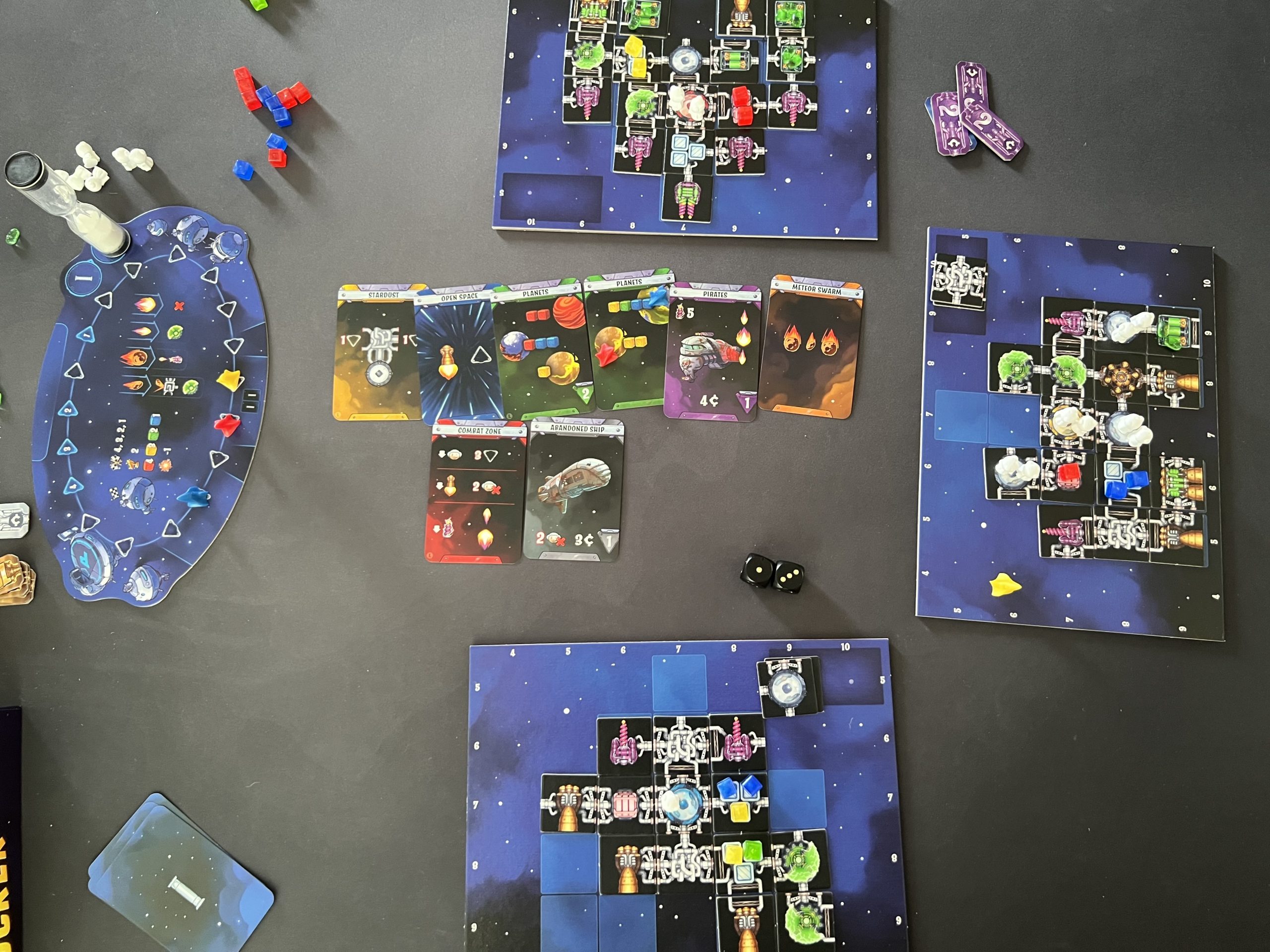
Once all the ships have been built and equipped with a crew and batteries, the real test begins. The lead player reveals one card at a time from the event pile. These events include:
- Space Routes: Where the speed of your engines is decisive. The fastest player moves up the ladder.
- Planets: An opportunity to land and send your crew to collect valuable goods (which you store in your holds).
- Meteor showers: Small and large meteors fly towards your ship from various directions. Small meteors bounce off the hull (unless they hit an open hatch) or you can deflect them with energy shields (which drain your batteries), whilst large ones must be destroyed with lasers.
- Pirates and Smugglers: Battles against enemy ships. If your firepower (lasers) is too weak, they may rob you or destroy parts of your ship.
Victory conditions
Once the flight is over, scoring takes place based on the cosmic credits earned:
- Sale of goods: Each colour of goods yields a certain number of credits (red is the most expensive, blue the cheapest).
- Ship condition: The player with the best-preserved ship (with the fewest free connectors) receives bonus credits.
- Order of arrival: The first ship to reach the finish line receives the largest cash prize.
- Penalties: You must pay a specific penalty for every tile you lose along the way.
The winner is the player who has the most cosmic credits in their pocket after three rounds (or after an agreed number of flights). As the game’s author states in the instructions: “If you’ve finished a flight with at least one credit and a functioning cockpit, you can already consider yourself the winner!”
Analysis of strategies and tactics
Although Galaxy Trucker may seem like pure chaos at first glance, experienced freighters know that a good strategy drastically increases your chances of survival.
Strategy for beginners
- Symmetry and protection: Try to build a ship with lasers evenly distributed on the left and right sides. Shields should be positioned to cover all sides.
- Don’t skimp on the crew: More cabins mean more astronauts. Without a crew, you cannot explore planets or operate abandoned ships, and you can quickly be eliminated by events that reduce your crew size.
- Connect the ducts: Avoid leaving ducts open at the edges of the ship. Every open duct is like an invitation for a meteor to tear off an entire section of your ship.
Advanced tactics for experienced players
- Speed versus safety: Sometimes it’s worth finishing your ship extremely quickly, even if it isn’t perfect. If you’re the first to take off, you’ll be the first to collect the best goods from the planets.
- Specialising in crew members: Purple crew members increase the power of your lasers by 2 points, whilst brown ones boost your engines’ power. If you manage to build a ship with the right cabins for your crew, you’ll easily defeat tough pirates.
- Tactical map checking: Whilst building, take those three seconds to check the event maps. If you see that there are no large meteors in your path, you can build a ship with fewer shields and more cargo holds.

An overview of the official expansions
Galaxy Trucker offers some excellent expansions that take the base game to a whole new level of challenge and fun.
| Expansion | What does it offer? | Is it worth buying? |
| Galaxy Trucker: Keep on Trucking | New tiles featuring unusual technologies, new support cards, new ship classes and additional challenging events. | Highly recommended! The perfect first expansion for anyone who has already mastered the base game and wants more variety. |
| Rough Road Ahead (Mini Expansion) | Cards featuring permanent challenging conditions (e.g. reduced shield effectiveness or more aggressive pirates). | Suitable only for true masochists for whom the base game no longer presents any challenge whatsoever. |
FAQ (Frequently Asked Questions)
Conclusion
Galaxy Trucker is more than just a board game – it’s an unforgettable experience, full of laughter, adrenaline and epic space disasters. If you’re looking for a game that will break the monotony of classic strategy game nights and provide top-notch entertainment for the whole group, then this is your next stop.
Get your spacesuits ready, fire up your engines and build the weirdest spaceship in the galaxy!