

Welcome to a world where your every move helps to create a living, breathing landscape. The board game Harmonies has taken the global and Slovenian board game communities by storm in an incredibly short space of time. At first glance, it may seem like just another in a long line of games that rely on stunning visuals, but appearances are deceiving here – in the best possible way. Beneath the soft pastel colours and minimalist design lies a deep, tactical and incredibly satisfying puzzle that demands players’ full attention and careful planning.
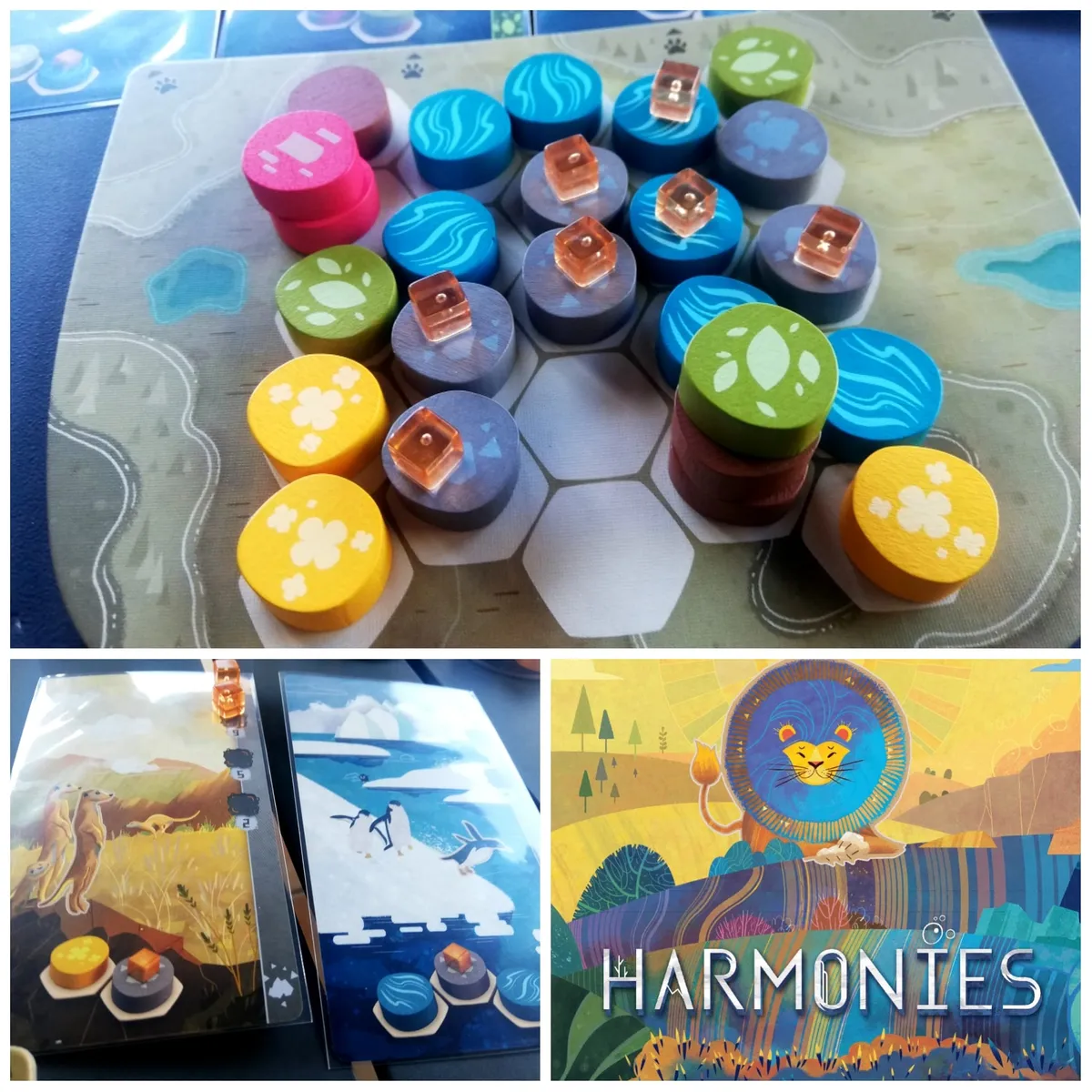
In this comprehensive guide, we’ll take a detailed look at why this game has become an indispensable part of any collection, how to set it up, what mechanics drive it, and which advanced strategies will lead you to victory. Get ready for a journey through the harmonious balance of habitats and wildlife.
Why is the game so popular?
The success of Harmonies on the Slovenian market is no coincidence. We Slovenians are a nation with strong ties to nature, hiking and environmental conservation, so the game’s theme immediately strikes a chord. However, visual appeal alone cannot keep a game on the table for months or years. The secret to Harmonies’ success lies in its psychological appeal and its ingeniously designed user experience.
The psychology of ‘world-building’
We humans have an innate desire to create order out of chaos. When you start the game, your personal board is an empty, grey grid of hexagons. With each turn, as you place wooden cylinders of different colours onto it, your landscape comes to life. Green cylinders become tree canopies, brown ones become tree trunks, grey ones become mountains, and yellow ones become fields of wheat.
This visual and tactile progression triggers micro-doses of dopamine in the brain. Every time you successfully build a three-dimensional tree or complete a mountain range, you feel a deep sense of satisfaction. The game has an almost therapeutic effect; despite the strategic thinking involved, the process of placing the pieces is calming.
The social aspect: Competitive harmony
Unlike aggressive strategy games, where you destroy each other’s armies or steal resources, Harmonies offers a form of indirect interaction. This means that players do not clash directly. Your opponent cannot destroy what you have already built on your own board. Interaction takes place entirely on the central board through the selection of resources.
This creates a pleasant atmosphere around the table. Players often watch with interest to see what landscapes their neighbours are creating and admire their solutions. As a result, the game is extremely popular amongst couples and families, as it reduces the frustration caused by direct conflict and taunting opponents (when you deliberately take a component from someone just to harm them), although the latter is certainly present at higher levels of play.
Dynamics without downtime
One of the biggest problems with modern board games is that long, tedious wait for the other players to take their turns. In Harmonies, this is practically non-existent. Because the turns are quick and the selection of tokens and cards is constantly changing, you must keep a close eye on the central board at all times. Every token taken by the player before you can dramatically alter your plans for your next move. This keeps you constantly alert and focused, so time literally flies by during the game.
Detailed instructions and gameplay
To fully appreciate the elegance of this game, we must delve into its core. Harmonies is a tile-placement and pattern-building game characterised by a vertical building component.
List of components: What’s in the box?
When you open the beautifully designed box, the first thing that will impress you is the quality of the materials. The publisher has paid great attention to durability and tactile enjoyment.
| Component | Quantity | Description and function |
| Personal landscape boards | 4 | Double-sided boards (sides A and B) for each player, on which you build your own ecosystem. |
| Central board | 1 | A board on which habitat tokens and animal cards are placed, intended for the shared pool. |
| Wooden habitat tokens | 120 | High-quality wooden cylinders in various colours (green, brown, grey, yellow, blue, red). |
| Animal cards | 32 | Cards depicting individual animals, their scoring conditions and habitat requirements. |
| Animal dice | 75 | Small acrylic cubes that you place on your cards and later on the landscape. |
| Nature Spirit Cards | 10 | Advanced cards used in the advanced game mode for asymmetrical starting conditions. |
| Nature Spirit Cubes | 4 | Small acrylic dice that you place on your cards and later on the landscape. |
| Scoring cards | 4 | Cards showing the scoring system for landscapes |
| Cloth bag | 1 | An opaque bag from which wooden habitat tokens are drawn at random. |
| Scoring pad | 1 | A notepad to make it easier to tally up the points at the end of the game. |
Setting up the game
Setting up the game is extremely quick, meaning you can start playing in under five minutes.
- Distributing the tiles: Each player receives one landscape tile. For your first game, we strongly recommend using side A. All players must use the same side.
- Placing the central board: Place this board in the centre of the table so that it is clearly visible and accessible to everyone.
- Preparing the bag: Place all the wooden habitat tokens (cylinders) into the fabric bag provided and mix them thoroughly.
- Filling the token supply: Randomly draw tokens from the bag and place them on the marked spaces on the central board in groups of three. These groups form the areas from which you will select resources during the game.
- Preparing the animal cards: Shuffle the animal cards. Turn three cards face up and place them next to the central board. Place the remaining pile next to them.
- Animal tokens: Place the animal cubes in a pile near the cards so that they are within everyone’s reach.
Game mechanics
The game proceeds in a clockwise direction. On their turn, a player must perform one mandatory action and may perform two optional actions.
1. Selecting and placing habitat tokens
A player must choose one of the groups of three tiles on the central board. They must take all three tiles from the chosen space. They must then immediately place these three tiles on their personal landscape board.
The following basic rules apply when placing tokens:
- You may place tiles on any empty hexagonal space.
- You may place tokens on top of one another, but only in accordance with the construction rules for the specific habitat (e.g. brown trunk at the bottom, green canopy on top).
- Once tokens have been placed on the board, they may not be moved or rearranged during the game.
2. Taking an animal card (Optional action)
Once during their turn, a player may take one of the three face-up animal cards from the central board and place it in front of them.
- A player may have a maximum of four uncompleted animal cards in front of them at any one time.
- When you take a card, immediately place as many animal tokens on it as there are spaces marked on the card (usually between 2 and 4).
3. Settling Animals (Optional Action)
If the pattern of tokens on your personal board matches the pattern shown on one of your animal cards, you may move one animal marker from the card onto that pattern on your board.
- The animal must be placed on a specific token within the pattern (e.g. a bear must be on top of a mountain, a bird on top of a tree).
- Only one animal may be placed on each token.
- When you remove the last animal marker from a card, that card is ‘completed’ and is set aside; it no longer counts towards the limit of four cards.
At the end of a turn, the empty space on the central board is refilled with three tokens from the bag, and the supply of animal cards is also replenished.
Winning conditions
The game inevitably nears its end when one of two conditions is met:
- The bag runs out of wooden habitat tokens to fill the central board.
- One of the players completely fills their personal landscape board (leaving two or fewer empty spaces).
Once a round is complete, with all players having taken the same number of turns, scoring takes place. The winner is the player who scores the most points. Points are derived from two main sources:
Points for landscapes (Habitats):
- Trees: You receive points based on the height of the tree (trunk + crown). Taller trees are worth more points.
- Mountains: Mountains yield points if they form a chain of two or more mountain tokens. The height of the mountains also affects the score.
- Fields (Wheat): Points are awarded based on the size of a continuous area of fields (the larger the group of fields, the more points it yields).
- Rivers (Water): A river must flow through your landscape. You receive points for the longest unbroken river.
Points for animals:
Each animal card has its own scoring table. The more markers you manage to move from a particular card onto the landscape, the exponentially more points that card will earn you at the end of the game.
Analysis of strategies and tactics
Harmonies is a game where the line between winner and loser is often determined by a difference of just two or three points. Understanding the tactical nuances is therefore crucial.
Strategy for beginners: Laying a solid foundation
If you’re just discovering the joys of this game, focus on the following guidelines:
- Don’t overdo it with animal cards: Beginners often rush to take cards, only to realise they don’t have the space or the right tokens to fulfil them. Blocked card slots prevent you from adapting your play.
- Build long rivers: A river is an excellent source of steady points. Try to start it at one edge of the board and gradually extend it towards the other.
- Verticality is your friend: Building upwards (tall trees and mountains) saves valuable space on the board. A mountain made up of three tokens takes up just one space, yet yields a good number of points whilst also serving as an excellent habitat for large beasts.
Advanced tricks for experienced players: Mastering harmony
Once you’ve mastered the basics, you need to start thinking a few moves ahead and keep an eye on your fellow players.
- Multi-purpose habitats: This is the key to top results. Your aim should be for a single mountain ridge or a single tree to fulfil the conditions for two or three different animal cards. For example, a long mountain range might be home to an ibex at one end and a bird of prey at the other.
- Tactical observation of opponents: If you notice that an opponent desperately needs blue water tokens to complete their epic river and high-scoring cards, take them away from them if it fits in with your plans even slightly. By reducing their potential, you indirectly increase your own value.
- Time management for the end of the game: If you have a significant lead in animal points, deliberately speed up the end of the game by quickly filling your board with low-value tokens. This will cut short the time your opponents need to develop their long-term strategies.
FAQ – Frequently Asked Questions
Conclusion
Harmonies is not just a board game; it is a visual and intellectual treat that successfully combines a relaxing atmosphere with a deeply strategic puzzle. Whether you’re looking for the perfect game for quiet evenings for two, or want to impress your friends at your next games night, you simply can’t go wrong with this choice. Your natural symphony is already waiting for you to put it together.