

Imagine standing in the middle of a bustling market, brimming with colours and scents, in the ‘Pink City’ of Jaipur. The air is thick with the aroma of exotic spices, the rustle of fine silk fabrics, the sparkle of glittering diamonds and the loud braying of camels waiting to be loaded with goods. In this exotic setting, you are not just an ordinary visitor, but one of the two most influential merchants in the region. Your goal? To become the maharaja’s official personal merchant! But a place at the royal court is reserved for just one – the one who, through skilful trading, calculated risks and seizing the right moment, succeeds in proving their economic superiority.

The board game Jaipur, designed by the renowned Swiss designer Sébastien Pauchon, has achieved cult status in the world of modern board games. It is considered one of the best two-player games of all time. Although at first glance it appears to be an elegant game of cards and tokens, beneath its accessible surface, Jaipur conceals risk management and a relentless psychological duel between two minds.
Why is the game so popular?
To understand why Jaipur has remained at the top of the charts for the best two-player games for years, we need to analyse its psychological structure and mechanics. Jaipur is not merely a game of scoring points; it is a sophisticated test of predicting your opponent’s moves and managing resources under time and space constraints.
The psychology of risk and patience
The heart of the psychological tension in Jaipur lies in the constant dilemma: ‘Should I sell now, or wait for one more turn?’
The game operates on the principle of falling token values and increasing bonuses for bulk sales:
- Declining token values: Tokens for individual goods are stacked from highest to lowest value. The first player to sell a good receives the highest-value tokens. This encourages you to sell quickly.
- Volume bonus: If you sell 3, 4 or 5 identical cards at the same time, you receive a special bonus token which earns you extra points. This encourages you to hoard cards in your hand.
These two conflicting mechanisms create an invisible yet extremely palpable psychological pressure. If you wait too long to collect 5 gold cards and claim the highest bonus, your opponent may sell their 2 cards first and snatch the most valuable tokens right from under your nose. If you sell too early, you risk missing out on key bonuses that often decide the winner.
The social aspect and tactical bluffing
Although this is a game without direct attacks or the destruction of opponents’ cards, the interaction between players is exceptionally strong. The marketplace is shared. Every card you take from the marketplace reveals a new card from the pile. There is constant micro-analysis: What is my opponent collecting? Do they already have two diamonds in their hand? If I take this single silk cloth card, will I reveal the next card on the marketplace – which might be gold – and thereby hand it to my opponent on a plate?
Camels play a special role. Camels do not serve directly as goods for sale (they do not yield direct points from sales), but act as your currency for exchange and as a tool for controlling the pace of the game. When you take all the camels from the market, you completely refresh the market’s supply. But in doing so, you give your opponent a prime opportunity to be the first to choose from a completely new set of cards!
Why has Jaipur become such a hit?
Board game enthusiasts appreciate games that combine depth with accessibility. Jaipur stands out for three main reasons:
- Perfect length (15–30 minutes): It’s excellent as a ‘filler’ game between longer evening sessions or as the ideal way to unwind in the evening over a cup of tea.
- Compact and portable: The box doesn’t take up much space, so players often take it with them on holiday, to the countryside or to a café.
- Exceptional balance: Thanks to the ‘best of three’ system, the element of chance when drawing cards is eliminated, allowing pure tactics to come to the fore.
Detailed instructions and gameplay
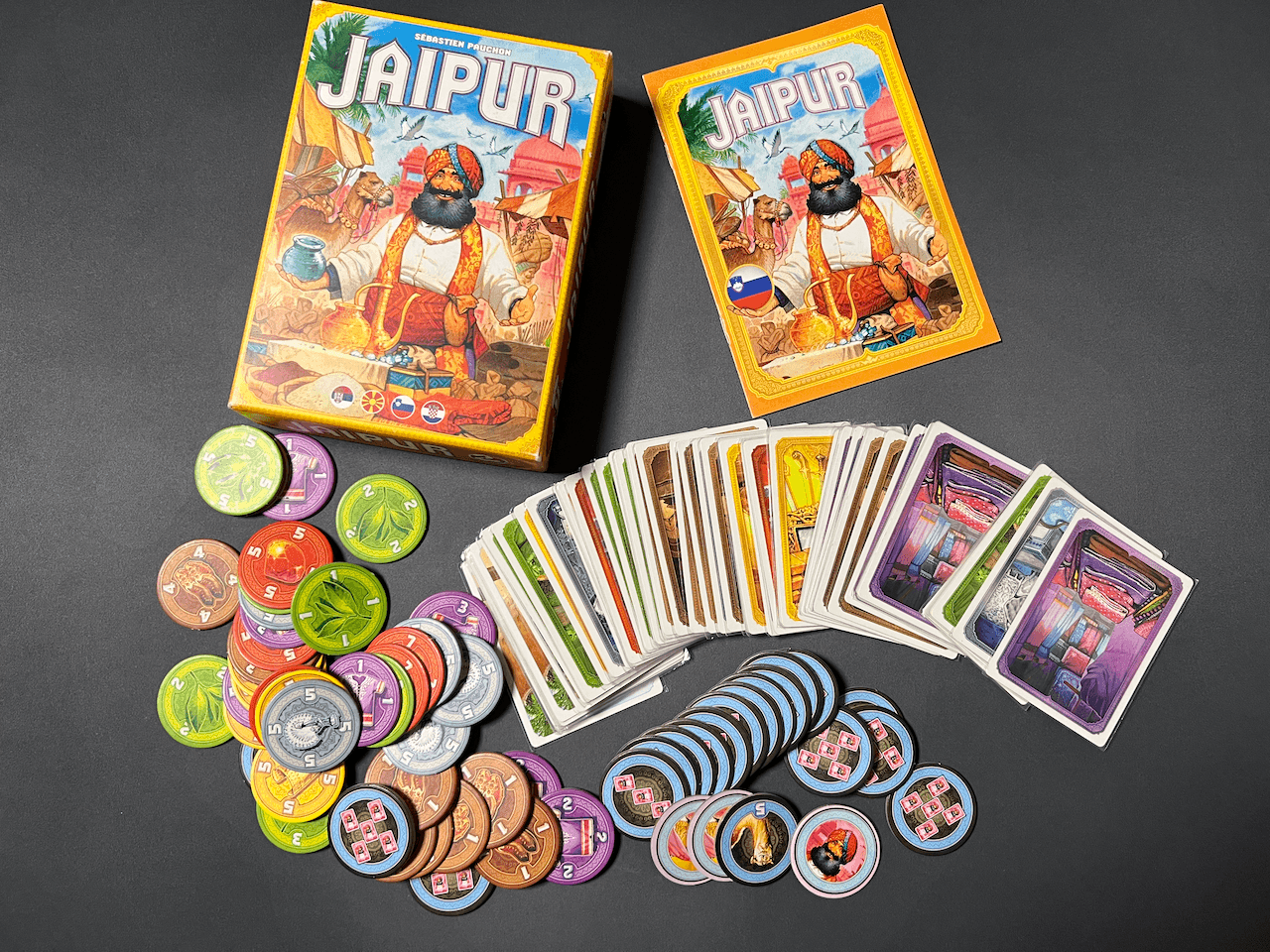
List of components: What’s in the box?
The game boasts superb build quality and a distinctive visual style:
- 55 cards:
- 6x Diamonds (red)
- 6x Gold (yellow)
- 6x Silver (blue)
- 8x Silk (purple)
- 8x Spices (green)
- 10x Leather (brown)
- 11x Camels
- 38 Goods Tokens:
- Tokens for each of the 6 types of goods, with different values on the reverse.
- 18 bonus tokens ():
- 7x bonus tokens for selling 3 cards
- 6x bonus tokens for selling 4 cards
- 5x bonus tokens for selling 5 or more cards
- 1 token for the largest camel herd (Camel Token): Awards 5 extra points at the end of the round.
- 3 Seals of Excellence: Tokens that indicate victory in a particular round.
Setting up the game
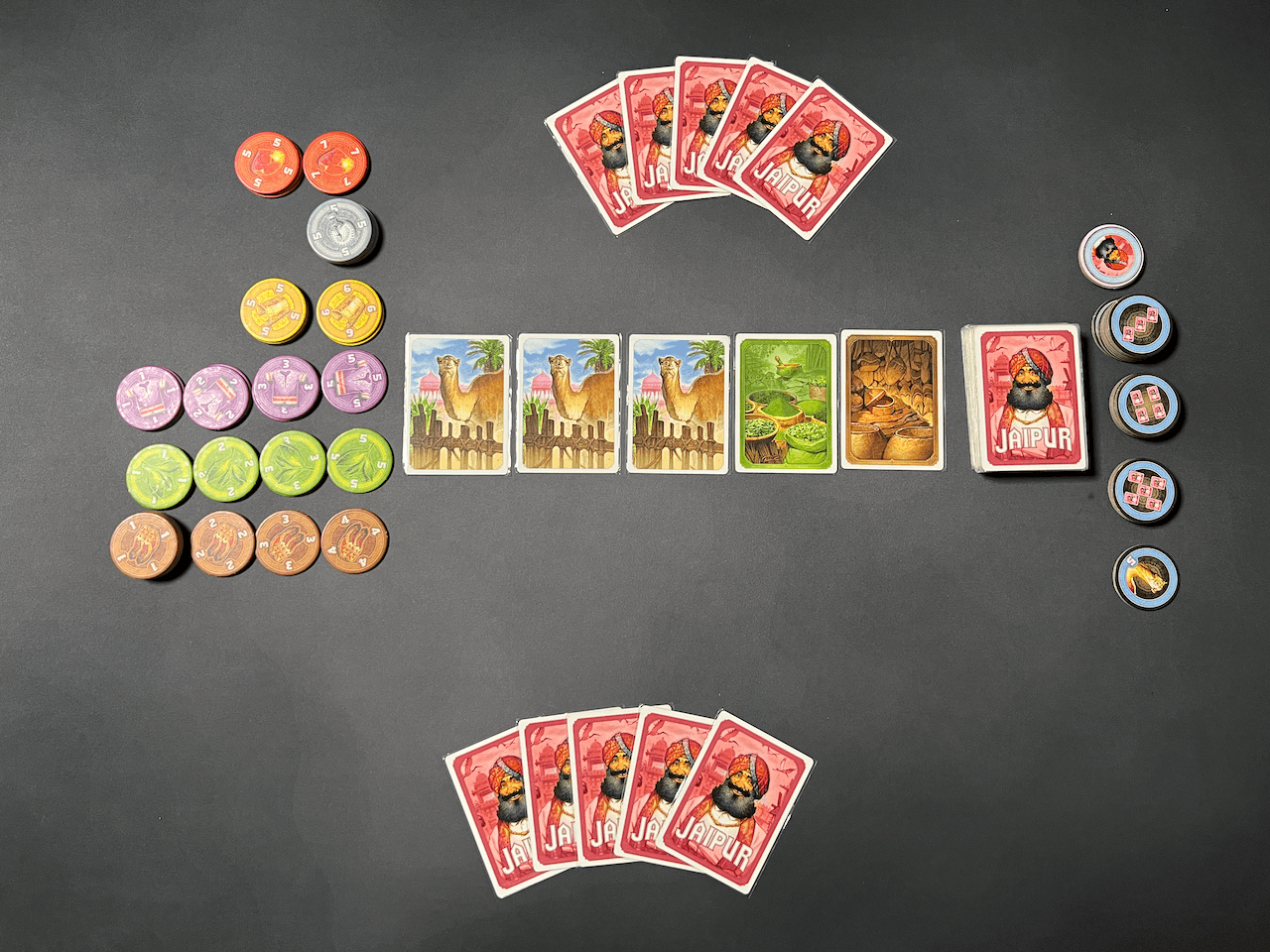
Setting up Jaipur is extremely quick and simple. Follow these steps:
- Setting up the market: Place 3 camel cards in a horizontal row between the players.
- Preparing the draw pile and dealing cards: Shuffle the remaining cards (camels and goods) thoroughly. Deal 5 cards to each player. Place the remaining cards as a face-down draw pile.
- Completing the market: Draw 2 cards from the top of the draw pile and place them next to the three camels. There are now a total of 5 cards on the market (a mix of camels and goods).
- Camel herd: If players have any camels in their hands, they must immediately remove them from their hand and place them in front of them in an open pile, which represents their camel herd. Note: Camels never count towards the hand limit!
- Sorting the tokens:
- Sort the commodity tokens by type (diamonds, gold, silver, cloth, spices, leather). Arrange each type from the highest value at the top to the lowest at the bottom.
- Shuffle the bonus tokens (for 3, 4 and 5 cards) separately and form three face-down piles.
- Set the camel token and the 3 seals of excellence aside.
Game mechanics: Detailed description of turns
Players take turns. On your turn, you must choose exactly one of the two main actions: DRAW CARDS or SELL CARDS. You cannot perform both at the same time or skip your turn.
Action A: TAKE CARDS
If you decide to take cards from the market, you have 3 options:
- Take 1 single resource: You take one resource card from the market into your hand. You immediately draw a new card from the top of the deck and place it in an empty space on the market.
- Exchange multiple cards: You take 2 or more resource cards from the market. In return, you must return the same number of cards from your hand to the market (this can be a combination of resource cards and camels from your herd).
- Strict rule: You may not swap the same type of resource (e.g. you may not take a diamond from the market and return another diamond from your hand to the market). One-for-one swaps are also not permitted.
- Take all the camels: Take all the camels currently on the market and add them to your herd in front of you. Then refresh the market by drawing enough cards from the top of the deck to ensure there are 5 cards on the market again.
Important rule regarding cards in hand: At the end of their turn, a player must not have more than 7 cards in their hand (camels in the herd do not count towards this limit).
Action B: SELLING CARDS
Selling is the primary way to earn points (rupees).
- Choose a single type of resource from your hand and discard any number of cards of that type to the discard pile.
- Take as many tokens of that resource from the top of the corresponding pile as the number of cards you have discarded (starting with the highest-value ones).
- Bonus for larger sales: If you have discarded 3, 4 or 5 (or more) cards at once, take the top bonus token from the corresponding pile (3, 4 or 5).
- Restriction on expensive resources: When selling diamonds, gold and silver, you must discard at least 2 cards at the same time. A single diamond, gold or silver cannot be sold on its own!
Winning conditions
A round ends immediately when one of the following two conditions is met:
- All 3 types of commodity tokens are completely used up.
- The draw pile is empty and it is no longer possible to replenish the market to 5 cards.
Scoring at the end of the round:
- The player who has strictly more camels in their herd than their opponent receives a camel token worth 5 points. (If the numbers are equal, neither player receives a token).
- The players add up all the values on their resource tokens and bonus tokens.
- The player with the higher total score receives 1 Seal of Excellence.
- In the event of a tie, the player with more bonus tokens wins. If this is also a tie, the player with more resource tokens wins.
The game is played to two wins. The first player to collect 2 Seals of Excellence becomes the winner of the entire game and the new Royal Merchant!

Analysis of strategies and tactics
Jaipur is a game of micromanagement. It starts as a simple card-collecting game, but at a high level it becomes a veritable chess battle.
Strategy for beginners
If you’re just starting out, follow these golden rules:
- Focus on valuable goods: Diamonds, gold and silver have exceptionally high starting token values (diamonds start at 7 points!). Collecting these goods in pairs is the simplest way to secure a steady stream of points.
- Don’t overlook the bonuses: Selling three or more leather or spice resources may seem insignificant, but the bonus tokens (especially those for 5 cards, which yield between 8 and 10 points) are often the deciding factor.
- Watch out for the 7-card limit: Don’t let a full hand force you into making a sub-optimal sale.
Advanced tricks and tactics for experienced players
Once you’ve mastered the basics, the game shifts to managing the market and dictating the pace to your opponent:
1. The camel-steering trap
Collecting all the camels from the market is tempting, as it increases your herd. But be careful: if there are 4 or 5 camels in the market and you take them all, you must immediately refill the market with 4 or 5 new cards from the draw pile! By doing so, you’re giving your opponent a free first look and the chance to choose from a completely new selection of goods (perhaps two diamonds or gold).
- Advanced tip: Collect camels when your opponent already has 7 cards in their hand! Even if excellent cards appear in the market, your opponent won’t be able to simply take them, but will have to make a swap or sell cards.
2. Draining the market
If you notice that tokens are running low, you can deliberately make a trade by placing your camels on the market and taking resources. If you flood the market with camels, you’ll force your opponent to take the camels and draw new cards, or waste turns on trades.
3. Controlling the end of the round
As the round ends as soon as 3 types of tokens run out, the player in the lead can deliberately speed up the end of the round. If you realise you have the upper hand, start selling individual leather or fabric cards to clear the third pile of tokens as quickly as possible and prevent your opponent from forming larger combinations.
Conclusion
If you’re looking for the perfect game for two that will captivate you time and time again and offer an excellent balance between light-hearted fun and strategic thinking, Jaipur is an essential addition to your collection. Thanks to its simple elegance, top-quality components and the thrill of trading, it’s the ideal choice for both casual players and experienced gamers.
At druzabneigre.si, we ensure that your experience is as enjoyable as a successful trading move:
- Fast and reliable delivery: Your new favourite game will be with you at home in the shortest possible time.
- Friendly Slovenian customer support: We’re here to answer all your questions and advise you on choosing the right games to suit your tastes.
- Guaranteed quality: We offer only original, top-quality board games from world-renowned publishers.
Join thousands of satisfied players and put your trading skills to the test!