
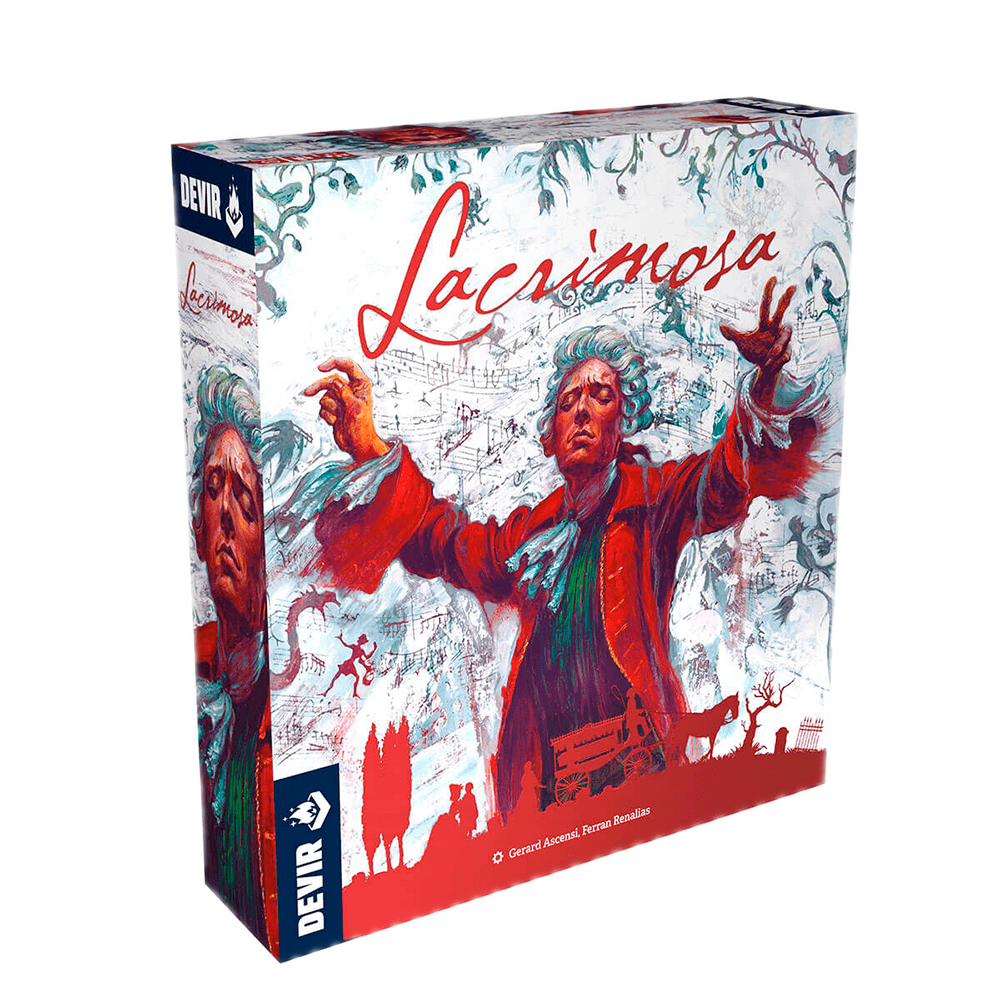



Description
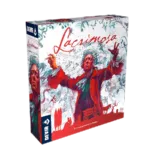
In December 1791, at the age of 34, Wolfgang Amadeus Mozart wrote the last eight bars of his life on his deathbed: the Lacrimosa from his Requiem in D minor. His widow Constanze called on his most generous patrons to help her complete the work. In Lacrimosa you are one of those patrons, sitting with her in a Viennese café and talking about your memories of Mozart. Each of you wants Constanze to record you in her memoirs as the genius's most important supporter.
How to play Lacrimosa
The game lasts five rounds, each representing one period of Mozart's life. On your turn you play two memory cards from your hand. The top card determines your action, while the bottom card gives you story points in the next round, which you use to pay for actions. There are five actions: add a new memory to your deck, commission a work by Mozart, perform or sell it, travel with Mozart to the courts and cities of Europe, or hire a composer for a part of the Requiem.
At the end of the game, for each movement of the Requiem you determine which composer contributed the most parts. Patrons who supported that composer's work score more points, the others fewer. Points also come from works, travels, royal courts, and leftover money and story points. The patron with the most points wins.
Why you will love it
- Every card has two roles: if you use it for an action now, you won't have it for story points in the next round.
- Your deck always has nine cards, and you replace weaker memories with better ones from new periods.
- Everyone moves Mozart around the map of Europe, so where you leave him matters to the other players too.
- The solo mode against the opponent Schikaneder has three difficulty levels.
Who Lacrimosa is for
The game plays with one to four players, and players like it best with three. It is suitable from age 14, and a game takes about 90 minutes. It is a medium-weight game, so it will appeal to experienced players who enjoy strategy games, as well as to lovers of music and history. Actions on the cards are shown with symbols, and the work cards carry only the titles of Mozart's compositions.
What you might not like
The game has many types of points, symbols and small rules, so the first game is slower, and it may not suit those who prefer quick and simple games.
What's in the box
- main board and 4 player boards
- 40 starting cards, 34 memory cards and 46 work cards
- 60 composer tiles and 4 composer portrait tiles
- 15 city tiles, 16 royal court tiles and 15 period tiles
- 5 Constanze cards and 10 Constanze tokens
- 45 story point tokens and 30 coins
- 48 player figures, 4 neutral Requiem markers, the Mozart travel marker and the first player marker
- 4 scoring tokens and 4 reference tiles
- 11 solo mode cards
- rules