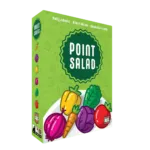







Description
Carrots, peppers, tomatoes, lettuce, onions and cabbage. Point Salad has 108 cards, and each one scores differently. One gives two points for every carrot and takes away a point for every onion, another rewards whoever has the most onions. Which vegetables are good therefore depends on the point cards you have chosen.
How to play Point Salad
There are three piles of cards on the table, point side up. Below each pile lie two face-up vegetables. On your turn you take one point card from the top of any pile or two vegetables from the market and place them in front of you. Once per turn you may flip one of your point cards to its vegetable side, but never the other way round. Empty spaces in the market are refilled with cards from the pile above them.
The game ends when all the cards have been taken. Each point card counts all of your vegetables, so the same vegetable scores on several cards. The player with the most points wins.
Why you will like it
- The same carrot can score points on three cards at once.
- A point card that nobody takes flips into a vegetable in the market, and its rule disappears.
- A point card that doesn't work out for you can later be flipped into a vegetable.
- Some cards reward only the player with the most of a certain vegetable, so it pays to keep an eye on your neighbours too.
Who is Point Salad for
The game is for two to six players aged 10 and up, and it takes 15 to 30 minutes to play. The rules are simple, and explaining them takes no longer than a single turn. Players like it best with three. It suits families, beginners and as a quick game between longer ones. Because it is short, the rules suggest playing several rounds in a row and adding up the points.
The cards show symbols and the English names of the vegetables, and the rules are in English.
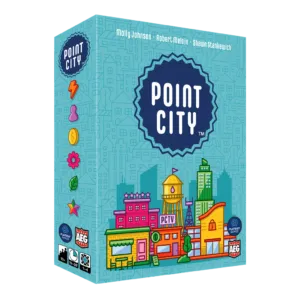
From the same series our shop also carries Point City and Point Galaxy.
What you might not like
In a larger group the market mostly changes before your next turn, so planning ahead rarely works out. You have more control when playing with two or three. The game is short and light, so it may not hold the interest of those looking for deeper strategy for long.
What's in the box
- 108 double-sided cards: 18 for each of the six vegetable types, with 108 different scoring rules on the other side
- rules in English