
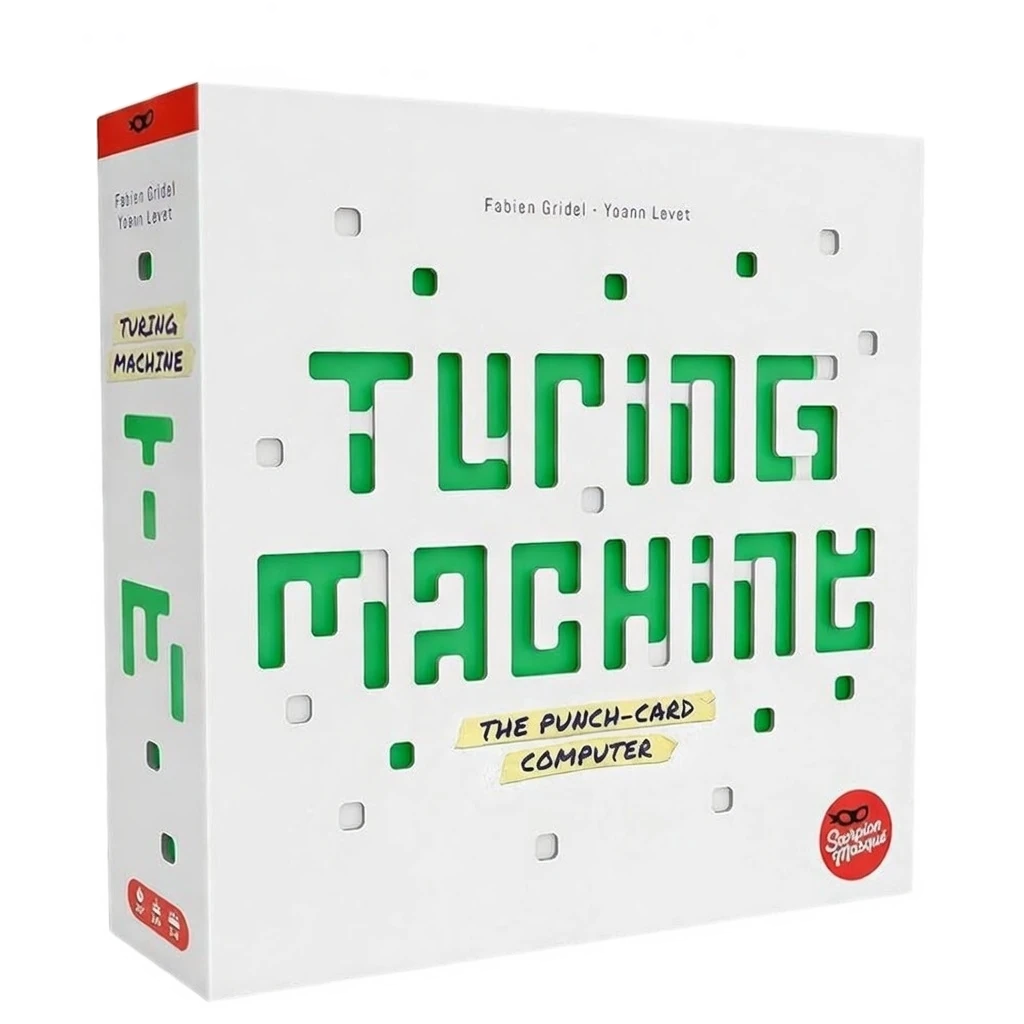



Description
A computer that runs on punch cards instead of electricity. In Turing Machine you try to be the first to work out a secret three-digit code. You don't question the other players but the verifiers: each one checks a single property of the code, and you piece the solution together from their answers.
How to play Turing Machine
The code is made up of a blue, a yellow and a purple digit, each from 1 to 5. Everyone plays each round at the same time. You build your guess from punch cards, then question up to three verifiers. You place a verification card under your guess and see the answer through its only hole: the guess either passes the test or it doesn't. You note down the answers and work out which property each verifier is checking.
At the end of the round, everyone shows a thumb up at the same time if they think they have the code, or a thumb down if not. Players with their thumb up check their code against the solutions. If more than one player has found it, the one who asked the fewest questions wins.
Why you'll like it
- The punch cards are a real little machine on the table, and the answer appears through a single hole.
- The booklet has 20 problems, and the game's website has millions more.
- Every question counts, so a well-thought-out guess really pays off.
- You can play solo, together or competitively, and the harder Extreme and Nightmare modes add an extra challenge.
Who is Turing Machine for
The game is for 1 to 4 players aged 14 and up, and one problem takes about 20 minutes. It is fairly easy to learn and plays best solo. It will appeal to fans of logic puzzles, maths and deduction. The criteria cards have some English text, and the rules are in English too.
What might you not like?
If you don't enjoy note-taking and careful reasoning, a more relaxed game will suit you better. There is hardly any interaction between players: everyone solves the same problem on their own, and there is little conversation at the table.
What's in the box
- machine board and punch-card stand
- 45 punch cards in three colours
- criteria cards and verification cards
- 50 note sheets
- player aids that also serve as screens
- booklet with 20 problems, and the rules