
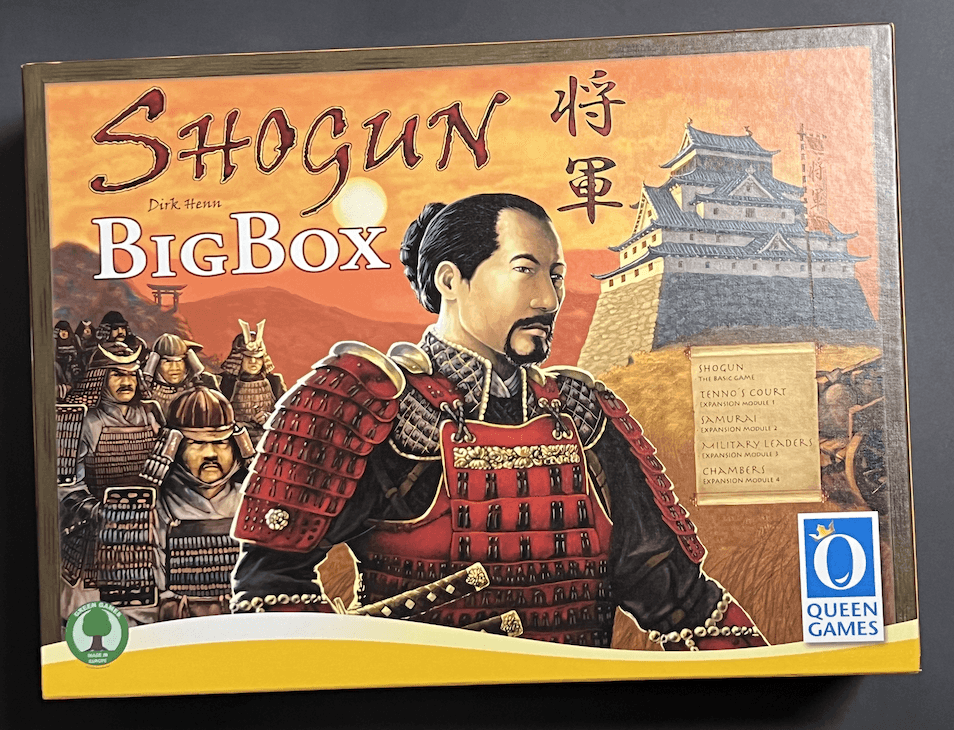
Welcome to feudal Japan, where players take on the role of daimyos competing for control of provinces, gathering rice and money, building up their lands and planning military campaigns. Shogun Big Box is a strategy board game by Dirk Henn that combines territorial control, resource management, hidden action planning and the distinctive cube tower used to resolve battles.
What makes the game special is above all that players plan their actions in advance, and their plans are then carried out in a set order. Players have to keep in mind both their own goals and the moves of the other players.
Why is the game interesting?
Hidden action planning
One of the core mechanics of Shogun is planning your actions in advance. Players have to assign their provinces to different actions without knowing exactly how their opponents will assign theirs.
You have to decide where to collect taxes, where to grow rice, where to build, where to recruit soldiers and where to move your armies. Because the actions are carried out in a set order, it also matters when each action takes place. Make sure nobody takes over a province where you wanted to do something important.
This kind of planning creates interesting decisions: will you first strengthen the province you want to defend, or will you risk an attack on a neighbouring territory?

The cube tower
One of the most recognisable elements of the game is the cube tower, which is used to resolve battles.
When a battle breaks out, the attacker's and defender's cubes are added to the tower. Some of the cubes can get stuck inside the tower, while others fall into the tray at the bottom. The outcome of a battle therefore depends not only on the current fight but also on the cubes left in the tower from earlier battles.

Because of this, even seemingly simple battles can be unpredictable. At the same time, players can keep track of which cubes have stayed in the tower and take that into account in their later decisions.
Resource management
Military expansion is not the only path to success. Players also have to look after their economy.
Rice is needed to feed your armies, while money lets you build and take other important actions. Collecting taxes brings in money, but it also makes the peasants more discontented. Poor resource management can therefore cause trouble just when you least expect it.
A game for different groups of players
Shogun combines several kinds of decisions: planning, resource management, territorial control and military conflict. Because of this, players can approach victory in different ways.
Both expanding across the map and developing the provinces you already hold, by building castles, temples and theatres, are important.
Detailed rules and how the game plays
What's in the box?
Shogun Big Box contains the base game Shogun, the expansion Tenno's Court and three additional modules: Samurai, Military Leaders and Chambers.
The base contents include, among other things:
- a double-sided game board,
- 5 player boards,
- province and action cards,
- 310 coloured army cubes,
- 20 green peasant cubes,
- 55 chests representing money,
- 80 building tiles,
- 42 revolt tokens,
- victory point and rice markers,
- the cube tower,
- components for the Tenno's Court expansion and the additional modules.

Setting up the game
Before your first game you need to set up the game board, the starting supplies and the starting provinces. The procedure below applies to the base game without the additional modules from the Big Box.

1. Choose a side of the game board
The game board is double-sided. Choose the side marked sun or moon and place it in the middle of the table. The two sides have a slightly different layout of provinces but use the same basic rules.
Then remove from the deck of province cards those cards that don't match the chosen side of the board. In a three-player game, special rules also apply to the provinces marked as unused in this setup.
2. Each player chooses a colour
Each player chooses one of the available colours and takes:
- their player board,
- 62 army cubes in the chosen colour,
- a Daimyo card,
- a set of bidding cards,
- the starting amount of money.
The starting amount of money depends on the number of players:
- 3 players: each receives 18 chests,
- 4 players: each receives 15 chests,
- 5 players: each receives 12 chests.
Army cubes and money must be visible to all players throughout the game.
3. Prepare the starting armies
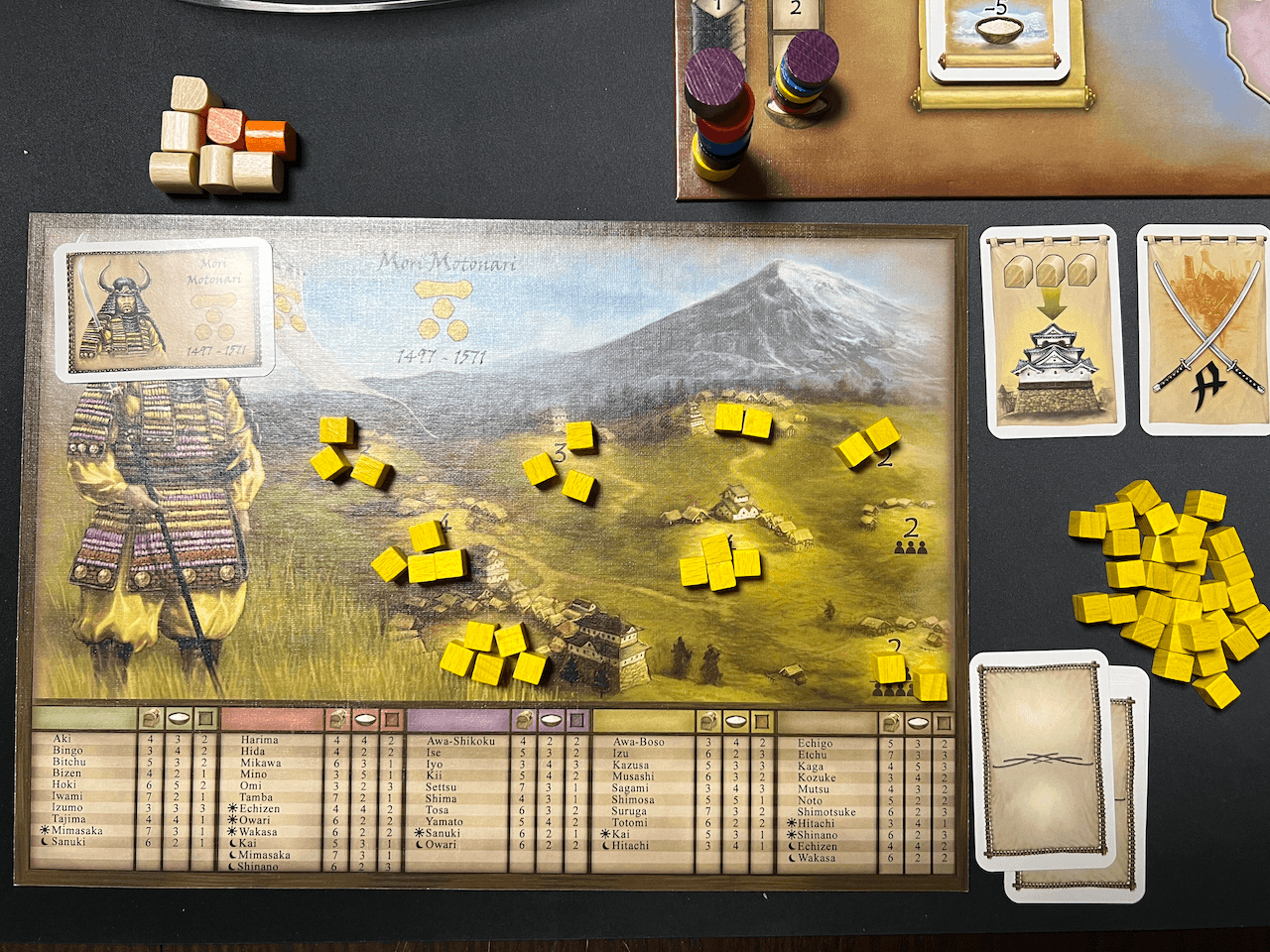
Each player's board has several areas for starting groups of soldiers. Place as many army cubes on each area as the number shown on it.
These groups are your starting armies. Different areas of the player boards are used depending on the number of players. A three-player game uses more starting groups than a five-player game.
4. Distribute the starting provinces
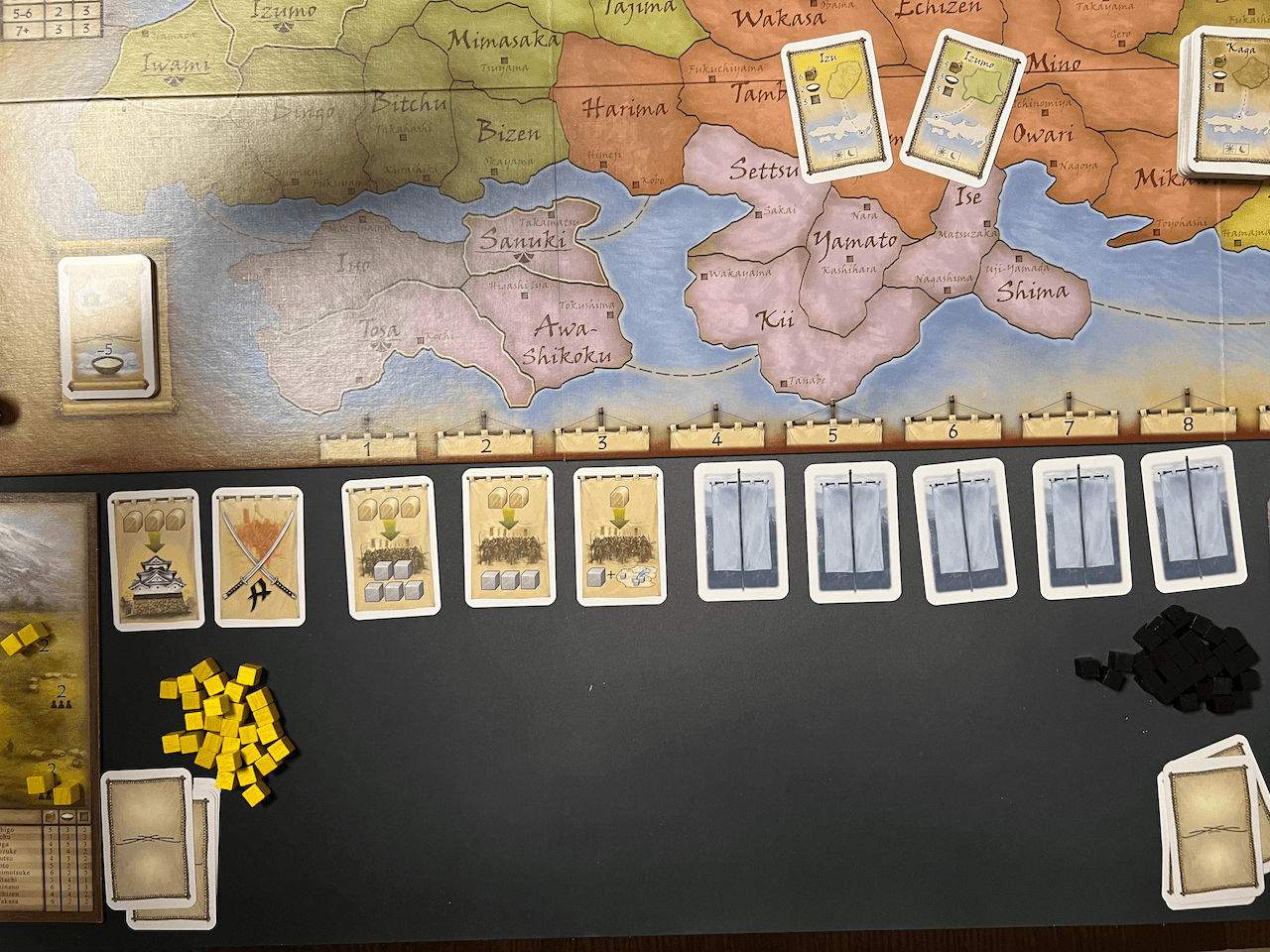
Shuffle the province cards and place them face down in a pile. Then reveal two province cards.
Players then take turns choosing their starting provinces. On their turn, a player can choose one of the two revealed cards or draw the top card of the pile blind. They then take one of the starting army groups from their player board and place it in the chosen province on the map.
They keep the chosen province card in their hand.
This is repeated until all players have placed all of their starting army groups. In this way, each player starts the game with several provinces, each holding one of their starting armies.
For your first game you can also use the suggested starting setup from the rules, which saves players some time and gets the game going faster.
5. Prepare the general supply
Place the general supply next to the game board:
- the remaining army cubes,
- the green peasant cubes,
- the chests, i.e. the money,
- the castle, temple and theatre tiles,
- the unrest tokens,
- the rice markers,
- the victory point markers.
Each player places their victory point marker on the starting space of the track. They also set their rice marker to the starting value of 0.
6. Prepare the cards
Prepare the province cards, action cards, events and other cards used in the base game separately and shuffle them.
The action and event cards will determine the order of actions and the special effects of each season. The chest cards are used to determine the turn order.
7. Prepare the cube tower
Assemble the cube tower and place it where all players can reach it. The tower is used in every battle, so leave enough room during the game to drop army cubes into it easily.
Before the game starts, 10 green peasant cubes and 7 army cubes for each player are put into the tower, as set out in the rules. Cubes that fall through the tower go back to their respective supplies.

Once all players have placed their starting provinces and armies, and the general supply, the cards and the cube tower are ready, the game can begin.
For your first game we recommend the base game without the additional modules. Once players know the basic mechanics of action planning, managing rice and money, and fighting, they can gradually add the modules from Shogun Big Box in later games.
How does the game play?
Shogun is played over two years. Each year is divided into four seasons: spring, summer, autumn and winter. Spring, summer and autumn are action seasons, while winter is for settling accounts and checking supplies.
In the action seasons, players plan and carry out various actions, including:
- building (castles, temples and theatres),
- collecting taxes,
- growing rice,
- recruiting soldiers,
- moving armies or attacking neighbouring provinces,
1. Revealing the event and the order
At the start of each action season, the events and the order of actions are determined. This lets players take into account, while planning, which actions will be carried out earlier and which later.
2. Hidden planning
Players assign their provinces to the action spaces on their player boards. In doing so, they have to anticipate what their opponents might do. They also bid chests for the turn order.
For example: if you expect an attack on a particular province, you can strengthen it, but in doing so you may have to sacrifice another province.
3. Carrying out the actions
The actions are then carried out in the set order.
When building, players can place castles, temples or theatres in their provinces. By controlling provinces they can also gain resources for further expansion and development.
With military actions, armies move between neighbouring provinces. If the target province is controlled by another player or by peasants, a battle takes place.
4. Resolving battles with the cube tower
In a battle, the relevant army cubes are dropped into the cube tower. The attacker must always leave at least one cube in their own province. The cubes that fall into the bottom tray determine the outcome of the battle.
Cubes that remain in the tower can affect the outcome of future battles. That is exactly why the cube tower is not just a way of producing a random result, but also part of the wider game of managing risk.
The peasants also play a part in deciding the outcome. Peasants in a province without a revolt help the defender, while peasants in a province with a revolt help the attacker.
5. Winter
After the three action seasons, winter arrives. Players then check their rice supplies and carry out the winter accounting.
Each player has to provide for their provinces and army. A shortage of rice can have serious consequences, so planning food production is an important part of the game. To feed the army and the provinces, we need 1 rice for each province, and we also need rice for the event card. If we don't have enough rice, revolts break out.
After the revolts, buildings and other elements of the game are scored.
- 1 point for each province
- 1 point for each building
- 1 point for the most theatres in a region
- 2 points for the most temples in a region
- 3 points for the most castles in a region
If players are tied for the most buildings of a type in a region, each of them gets -1 point for that scoring. So if 3 players were tied for the most temples in a region, each would get 1 point instead of 2.
How do you win?
The goal of the game is to have the most victory points at the end of the second year.
Players score points by controlling provinces, constructing various buildings and winning majorities in individual regions.
When the additional modules are used, there can also be extra ways to score points.
Strategies and tips
For beginners
1. Don't forget the rice.
Expanding your territory is important, but more provinces also mean greater demand for resources. Before any larger military action, check that you'll have enough rice.
2. Don't neglect your economy.
You need money to develop your territory, so simply conquering provinces is not enough.
3. Think ahead.
Because you plan your actions before they are carried out, try to anticipate which provinces will matter later in the season.
4. Watch your opponents.
In Shogun, it's not only what you want to do yourself that matters. It's also important which provinces your opponents need and where they are preparing to attack.
For experienced players
Keep an eye on the cube tower.
Cubes that stay in the tower can affect future battles. That's why in some situations it pays to take past battles into account as well.
Think about the order of actions.
The same action can have a completely different effect depending on whether it is carried out before or after another player's action.
Manage your risk.
Sometimes the biggest possible attack is not the best decision. What matters is how many troops you could lose, what you will gain and how the move will affect the rest of the year.
Expansions and modules in Shogun Big Box
Shogun Big Box contains the base game plus Tenno's Court and three additional modules: Samurai, Military Leaders and Chambers.
Tenno's Court
Tenno's Court lets players take part in the imperial court. Using the additional components, they can win the emperor's favour and various benefits. The expansion thus adds competition for influence at court to the basic territorial control.
Samurai
The Samurai module lets players earn various bonuses if they meet a condition for controlling provinces in different regions. Bonuses can include money, rice, armies or victory points.
Military Leaders
Each player gets a military leader they can use in their provinces. The leader provides various benefits for actions in that province, such as lower building costs or extra resources.
Chambers
The Chambers module adds a new area of competition for influence. Depending on their control of regions, players gain positions in various chambers, and the final standings award additional victory points.
FAQ – Frequently asked questions
Conclusion
Shogun Big Box combines several strategic elements: territorial control, resource management, hidden action planning and battles with the cube tower. The base game already offers plenty of different decisions on its own, and the additional modules in the Big Box allow even more ways to play.
If you like strategy games where you have to plan your moves in advance while keeping an eye on what the other players are doing, Shogun is an interesting choice for a group of players.