

Why is the game popular?
In this day and age, when digital screens constantly bombard us with information and rapid stimuli, board games offer a refuge of genuine human connection. Among the many titles that have won the hearts of Slovenian families, friends and casual players over the last decade, Sushi Go! – designed by Phil Walker-Harding, a master of accessible party games – holds a special place. Why has this seemingly simple card game become a genuine cultural phenomenon? The answer lies in the unique interplay of the psychology of play and game mechanics that encourage both laughter and healthy competition.
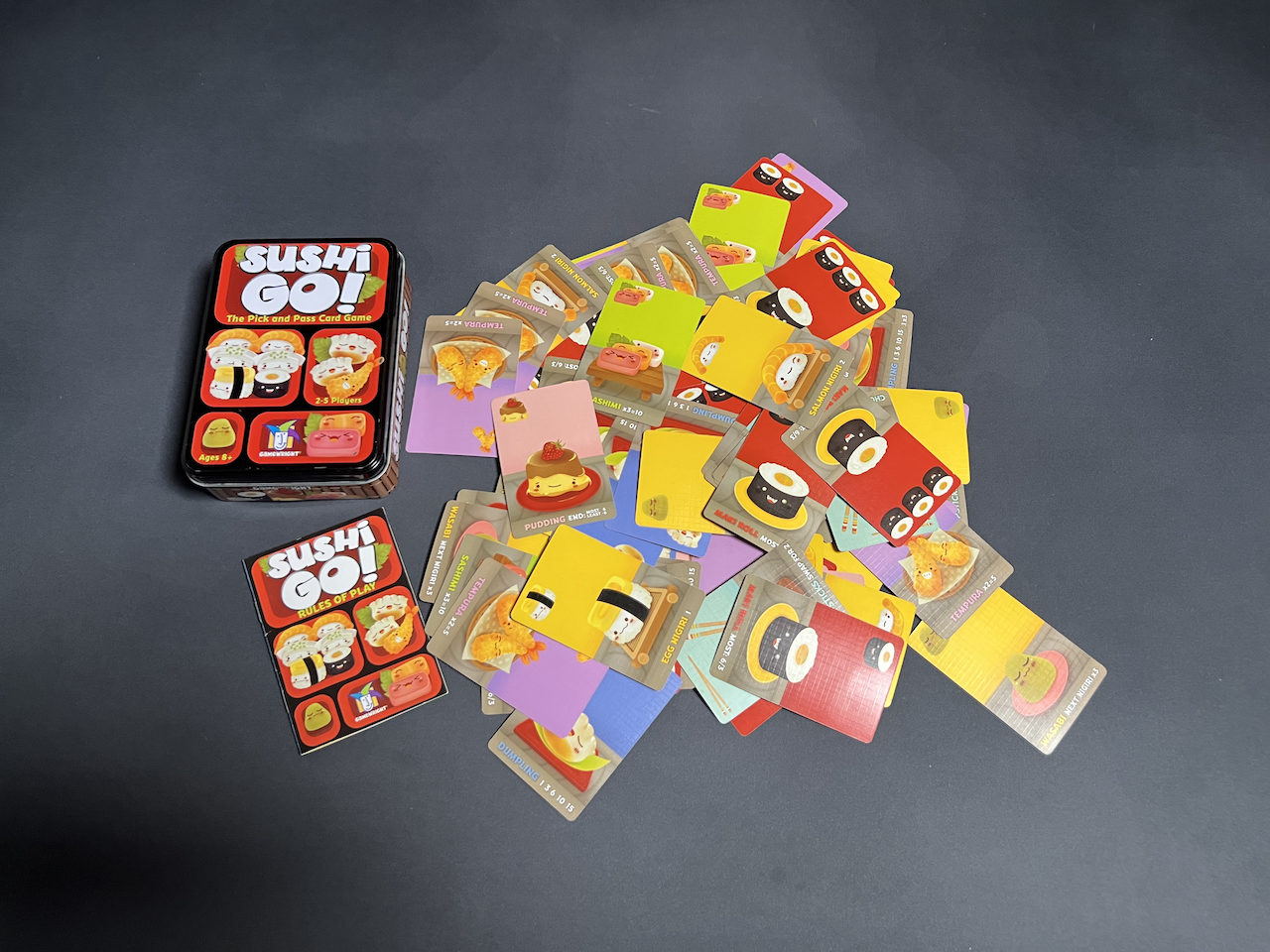
From a psychological perspective, Sushi Go! exploits the so-called ‘just one more round’ phenomenon. Each individual game lasts a mere fifteen minutes, which leaves players no time to get bored, whilst at the same time creating an irresistible desire for revenge or a rematch. As players gaze at the charming, caricatured illustrations of various Japanese dishes with their big, endearing eyes, the brain releases endorphins that reduce stress. The social aspect of the game is simply brilliant. As all players choose their cards at the same time and then pass them on, there’s none of that awkward waiting for a turn, which can sometimes kill the momentum in more complex strategic games.
In Slovenia, where we value genuine company, good food and relaxed conversation over a cup of coffee or a glass of wine, Sushi Go! has proved to be the perfect gateway into the world of modern board games. It’s a game that transcends generational divides – eight-year-olds, their parents and even their grandparents can play it at the same table with equal ease and enthusiasm. The speed at which the cards are passed creates a unique group dynamic, where laughter mingles with frustrated sighs when someone snatches the last fresh piece of sashimi from right under someone’s nose.
Detailed instructions and gameplay
List of components: What’s in the box?
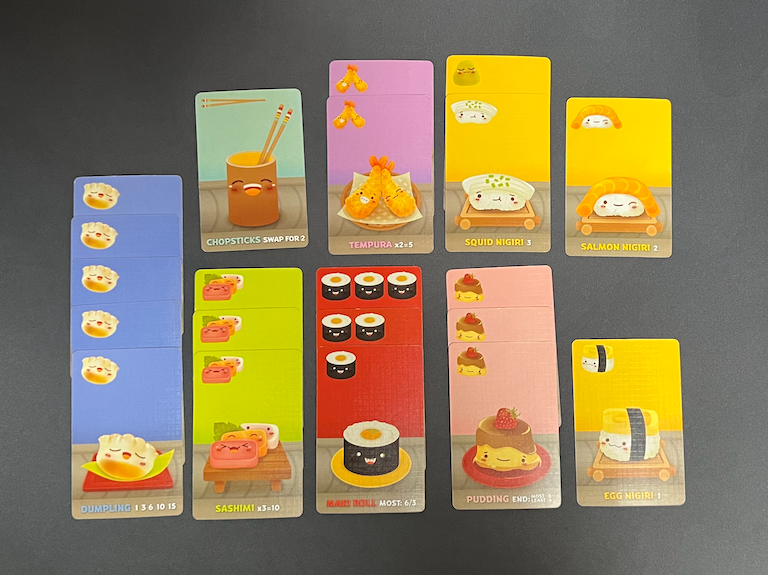
Sushi Go! impresses with its compact metal box, which is durable and perfect for travelling. Inside, you’ll find exactly 108 high-quality cards with a special coating that can withstand countless shuffles. Here are the key ingredients of our game menu:
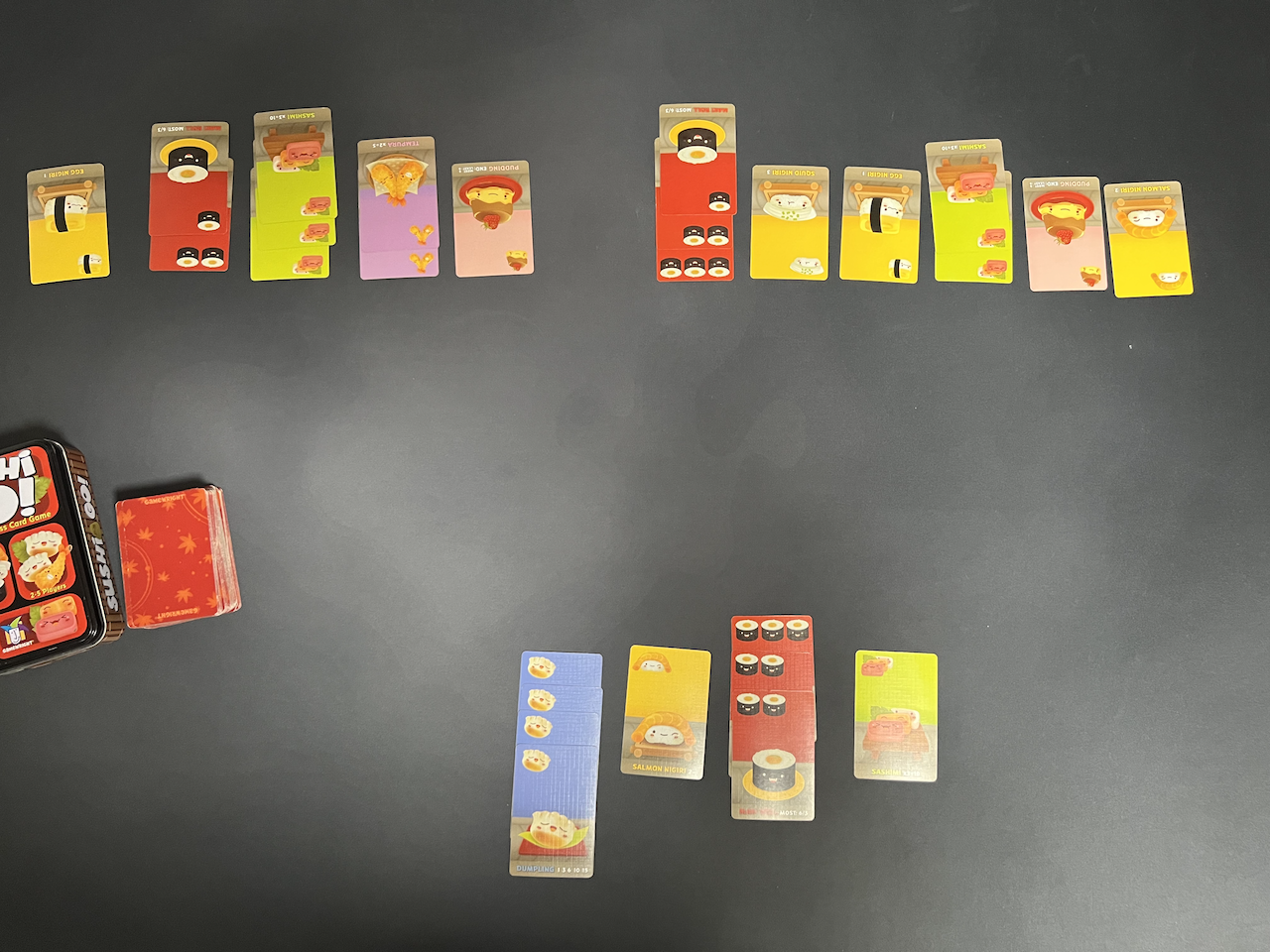
- Tempura (14 cards): A pair of fried prawns scores a delicious 5 points, whilst a single one brings disappointment and 0 points.
- Sashimi (14 cards): A set of three pieces of raw fish is worth a full 10 points, whilst a smaller number counts for nothing.
- Dumplings / Gyoza (14 cards): The more you have in your collection, the greater the reward (from 1 point for one to 15 points for five or more).
- Maki rolls (26 cards): Cards featuring one, two or three red rolls, which at the end of the round award bonus points to the player with the most rolls (6 points) and the runner-up with the most rolls (3 points).
- Salmon Nigiri (10 cards), Squid Nigiri (5 cards) and Egg Nigiri (5 cards): Quick points (2, 3 and 1 point respectively) that can be combined with wasabi.
- Wasabi (6 cards): A magical green paste that triples the points of the next nigiri you choose (making it worth three times as much!).
- Chopsticks (4 cards): A unique tool that allows you to take two cards at once in a later round.
- Puddings (10 cards): A dessert that isn’t scored immediately, but is accumulated throughout all three rounds of the game – at the end, it brings either a great reward or a painful penalty.
Setting up the game
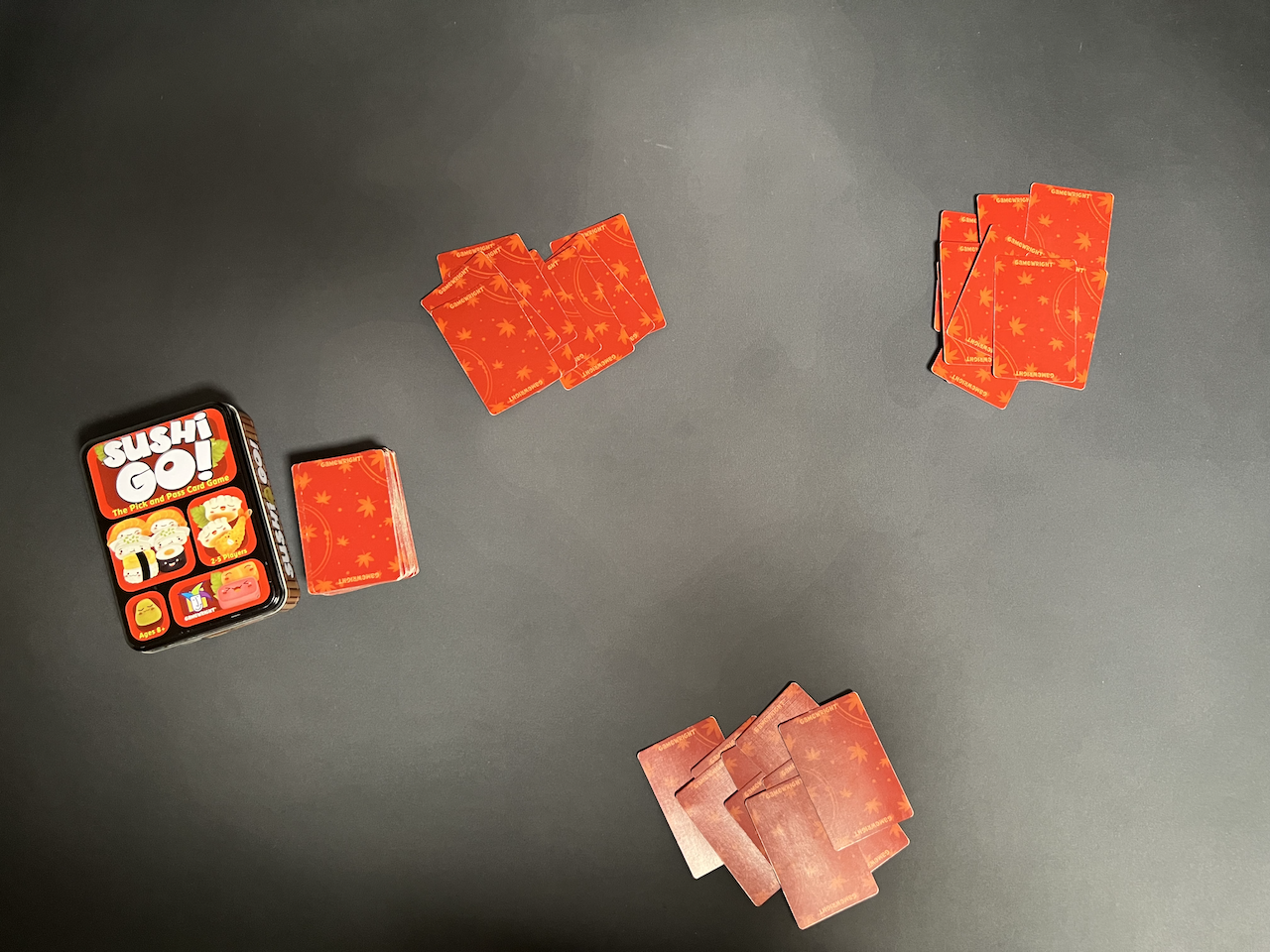
Setting up the game is quick and simple and takes less than a minute. Shuffle all the cards thoroughly to create a single deck. Depending on the number of players (the game supports 2 to 5 players), each player is dealt a specific number of cards (e.g. with 4 players, each receives 8 cards). The remaining cards are placed in the centre of the table to form a draw pile for drawing between rounds.
Game Mechanics: The Heart of ‘Card Drafting’
Sushi Go! is based on a mechanic known in the world of board games as ‘card drafting’. The game is played over three consecutive rounds, representing the three courses of a meal.
Each round proceeds in the following order:
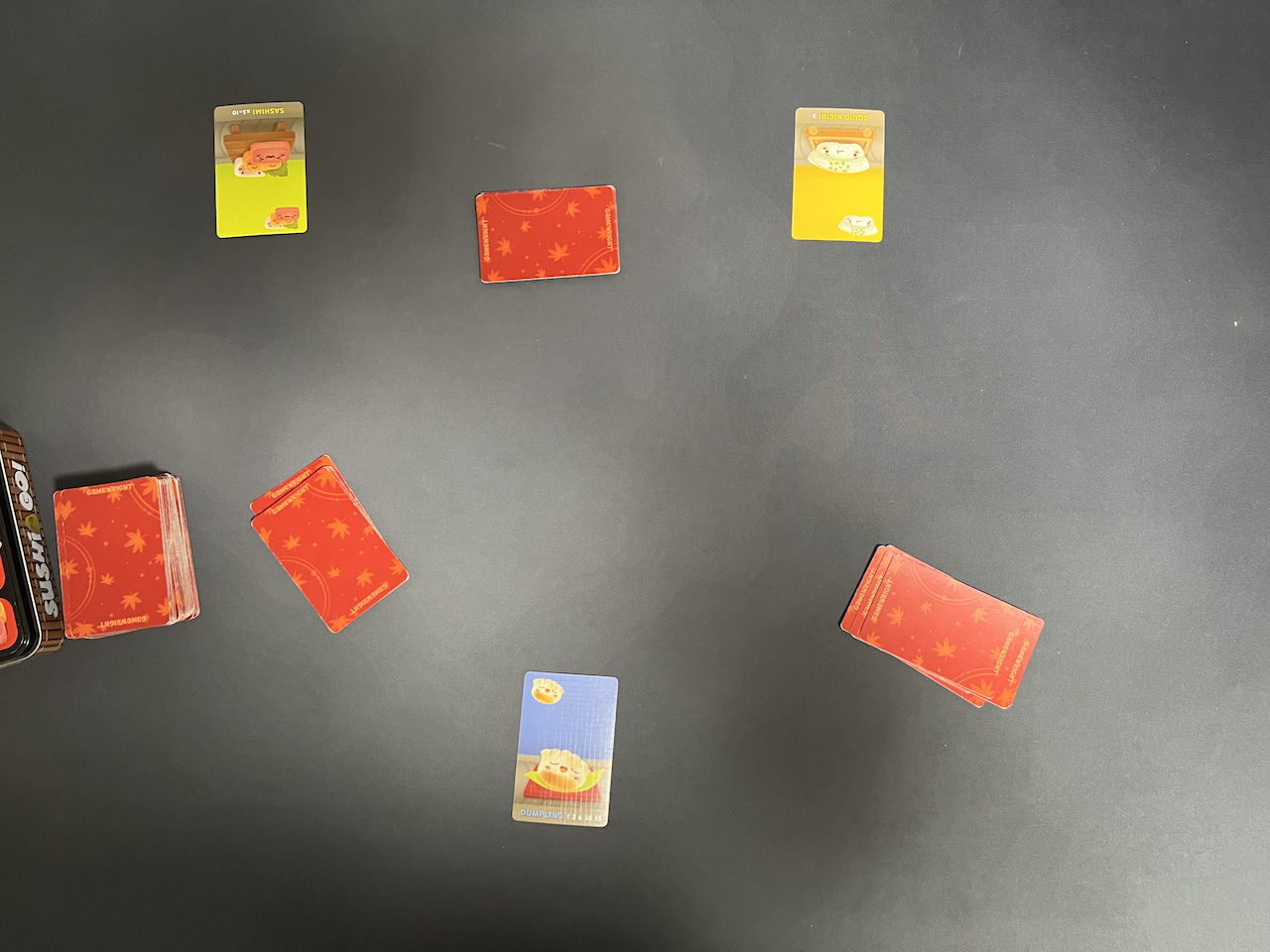
- Simultaneous selection: All players look at the cards in their hands at the same time, choose one card that they consider the most strategically sound addition to their current collection, and place it face down on the table in front of them.
- Reveal: Once everyone has chosen their card, they simultaneously turn it face up so that all other players can see it.
- Passing (Drafting Pass): Players pass the remaining cards in their hand to the player sitting to their left or right (the direction alternates each round).
- This starts a new turn with a new hand of cards, which you have just received from the player on your right or left. The process is repeated until there are no cards left in your hand. At that point, the round ends and the points for that round are tallied.
Winning conditions
After three rounds have been played, the points accumulated in each round are totalled. Special attention should be paid to the puddings, which are only scored at the very end of the entire game: the player with the most puddings receives 6 bonus points, whilst the player with the fewest puddings receives 6 penalty points (if there are more players, the points are adjusted). The player with the highest number of points after the final tally wins.
Analysis of strategies and tactics
As with any top-class board game, Sushi Go! also conceals surprising tactical depth beneath its charming exterior. The difference between a casual player and a master of this game is evident after just the first round.
Strategy for beginners
Beginners usually focus exclusively on their own board (“their tray”) and pick up whatever is obviously worth the most points at that moment – for example, individual salmon nigiri or the first visible dumplings. This is a safe approach, but it won’t get you onto the podium. We advise beginners to focus on a simple combination: wasabi + nigiri, as this reliably maximises their points haul without taking too much of a risk.
Advanced tricks for experienced players
Once you’ve mastered the basics, a whole world of tactical manoeuvres opens up:
- Card counting: There is a precise number of individual cards in the game. If you know that all three sashimi have already been played or are in a hand approaching you, it is no longer worth starting to collect a new sashimi set, as you will be left empty-handed (0 points).
- Blocking fellow players (Defensive drafting): Sometimes the best move is the one that prevents a fellow player from winning. If you notice that the player to your left already has two sashimi, simply take the third sashimi, even if you aren’t collecting it yourself. This will ruin their chance of scoring 10 points.
- Using chopsticks at the right time: Chopsticks are a powerful weapon, but they must be used wisely. It is best to sacrifice them when, in a new hand, you spot two exceptionally valuable cards at the same time (e.g. wasabi and a large piece of nigiri or a missing dumpling), which you would otherwise have to discard.
An overview of the official expansions
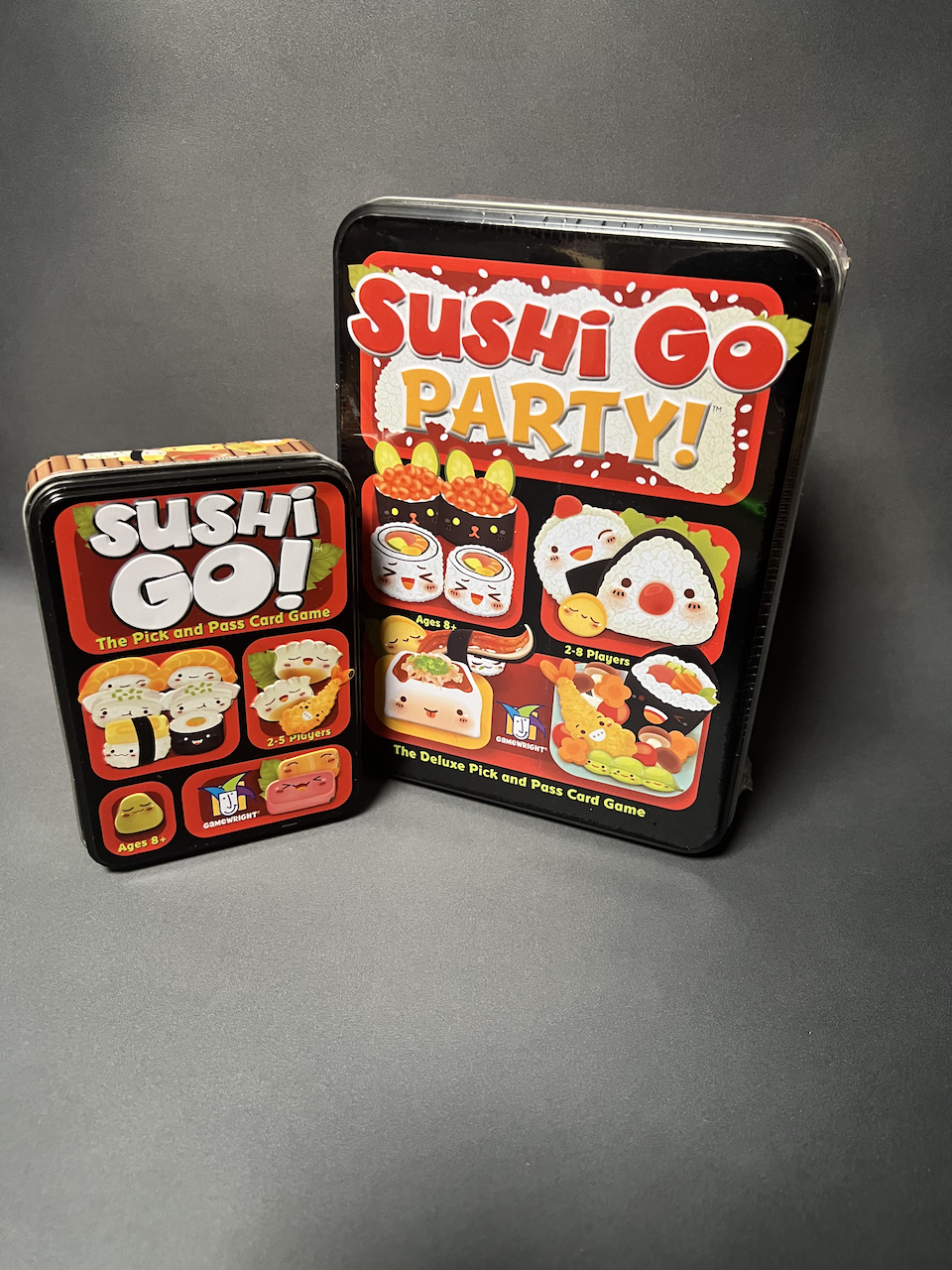
The base game offers a huge amount of replayability, but if you want to take your gaming experience to a whole new level, there’s an official standalone expansion or upgrade available: Sushi Go Party!
Sushi Go Party! – A bigger, better and more varied feast
Whilst the base game supports up to 5 players, Sushi Go Party! allows for up to 8 players, making it the perfect choice for larger groups and parties. The main innovation in this edition is the modular menu. Before the game begins, players put together their own menu from a wide range of dishes (they can choose from several types of starters, main courses, side dishes and desserts).
As well as classic dishes, it features a whole host of new delicacies:
- Edamame: Group points if all players contribute to ordering them.
- Tofu: A tactical card that awards points only if a specific number of tofu pieces are collected on the tray.
- Miso soup: Scores points until someone orders the same soup, at which point it is discarded.
- Tea and Stars (Sake): These add entirely new layers of interaction and scoring bonuses.
Is it worth buying? Without a doubt! If you find that the base game regularly fills your table and you’re looking for more variety and the ability to play with more players, Sushi Go Party! is a must-have for any board game enthusiast’s collection.
Frequently Asked Questions
Is Sushi Go! suitable for younger children?
+The official recommended age is 8+, but thanks to its extremely simple visual rules and the basic addition skills required (up to 20), children around the age of 6 can also play the game without difficulty, with a little initial guidance from their parents.
How language-dependent is the game?
+The game is almost entirely language-independent. In addition to the cute illustrations, the cards feature only simple icons, numbers and dish names, while the rules contain no complicated text.
How long does an average game last?
+An average game lasts between 15 and 20 minutes. This makes it ideal as a warm-up game before a longer game night or as a quick bit of fun during a break.
How many players can play the base game?
+The base edition of Sushi Go! is designed for 2 to 5 players. With two players, special rules involving additional piles of cards apply, while games with four or five players feature the wildest and most unpredictable card-drafting dynamics.
Is the game suitable for travelling?
+Absolutely! Thanks to its compact, sturdy metal tin and the lack of large game boards or numerous tokens, you can easily pack it in a backpack, a beach bag or your car's glove compartment.
How exactly does the final pudding scoring work?
+Puddings are not scored during the three rounds themselves; instead, you collect them on your table throughout the game. At the end of the third round, they are counted: the player with the most puddings receives bonus points, while the player with the fewest loses points. This adds an interesting strategic element of long-term planning. Conclusion
Sushi Go! is more than just a simple card game – it’s a perfect blend of fun, laughter and light-hearted tactical tension, all packed into a charming metal box. Whether you’re a passionate collector of complex strategy games or simply looking for the perfect gift for family evenings, this game is sure to find a special place on your shelf and make regular appearances on the table.