

Imagine that the entire fate of Tolkien’s iconic world does not rest on the shoulders of vast armies, but on two players sitting opposite each other over a cup of coffee or tea. The Lord of the Rings: Duel for Middle-Earth is one of the most exquisitely crafted two-player board games of recent years. It was created by the legendary design duo Antoine Bauza and Bruno Cathala (authors of the global hit 7 Wonders Duel), thoughtfully reimagined in the beautifully illustrated world of artist Vincent Dutra and published by Repos Production.
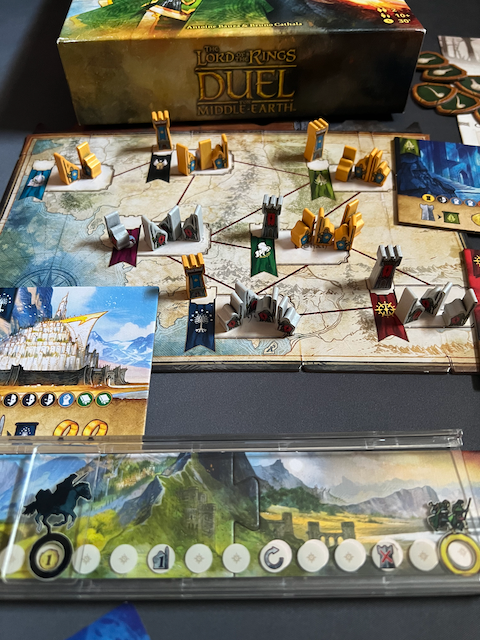
The game offers more than just a superficial reworking of familiar mechanics; it introduces completely revamped victory conditions, tactics for moving across the map of Middle-earth, and a thrilling Race for the Ring. Whether you take control of the Fellowship of the Ring or use Sauron’s dark forces to cast your shadow over the peoples, you’re in for a strategic experience that keeps both players in a state of complete uncertainty right up to the very last moment.
Why is the game so popular?
The game’s success at tables both at home and abroad is no coincidence, but rather a remarkable blend of the psychology of gameplay, the social dynamics of the duel, and an indispensable thematic depth.
1. The psychology of constant tension and micromanagement
When you sit down to play Duel for Middle-Earth, you very quickly realise that there is no room for passive play here. The mechanic of selecting cards from a shared pyramid (where some cards are face-up and others face-down) creates psychological drama with every single move. Every card you take not only benefits your faction, but also potentially reveals a key card to your opponent. The dynamic of quick, intense decisions keeps you 100 per cent focused throughout the entire 30 to 45 minutes of play.
2. The social aspect: A pure duel with no hidden information
Unlike extensive ‘co-op’ or party games for larger groups, duels are a direct, elegant clash of wits. As almost all the information on the table is public or predictable, the game is exceptionally fair and, at the same time, ruthless. Victory is not based on luck with the dice, but on your ability to read your opponent’s intentions, block their moves and adapt your own strategy to changes in the game.
3. Why has it become such a hit?
The board gaming community greatly values games that offer:
- An excellent balance between depth and playing time: In half an hour, you get the feeling of an epic clash that, in terms of strategic depth, rivals much larger and more complex games.
- Compact size and high quality: The game fits perfectly on any kitchen or club table, whilst the wooden tokens and superb graphics will delight everyone.
- Strong thematic integration: Tolkien’s saga is immensely popular, and the adaptation of the story of Hobbits, Nazgûls and alliances with Elves and Dwarves feels authentic and inspiring.
Detailed instructions and gameplay
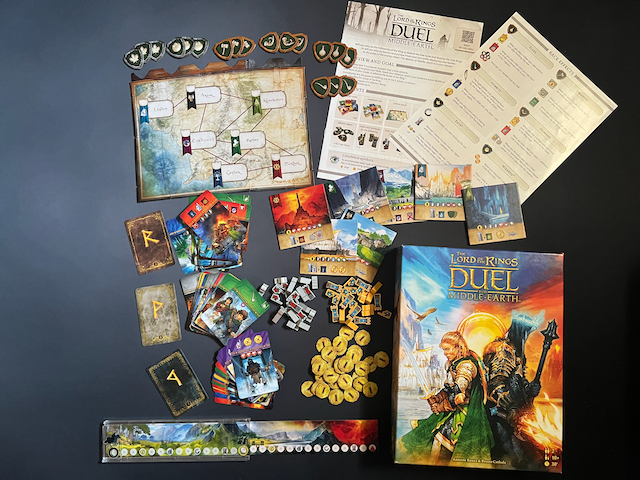
List of components: What’s in the box?
The game boasts exceptional production quality and beautiful wooden and cardboard components:
- 2 boards: The main game board featuring a map of Middle-earth (divided into 7 regions) and a separate board for the Race for the Ring.
- 69 cards: Cards divided into 3 chapters (Chapters I, II and III) with distinctive backs and coloured bands at the top.
- 44 wooden figures (units): The armies of the Fellowship and Sauron’s dark forces.
- 18 alliance tokens (shields): Representing the neutral peoples of Middle-earth.
- 30 gold coins: To fund missing resources and purchase cards.
- 7 tiles: Special locations featuring manors/fortresses.
- 2 transparent elements (sliders): To track the progress of Frodo, Sam and the Nazgûl on their journey to Mount Doom.
- Game accessories and detailed rules.
Game setup
1. Choosing sides and placing the boards: 1–2 minutes.
The players agree who will represent the Fellowship of the Ring and who will represent Sauron. Place the Middle-earth game board and the Ring Race board in the centre of the table. Place the transparent elements featuring the figures of Frodo and Sam, along with the Nazgûl, on the Path of the Ring in their starting positions.
2. Deployment of forces and alliances: 2 minutes.
Place the starting wooden units on the marked areas on the Middle-earth map. Randomly distribute the alliance tokens (shields) across the game board (Elves, Dwarves, Ents, etc.).
3. Organising the cards by chapter: 2 minutes.
Divide the cards into three piles (Chapters I, II and III). For the first chapter, arrange the cards in a specific pyramid structure, where the rows partially overlap (some cards are face up, others face down). Each player receives a starting capital of gold coins.


Game mechanics
The game is played over 3 chapters. On their turn, a player selects one of the freely accessible cards from the pyramid structure (these are cards not covered by any other card).
With the selected card, you can perform one of two main actions:
- Play a card into your area: If you meet the conditions (you have the relevant skill symbols or enough gold), you add the card to your collection, which grants you immediate or permanent bonuses.
- Discard a card for gold: If you cannot afford the card or wish to take it away from an opponent, you discard it and take gold from the treasury.
Card colours and their roles:
- Yellow cards (Trade and Resources): These boost your finances and allow you to purchase future cards or strongholds at a lower cost.
- Grey cards (Skills): These provide skill symbols, which are essential for acquiring more advanced cards in Chapters II and III free of charge.
- Red cards (Military Units): Allow you to deploy your military units directly onto the Middle-earth map or move them to neighbouring regions.
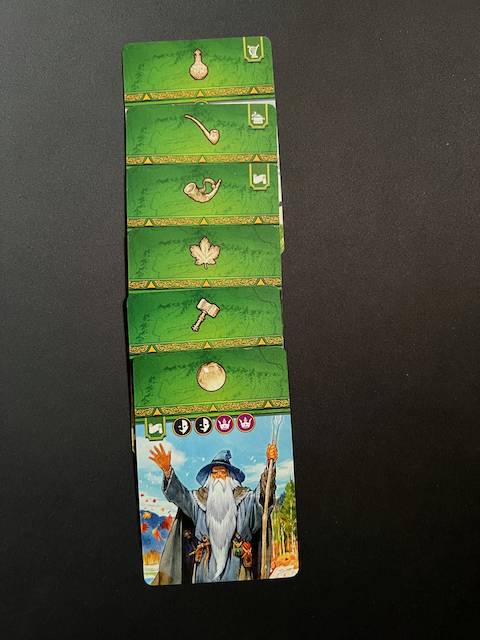
- Green cards (Alliances with the Peoples): These represent alliances with the Peoples. When you collect a pair of matching symbols, you gain special bonus tokens.
- Blue cards (Race for the Ring): Move along the path to Mount Doom. Flee from the Nazgûl or chase Frodo.
- Purple cards (Special Manoeuvres): Immediate, powerful actions that can tip the balance of power at a crucial moment.
Victory Conditions: Three Paths to Victory
One of the game’s greatest features is that it can end immediately (instant victory) when one of the players fulfils one of the three conditions:
| Victory Condition | How to achieve it? | Thematic description |
| 1. The Ring Race | Reach the end of the path on the special board. | Frodo and Sam destroy the Ring of Doom on Mount Doom, or else the Nazgûl capture them and return the Ring to Sauron. |
| 2. Alliance of the Peoples | Collect 6 different symbols of the peoples on the green cards. | You have united the free peoples of Middle-earth, or you have subjugated all the key races. |
| 3. Domination of Middle-earth | Be present (with a unit or stronghold) in all 7 regions at the same time. | Complete military supremacy and control over the entire map. |
Note: If, at the end of Chapter III, none of the conditions for an immediate victory have been met, the player who controls the greater number of regions on the map of Middle-earth wins.

Analysis of strategies and tactics
The game offers exceptional strategic depth, where players must constantly balance their own progress with hindering their opponent.
Beginner’s Guide (Basic Guidelines)
- Economic development in Chapter I: In the first part of the game, do not focus too much on direct attacks. Collect a few yellow and grey cards, as this is the only way to establish a stable financial and symbolic foundation for the expensive cards in Chapters II and III.
- Monitoring your opponent: If you notice your opponent is rapidly building up a stack of green alliance cards, you must immediately prevent them from gaining access to new symbols – even if you have to discard that card for gold!
- Double threat: Never focus on just one victory condition. If you only build up your army, your opponent will easily overtake you on the Path of the Ring.
Advanced tactics for experienced players
- Controlling card reveals (Tempo management): The most important skill in the game is keeping track of revealed cards. An experienced player will deliberately take a less favourable card or use a special action, simply to force their opponent to reveal a new row in the pyramid.
- Tactical use of fortresses: Building a fortress not only grants control points in a region, but often allows for an extra move or the immediate movement of units. Use this mechanic as a surprise to turn the tide of the game.
- Aggressive military presence: In military clashes on the map, units are removed on a one-for-one basis. Sometimes it is worth sending a single unit into a region where the opponent has a strong presence, simply to destroy a key piece and prevent them from dominating all 7 regions.
FAQ (Frequently Asked Questions)
Conclusion
The Lord of the Rings: Duel for Middle-Earth is undoubtedly one of the finest duels in the world of modern board games. It offers the perfect blend of elegant rules, deep strategy and an authentic thematic atmosphere that will captivate both casual players and seasoned strategists alike.