

Have you ever wondered why certain games keep us glued to our seats, whilst others bore us in no time? Ubongo is a rare gem in the world of board games, bridging the gap between a mentally challenging puzzle and an adrenaline-fuelled social experience. In this analysis, we’ll break down why this game by Grzegorz Rejchtman reigns supreme on the shelves of board game enthusiasts and how, with a few strategic moves, you can become unbeatable.

Why is the game so popular?
Ubongo isn’t just a game with pieces; it’s a psychological experiment packed into a box. Its popularity is no coincidence and is based on three key psychological factors:
1. The ‘flow’ state and the dopamine response
The psychology of playing Ubongo is based on the rapid solving of spatial challenges. When a player sees an empty board and a pile of geometric shapes in front of them, their brain triggers ‘space-time’ processing. When the pieces finally ‘click’ into place – and everyone at the table can hear it – a surge of dopamine is released. This sense of achievement is an immediate reward that compels players to play again.
2. Overcoming ‘waiting boredom’
In many games, players wait for others to take their turn, which leads to a drop in attention. With Ubong, however, everyone plays at the same time. The mechanics of solving the puzzle simultaneously mean that whilst you’re looking for the right angle for your block, your fellow players are doing the same. The tension created by the hourglass prevents anyone from zoning out during the game. This is ‘group dynamics in action’, where one player’s pace indirectly puts pressure on the others without causing any direct conflict.
3. Language independence and inclusivity
Ubongo is a language-independent game. Whether you’re with friends, children or elderly relatives, the rules are clear within seconds. This lowers the barrier to entry – the game is accessible to everyone, which is a major asset in Slovenia, where family gatherings are common.
Detailed instructions and gameplay
List of components: What’s in the box?
For the full experience, make sure your box contains the following items:
- 4 sets of 12 polymino tiles (in various geometric shapes and colours).
- 36 task cards (double-sided, with varying levels of difficulty).
- 1 game board (for collecting gems).
- 58 plastic gems (in various colours and values).
- 1 hourglass (duration approx. 30 seconds).
- 1 die (with symbols indicating which pieces you may use).
Setting up the game
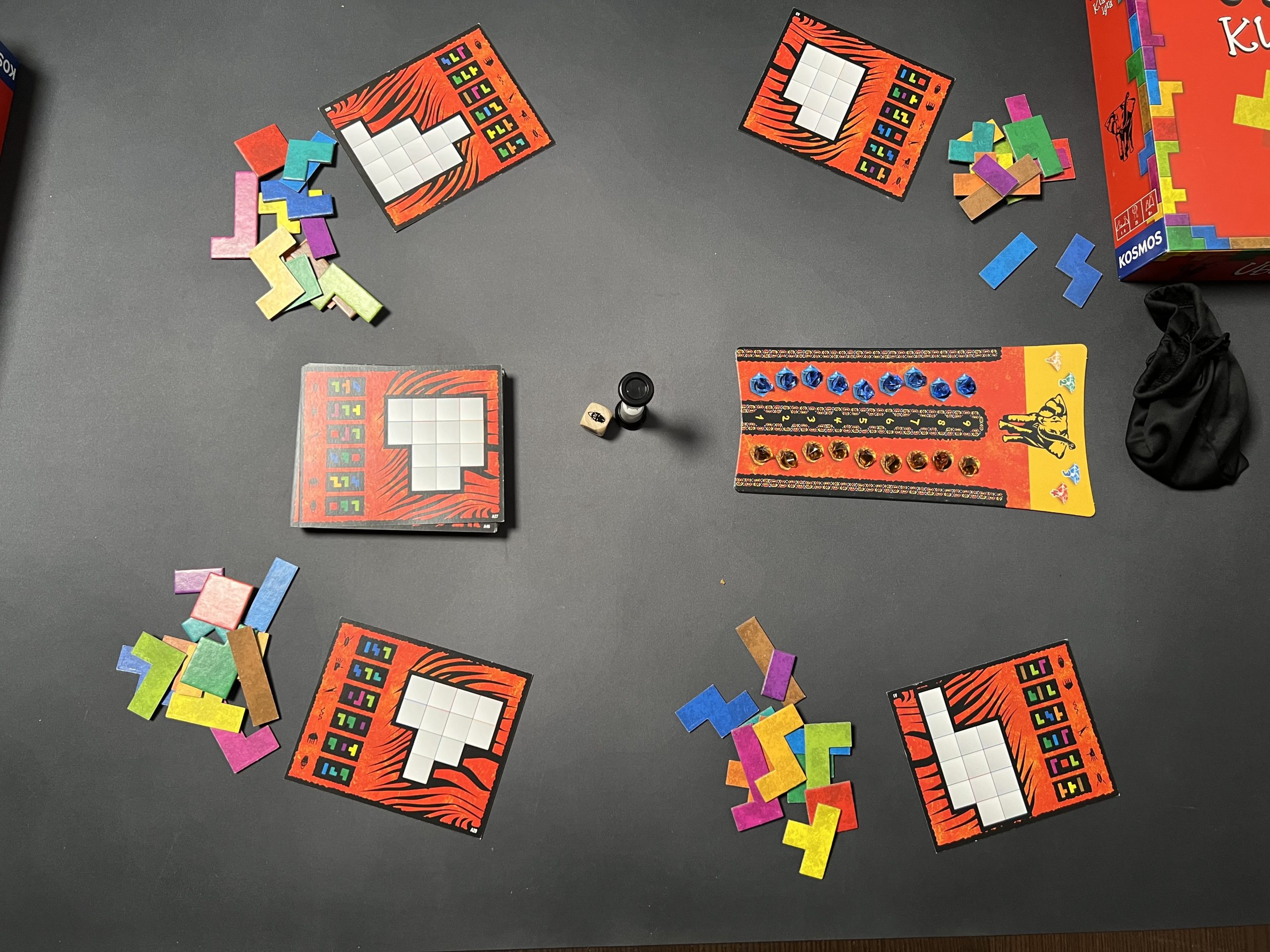
Set-up is quick, which is key to maintaining the game’s momentum:
- Each player chooses their colour and takes their set of 12 tiles.
- The task boards are distributed so that each player receives one.
- Place all the gems on the task board in the marked spaces.
- Place the dice and the hourglass in the centre of the table, where they are within everyone’s reach.
Gameplay
The game is played in a series of rounds. In each round, follow these steps:
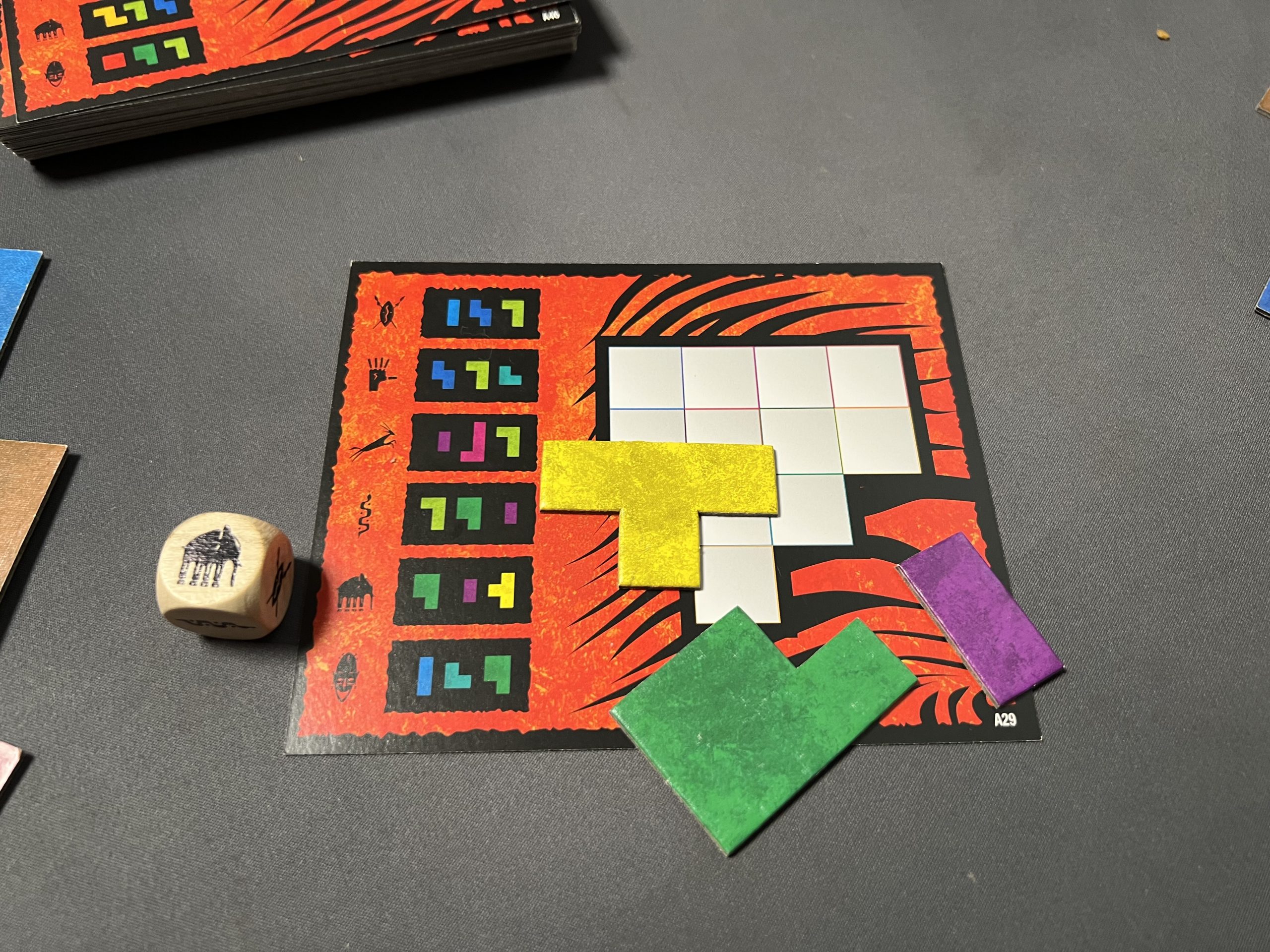
- Roll the dice: The first player rolls the dice. The symbol on the dice determines which tiles you must use this time to fill the white space on your card.
- Challenge: The moment the hourglass is turned over, all players start working on the challenge at the same time. The aim is to completely cover the white area on your board with the specified tiles, without overlapping them and without them sticking out over the edge.
- Shouting “Ubongo!”: The first player to succeed shouts “Ubongo!”. They must do so before the hourglass runs out. If they succeed, they may stop playing and collect a gem.
- End of the round: When the timer runs out, the game stops. Everyone who has successfully solved the puzzle before time runs out receives a reward.
Winning conditions
Victory is determined not only by speed, but by the value of the gems. After 9 rounds, points are totalled based on the gems collected. Different colours are worth different points. The player with the most points at the end wins.
Analysis of strategies and tactics
For beginners: Basic approach
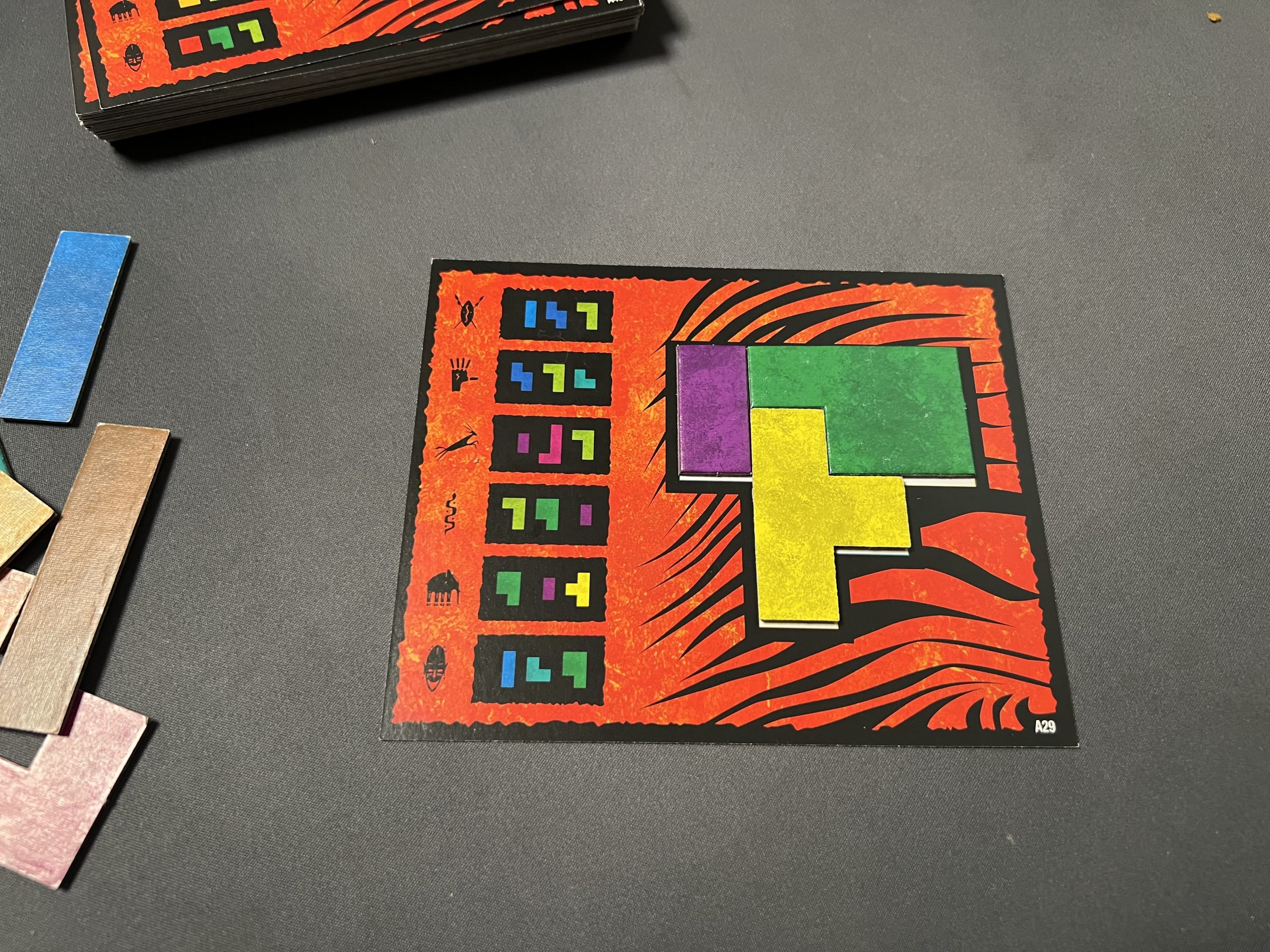
Beginners often make the mistake of trying to place pieces at random. Tip: First, check which pieces are required (the dice), then mentally rule out the space occupied by a particular ‘awkward’ shape. Start with the largest or most distinctive piece (e.g. the L- or T-shaped ones), as these are the hardest to fit into place at the end.
For experienced players: Advanced tricks
- Visualising negative space: Professional players don’t look at where to place the pieces; instead, they look at the gap that remains. Train your brain to recognise ‘negative space’.
- Preparation before the roll: Whilst the first player is rolling the dice, you should already be focusing on your board. Analyse the shape you need to fill. If you’re already aware of the possibilities on the board, you’ll be able to identify which pieces are needed more quickly when the dice are rolled.
- Ignoring panic: Don’t give in to panic. Learn to switch it off. Experienced players know that 30 seconds is plenty of time if they focus on the geometry rather than the fear of losing.
Frequently Asked Questions
Conclusion
Ubongo is more than just a game; it’s a workout for your brain that you’ll be happy to do again and again. It offers the perfect balance between relaxation and mental challenge, something that’s all too rare in the modern world. Whether you’re looking to liven up a family evening or find something to challenge your friends with, Ubongo is an essential addition to your collection.
Fancy putting your skills to the test? Get your copy of Ubongo at druzabneigre.si and see if you’ve got what it takes to be a master of quick logic!