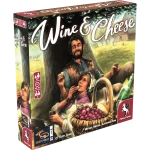

Picture late summer in Burgundy. Wheels of cheese and bottles of wine are aging in the cellar, workers in hats stand in the fields, and you and your neighbor are trying to work out who will send people into the vineyard first. In Wine & Cheese you run one of two neighboring farms. You share the vineyards, pastures and workers, but each of you earns your own income. For two years you gather grapes, milk and other ingredients, fill your cellar and wait for the wine and cheese to be ready just when you want to sell them.
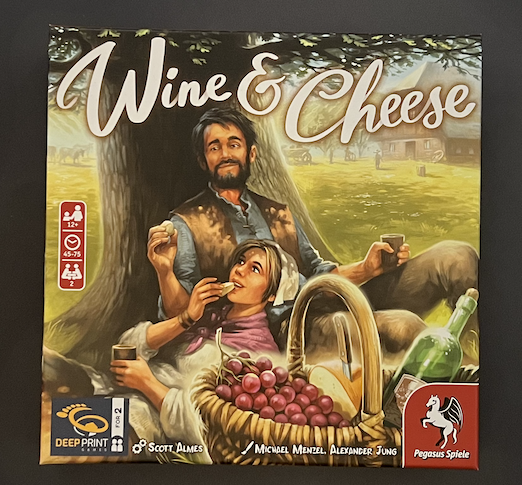
Wine & Cheese is a strategy game for exactly two players, suitable from age 12, and a game lasts 45 to 75 minutes. The winner is the one who keeps a balance: at the end, only the income from the product that earned you less counts.
What is Wine & Cheese?
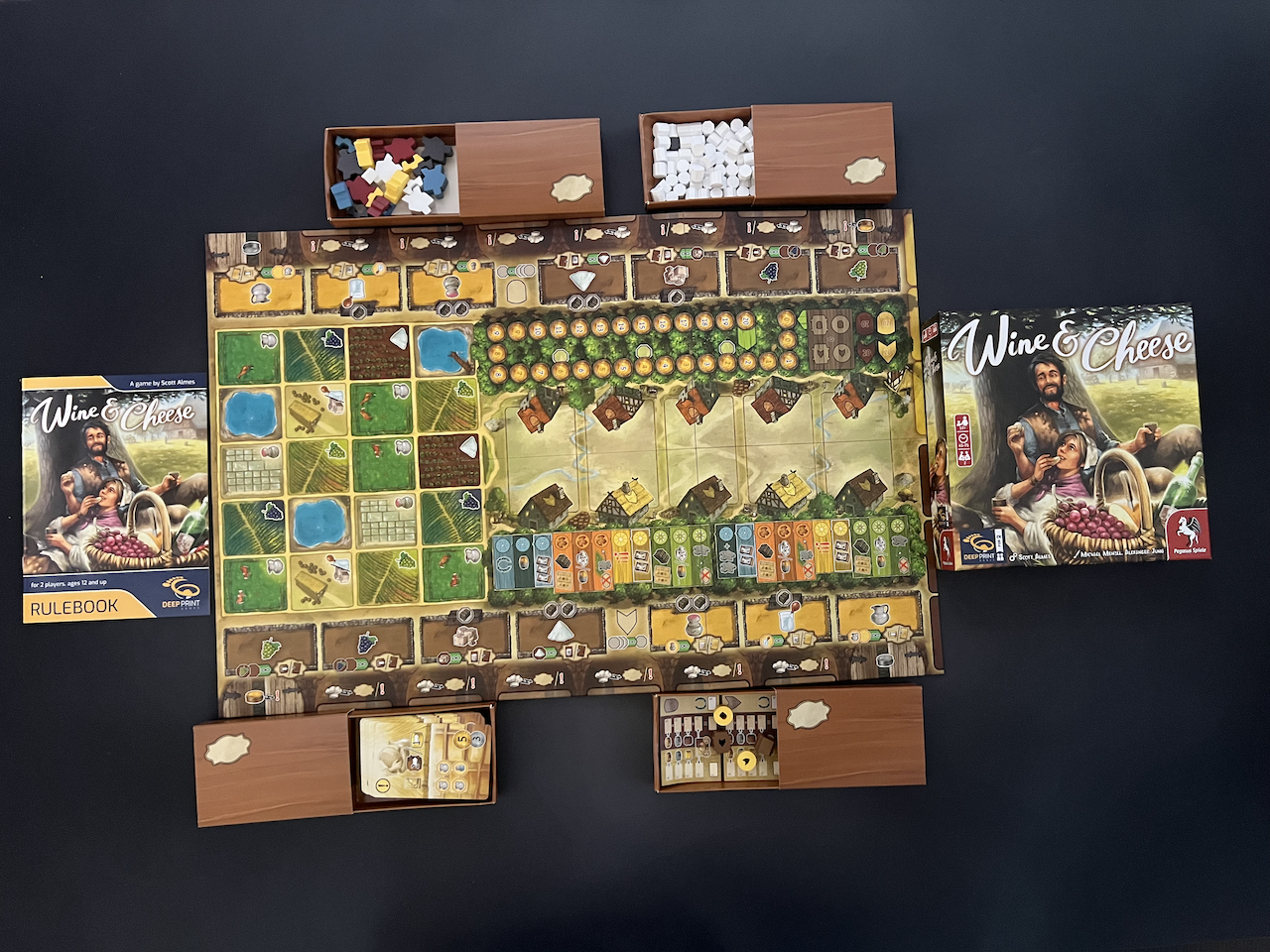
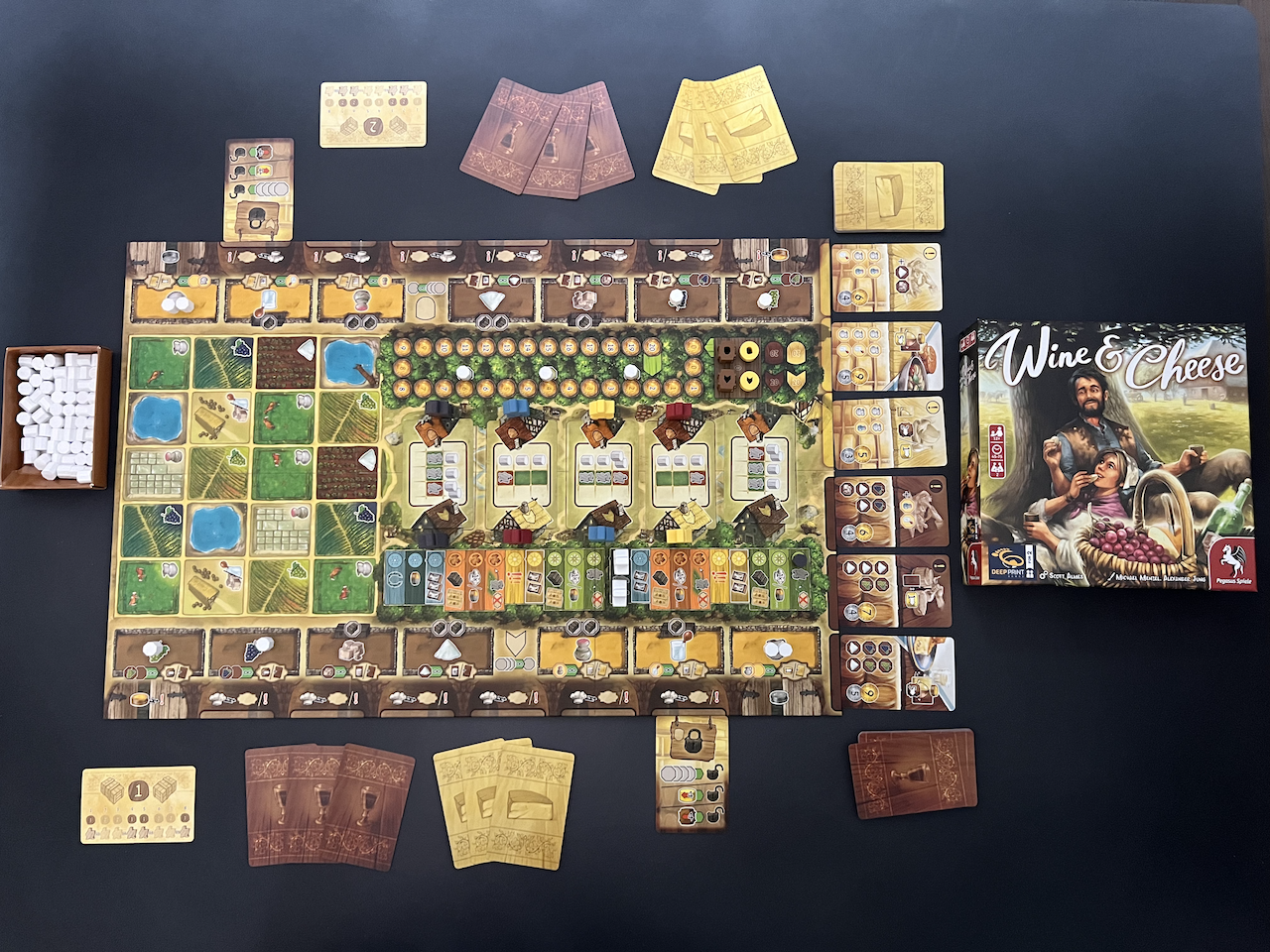
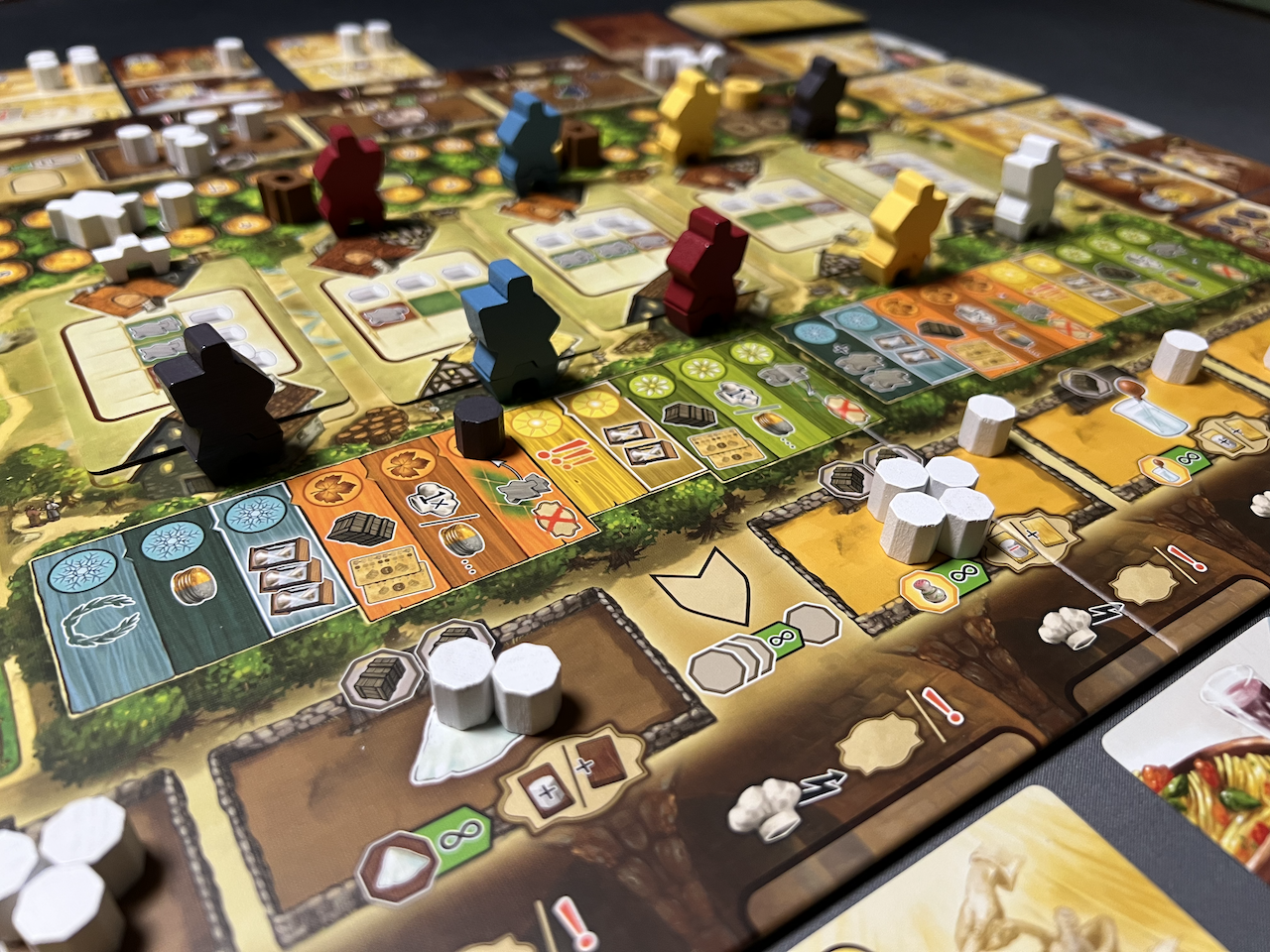
Everything happens on a single board between the two players. On your side is your farm with spaces for ingredients and a cellar, and in the middle are the shared fields, the workers' houses, the calendar and the income track, where you record how much you have earned with wine and with cheese. Everything in the middle is shared, so every decision you make also changes what your opponent can do.
The first twist is that workers come in pairs. Each color has two workers, one on your side and one on your opponent's. When you choose a color, your opponent must take the worker of the same color right after. The second twist is the scoring: you count your income from cheese and your income from wine separately, and your score is the lower of the two. Excellent wine won't help you if you've forgotten the cheese.
The game was designed by Scott Almes and illustrated by Alexander Jung and Michael Menzel. It was released in 2026 by the German company Deep Print Games, and the publisher is Pegasus Spiele. Its main mechanics include worker placement (you send your workers to spaces on the board), hand management (you choose wisely which cards from your hand to play) and contracts: each wine or cheese card requires a specific set of ingredients.
What's in the Wine & Cheese box
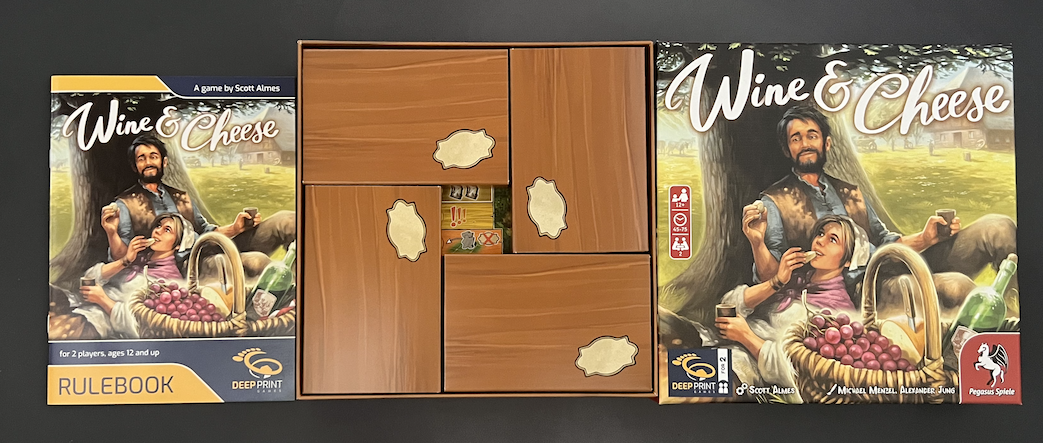
According to the official rules, the box contains:
- 1 game board
- 24 wine cards
- 24 cheese cards
- 70 ingredient tokens
- 8 house cards (4 Work Together and 4 Toil Alone)
- 2 locked cellar cards
- 10 workers in five colors
- 10 benches, which double as hats
- 2 wine markers
- 2 cheese markers
- 2 turn-order cards
- 1 calendar marker
- 1 score pad
The benches have a double role. When they stand in front of a house, they are benches on which a worker waits. When you send the worker to a field, you put the bench on the worker's head and it becomes a hat. All ingredient tokens are the same: what they represent depends on the space on your farm where they lie.
Wine & Cheese rules
The game lasts two years. Each year has a spring, summer, fall and winter, and each season has two or three steps. The marker on the calendar shows where you are, and you move it forward after each step.
Setup
- Place the game board between the players, each with their own farm on their side.
- Shuffle the house cards. Place three Work Together cards on the first, third and fifth house spaces and two Toil Alone cards on the second and fourth. Return the remaining three cards to the box.
- Place two benches of the same color on the calendar: these two workers only arrive in winter. Distribute the other benches among the houses and put a worker of the same color on each.
- Place the wine and cheese markers at the start of the income track, and one ingredient token on each of the three bonus spaces along the track. Each player places one white grape token, one red grape token and two milk tokens on their farm.
- Each player gets 3 wine cards and 3 cheese cards in hand, and three cards of each type are laid face up next to the board as a shared offer.
- Place your locked cellar card on the rightmost space of your cellar.
Who goes first
At the start, one of the players simply takes the first-player card. Later, turn order is decided each time you store ingredients: whoever stores more ingredients gets the first-player card. If it's a tie, the players swap cards.
Spring: workers go to the fields
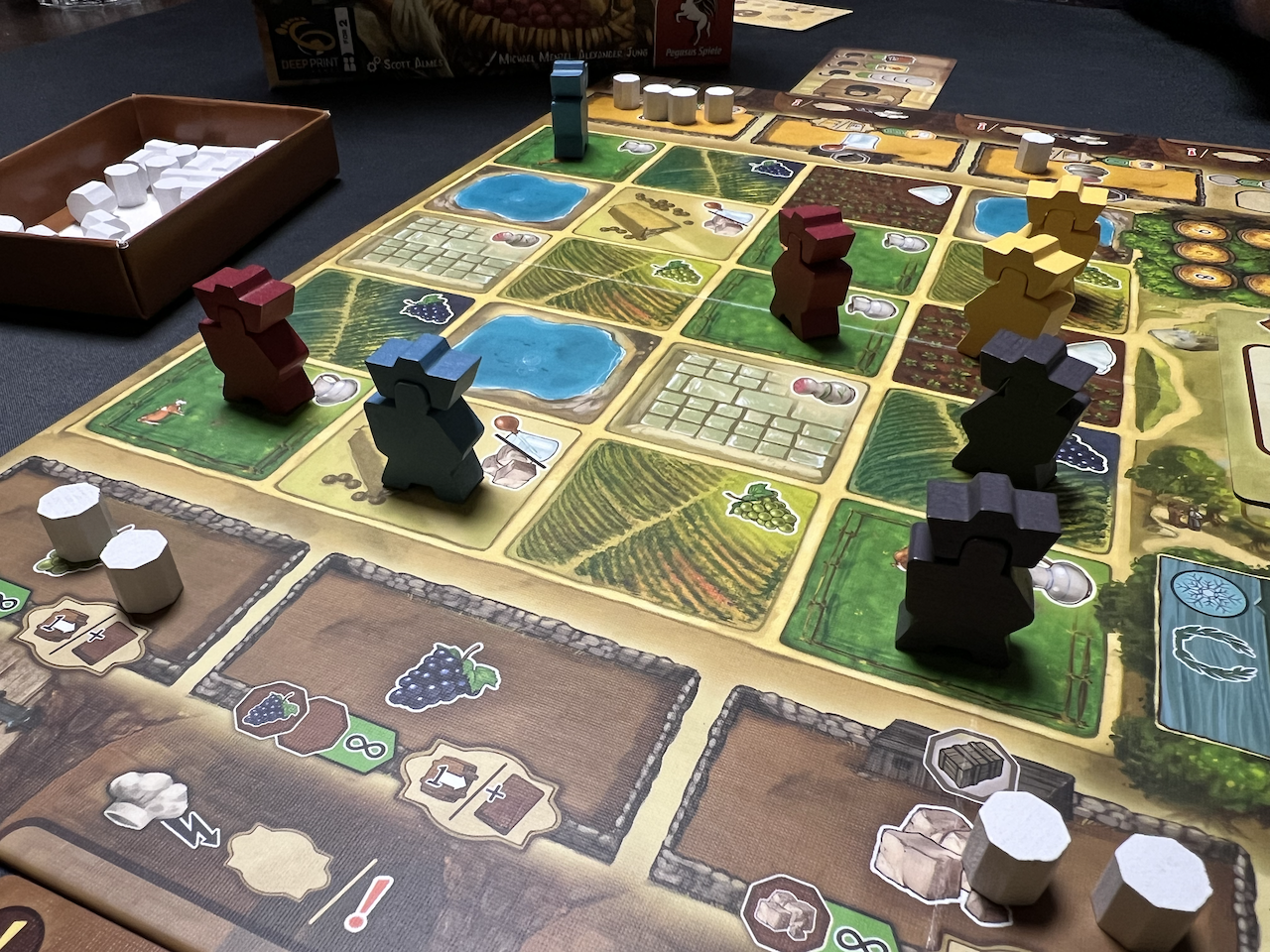
In the middle of the board there are 17 fields, plus 3 ponds where you can't place a worker. Fifteen fields give one type of ingredient: milk, white grapes, red grapes, sugar or salt. On the two laboratory fields you choose whether to take yeast or cultures (lactic acid bacteria for cheese).
On your turn, you take a worker from one of your houses and place it on an empty field. The card of the house the worker came from shows a pattern of three adjacent fields. You map this pattern onto the board to see which fields give you ingredients. With Toil Alone cards, you get one ingredient from the field the worker stands on and one from each of the other fields in the pattern, but only if they are empty. With Work Together cards, you get two ingredients from the worker's field and one from each of the other fields in the pattern only if a worker already stands there. It doesn't matter whose.
The first player takes one turn, then the second player takes two, then the first player two again, and so on. When one player chooses a worker color, the other must take the worker of the same color on their next turn, and only on their second turn can they choose freely again. Once a worker is in a field, you put its bench on its head as a hat.
Production and sales
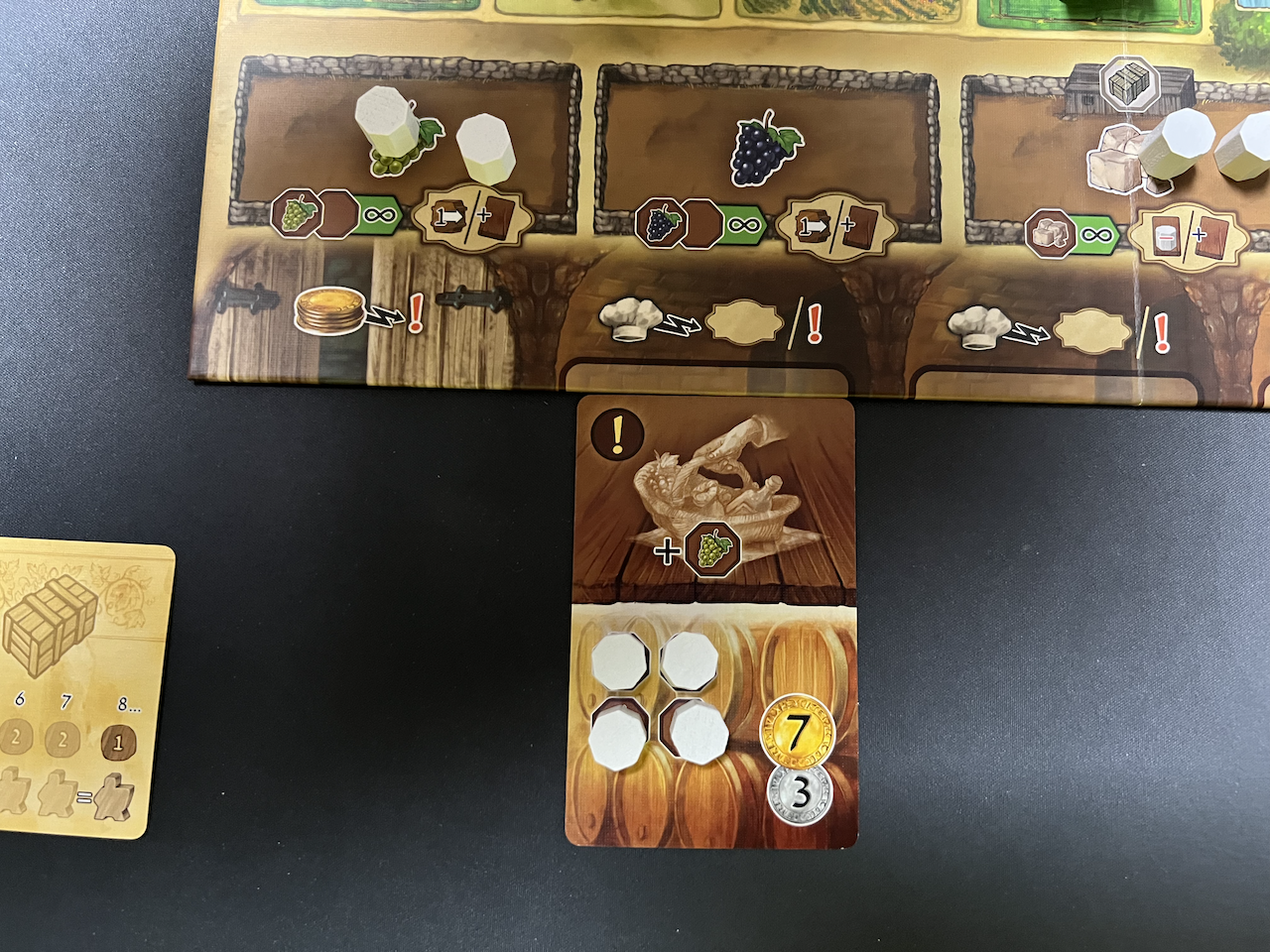
Next, the players take turns doing one of three things. You can play a wine or cheese card from your hand to an empty space in your cellar and place the matching ingredient tokens on all of its ingredient spaces. Right after that, you get the free action shown on the card's label or, if it is an action card, you trigger its special action. You can sell one or more cards from your cellar. Or you can pass, and the other player continues until they pass too.
Label actions are extra moves you pay for with ingredients. With them you move the wine or cheese marker one step forward, take a new card, or speed up or slow down the aging of one card in your cellar by removing one token from it or adding one to it. At any time, you can also trade three ingredients for one of your choice.
A card is finished when there are no tokens left on it. You sell a finished action card by triggering its special action once more. A gourmet pair is a wine card and a cheese card that together show the same dish: pasta, quiche (a savory tart), steak or ratatouille (stewed vegetables). When you sell one, you move both markers along the income track. You can also sell a single gourmet card without its pair, but without the bonus. If you sell an unfinished card, only its lower, silver value counts at the end.
Storage
At the end of spring and fall, you store ingredients. Space is limited: two spaces each for salt and sugar and one each for yeast and cultures. Grapes and milk don't keep, so everything left over goes back to the supply.
Summer, fall and winter
In summer, the wine and cheese age. Remove exactly two tokens from each card in your cellar. If that isn't possible because there aren't enough tokens on the card, the card over-ages: you sell it immediately for its silver value. Then each player triggers the special action of every action card in their cellar once.
In fall, the workers return from the fields to the houses, again in pairs. You place a worker on a free house on your side and get ingredients according to the pattern on that house card. Production and sales follow, then storage, just as in spring.
The first winter brings aging and two new workers from the calendar. In the second winter, the cards age three times, then you sell all the cards still in your cellar and the game ends.
The locked cellar
One space in your cellar starts out locked. You can unlock it at any time on your turn by paying four ingredients or moving your wine or cheese marker four steps back.
End of the game and scoring
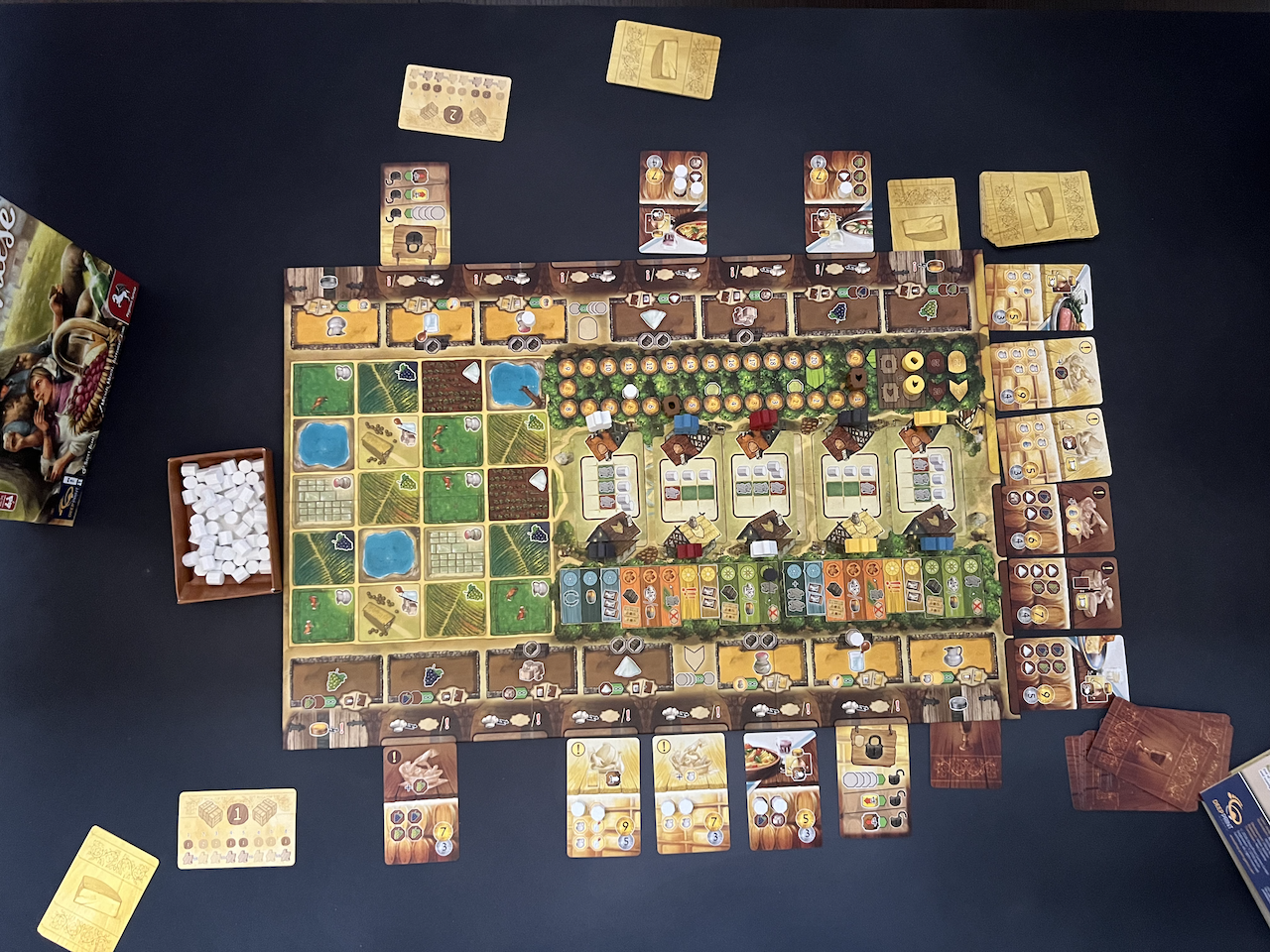
You score cheese and wine separately. For each product, you add up the full, gold values of the finished cards you sold, the silver values of the unfinished cards you sold, the value of the space your marker stands on (plus 20 for each lap of the track), and one coin for each gourmet pair. Your score is the lower of the two totals. The higher score wins. In a tie, the player with the higher total for the other product wins, then the player with the first-player card.
Common mistakes
- Two workers of the same color must be chosen one after the other: after your choice, your opponent can't take a different color.
- You can't use label actions while sending workers to the fields in spring or returning them to the houses in fall.
- With Toil Alone, the other fields in the pattern give ingredients only if they are empty; with Work Together, only if they are occupied.
- An over-aged card is not discarded: you sell it immediately for its silver value.
- You can't store grapes and milk until the next season.
Wine & Cheese tips and strategies
For beginners
Take care of both products. Because the lower total counts, every step forward with wine loses its value if your cheese is lagging behind. When choosing cards and actions, always ask yourself which of the two products is weaker right now.
Look at your opponent's side before choosing a color. When you choose a color, your opponent immediately gets the worker of the same color. Before you decide, check where they could place it and how much it would earn them. Sometimes it pays to take a color that gives you a little less and them a lot less.
Use up your grapes and milk before storage. Whatever is left over goes to waste, so trade your extra tokens, three for one, for salt, sugar, yeast or cultures, which you can store.
For experienced players
Play with the patterns of both house types. Work Together cards reward fields where workers already stand, Toil Alone cards reward empty fields. So the worker you place also sets up a field for your opponent's next pattern, which can help or hurt them.
Control the aging. By speeding up and slowing down, you can make both cards of a gourmet pair finish at the same time and keep any card from over-aging. But every such action costs ingredients you would otherwise spend on new cards.
Weigh when to sell an action card. As long as it is in your cellar, it triggers its special action every summer. When you sell it, you trigger it one last time and free up a space for a new card.
Unlock the locked cellar at the right moment. An extra space means more cards aging at once, but four ingredients or four steps back on the income track are not a small price. When moving along the track, also keep an eye on the bonus spaces with ingredient tokens.
Who is Wine & Cheese for?
Officially, the game is suitable from age 12. The special actions on the cards are shown with symbols, so there is hardly any reading during play, and the rules are in English. There is little math: during the game you count steps along the income track, and at the end you add up the card values.
Wine & Cheese is a game of medium difficulty. There are quite a few rules, from the seasons and house patterns to the label actions, but the course of a year repeats quickly and you'll have it down after the first year. The workers in pairs and the balance between wine and cheese take the most thought. Luck has a small influence: the houses are placed randomly at the start and you draw cards, but you can choose from the face-up cards, trade ingredients three for one and control the aging.
There is little waiting, since the players take turns one move at a time. There are no attacks and no one is eliminated, but the players constantly run into each other on the shared fields, in the card offer and on the income track, where you skip occupied spaces. The game is for two players and can't be played any other way: there is no variant for one player or for more players.
What might you not like?
Since the game is for two only, it isn't for larger groups. And because you have to look after both products all the time, it may not suit those who prefer games where you go all in on one strong strategy.
Games similar to Wine & Cheese
Everdell Duo is also a two-player game where you send workers out for resources, but it is shorter and lighter.

- Players: 1 - 2
- Age: 10+
- Duration: 30 min
In Angel's Share, whiskey ages in barrels and you also look for the right moment to sell, but it can be played in a larger group too.
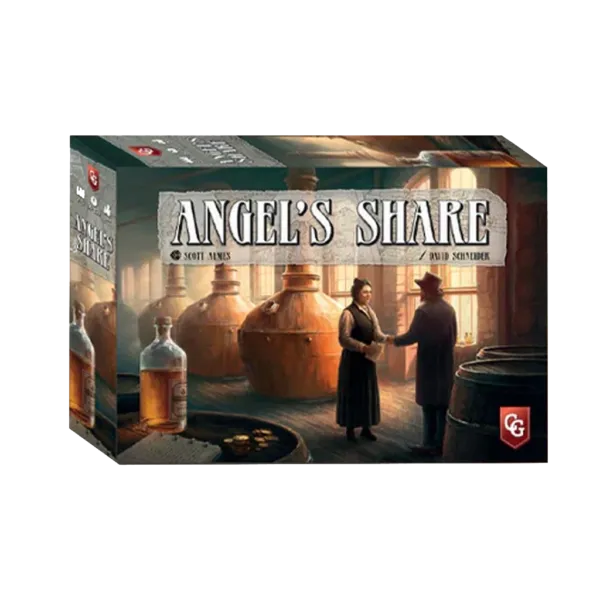
- Players: 2 - 5
- Age: 12+
- Duration: 75 - 120 min
Stephens combines worker placement with fulfilling orders, but it is longer and more demanding.
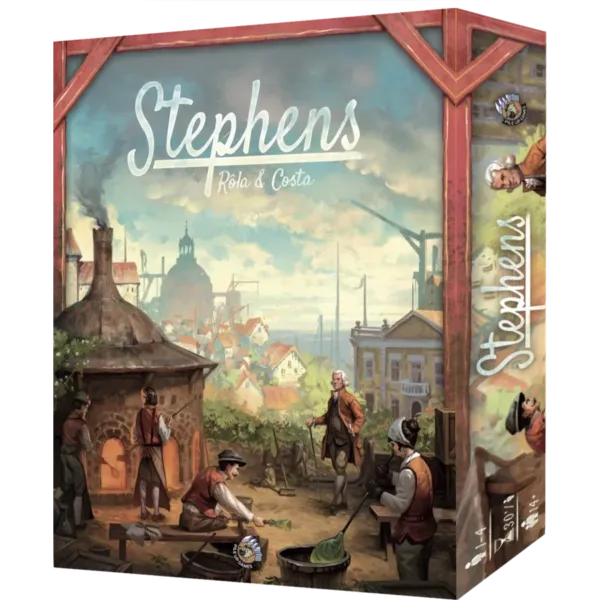
- Players: 1 - 4
- Age: 12+
- Duration: 60 - 120 min
Wine & Cheese FAQ
Sources
- Official Wine & Cheese rules (PDF, English) – Deep Print Games
- Wine & Cheese – game page – Deep Print Games
- Wine & Cheese – BoardGameGeek