

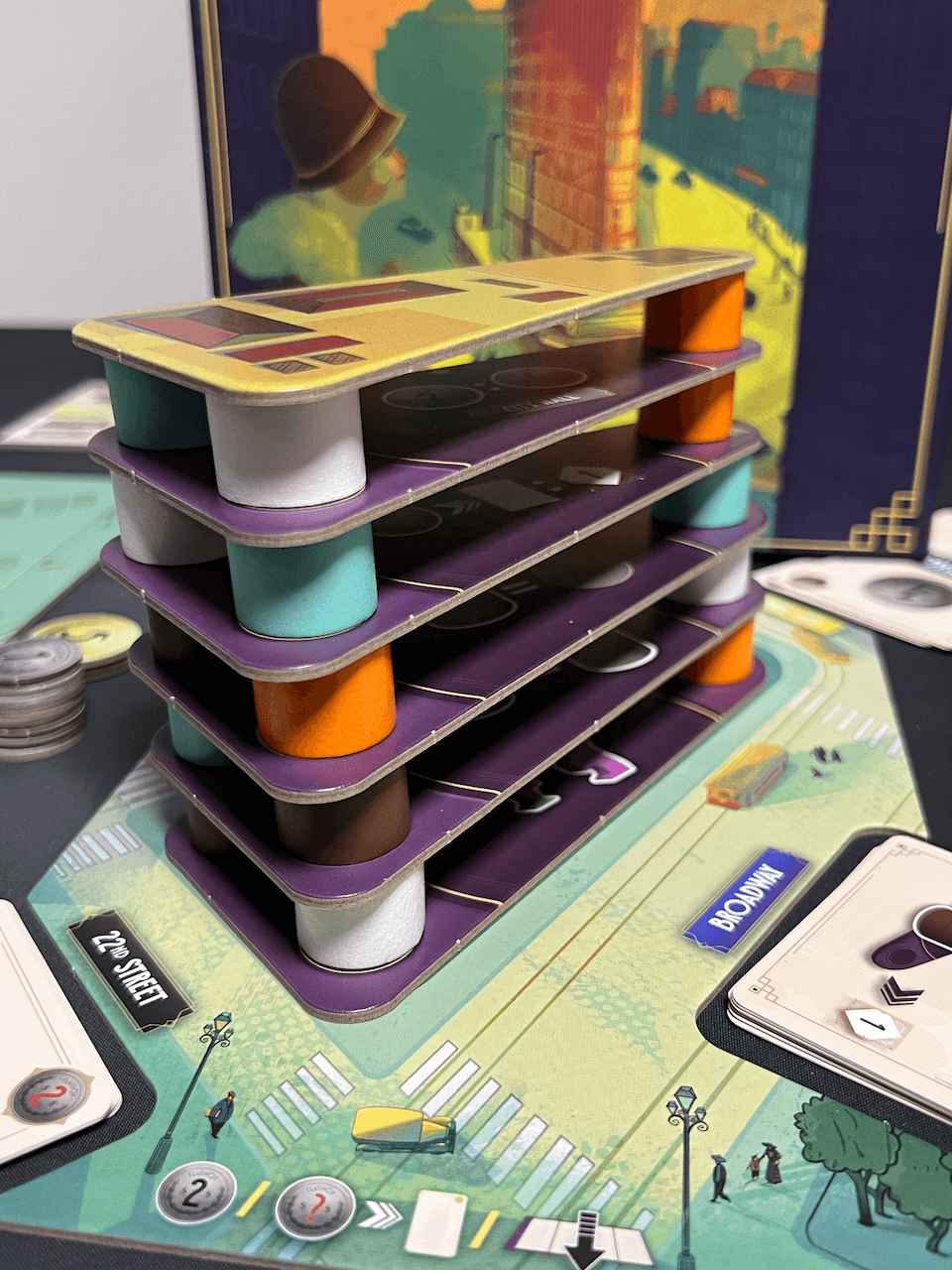
New York, 1902. On the corner of Fifth Avenue and Broadway, an unusual skyscraper shaped like an old clothes iron is going up, and you are one of two builders competing for the credit. In Flatiron you raise the building floor by floor, and it grows right there on the table: columns hold up the floors, the floors hold up the next ones, until the roof goes on top. Who will have more reputation and points at the opening is decided only at the very end.
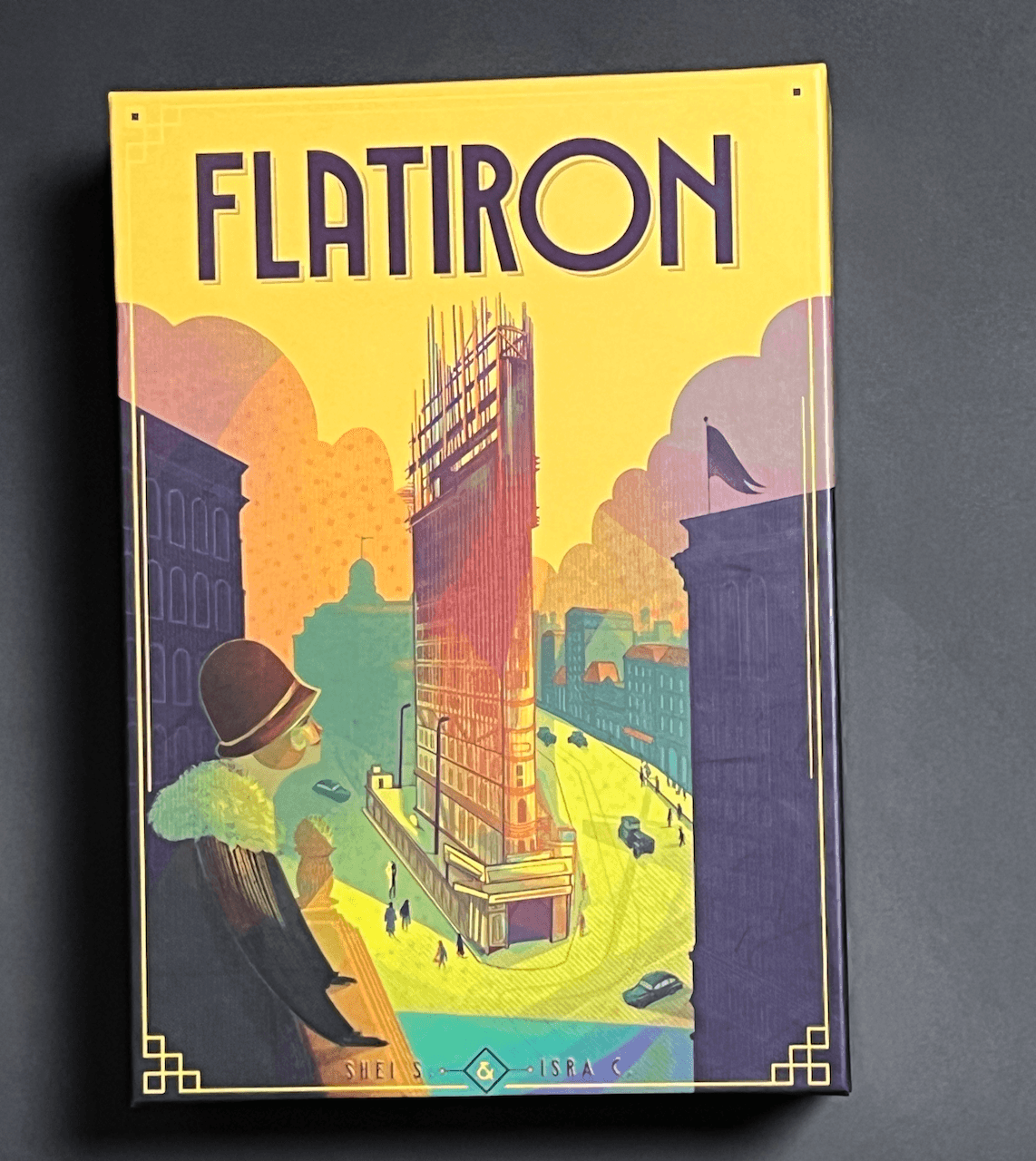
Flatiron is a strategy game for 1 or 2 players aged 12 and up, and a game takes about 45 minutes. Below you will find the rules as set out in the official rulebook, tips for your first and later games, and who will enjoy the game and who might not.
What is Flatiron?
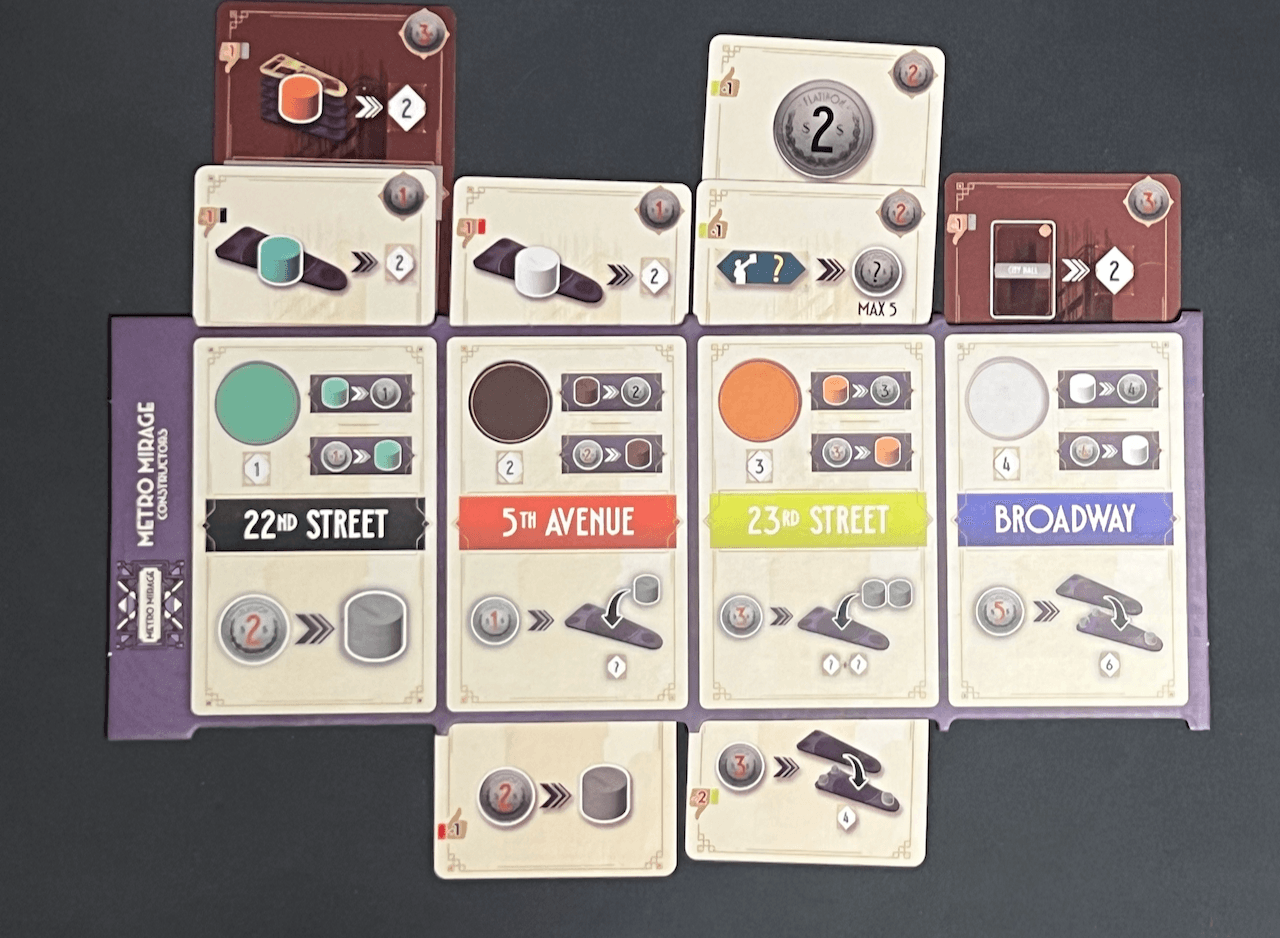
Flatiron is a game for two in which you build the same building together, but each for your own company. Around the building there are four streets – Broadway, 23rd Street, 5th Avenue and 22nd Street – and City Hall. On your turn you send your architect to one of these locations and do something there: buy a card, trigger actions or take money. With cards you build up your company, with money you buy columns, and the columns become the floors of the skyscraper.
What makes the game special is each player's personal board. You place the cards you buy in the column of their street, at the top or at the bottom, and in doing so choose which of the card's two actions stays visible. When you later visit that street, you trigger all visible actions in its column, one after another. Turn by turn, you put together an ever stronger chain of actions.
The game was designed by Sheila Santos and Israel Cendrero, illustrated by Weberson Santiago and published in 2024 by the Spanish publisher Ludonova. On BoardGameGeek it was nominated for the Golden Geek for Best 2-Player Game of 2024. We have also played it ourselves.
What's in the Flatiron box
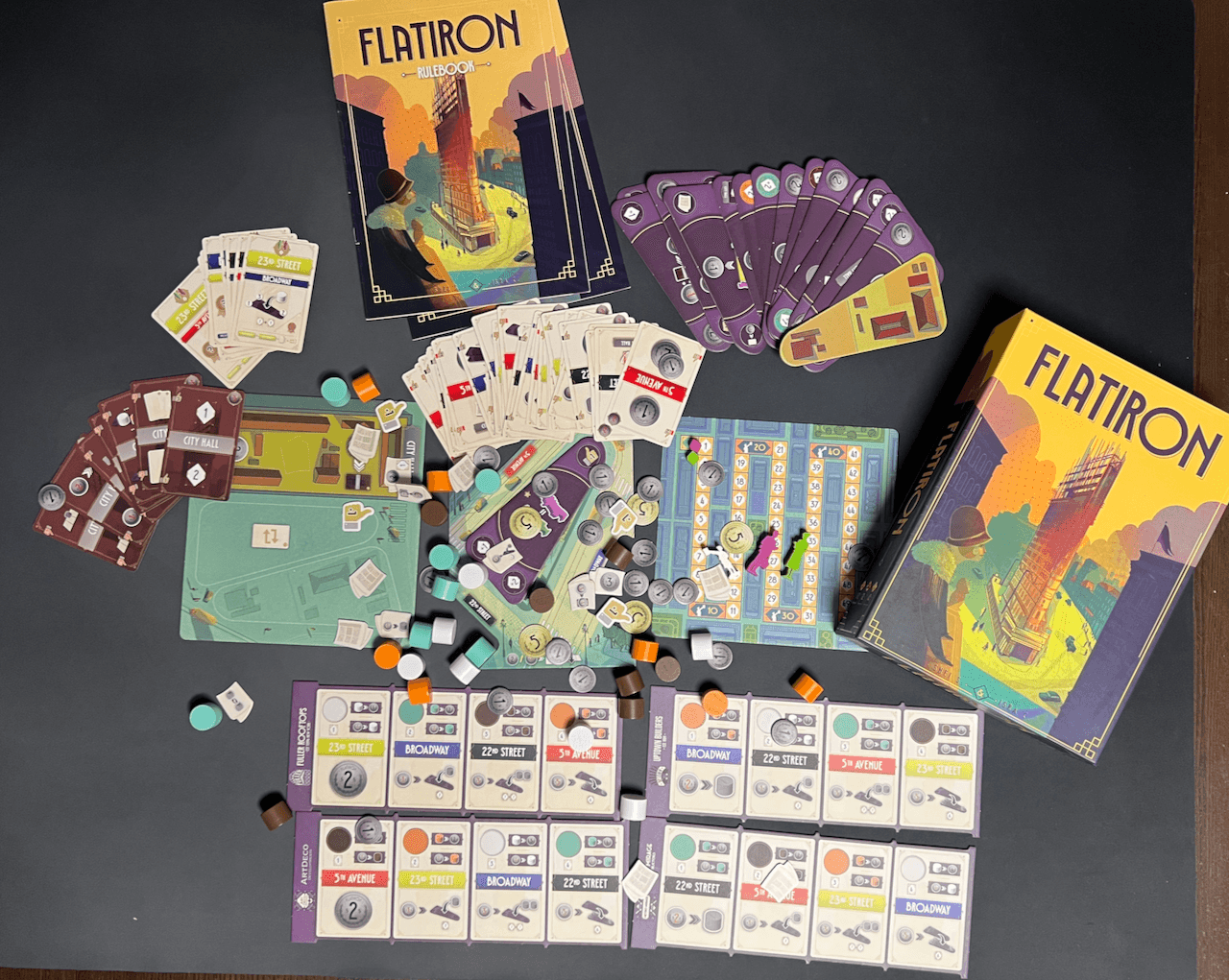
According to the official rules, the box contains:
- a Manhattan board, a City Hall board and a scoring board
- 4 double-sided player boards
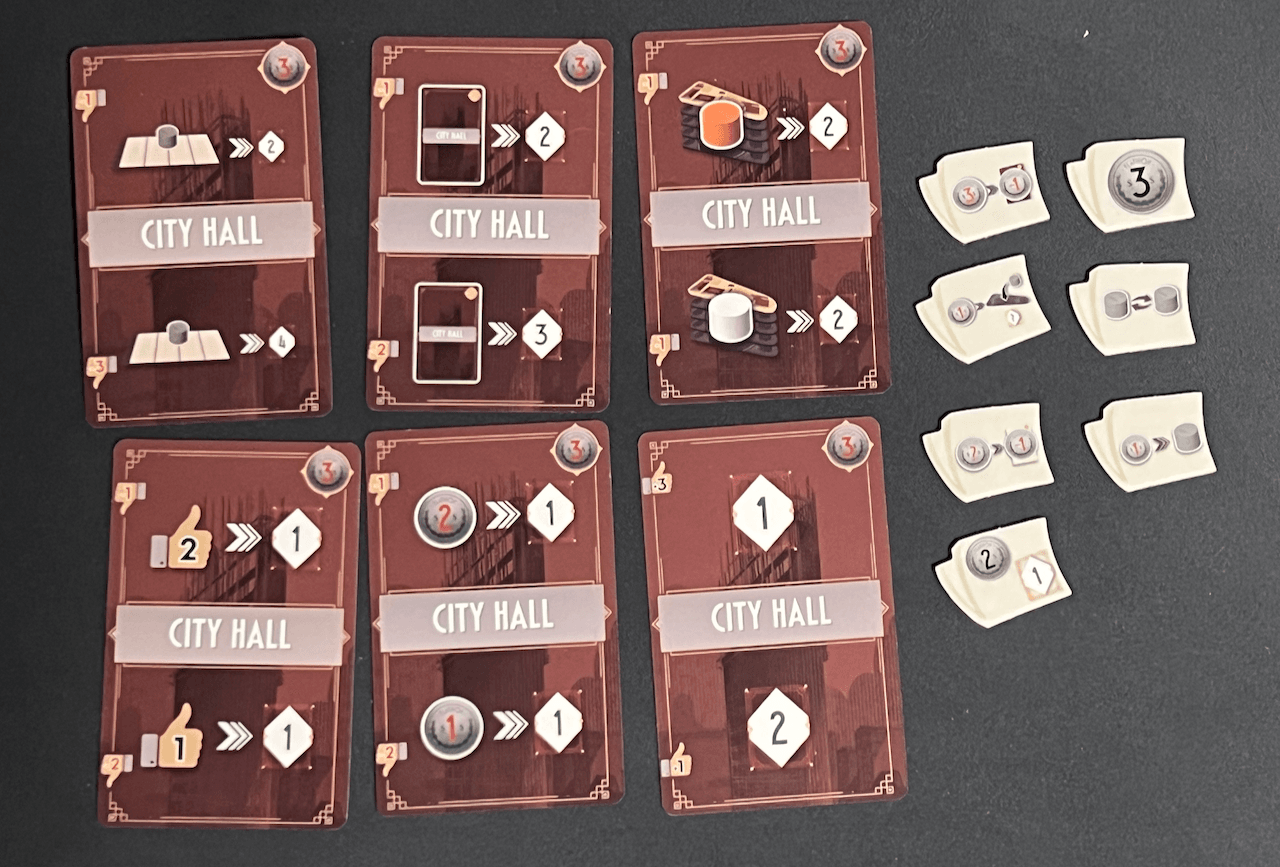
- 32 street cards (8 for each street) and 10 City Hall decree cards
- 15 floors and a roof
- 28 columns (7 in each of four colours)
- 14 newspaper tokens and 4 reputation tokens
- 26 coins (21 worth 1 dollar and 5 worth 5 dollars)
- 2 architects, 2 score markers and the newsboy
- 9 Daniel Burnham cards for the solo game
Flatiron rules
Setup
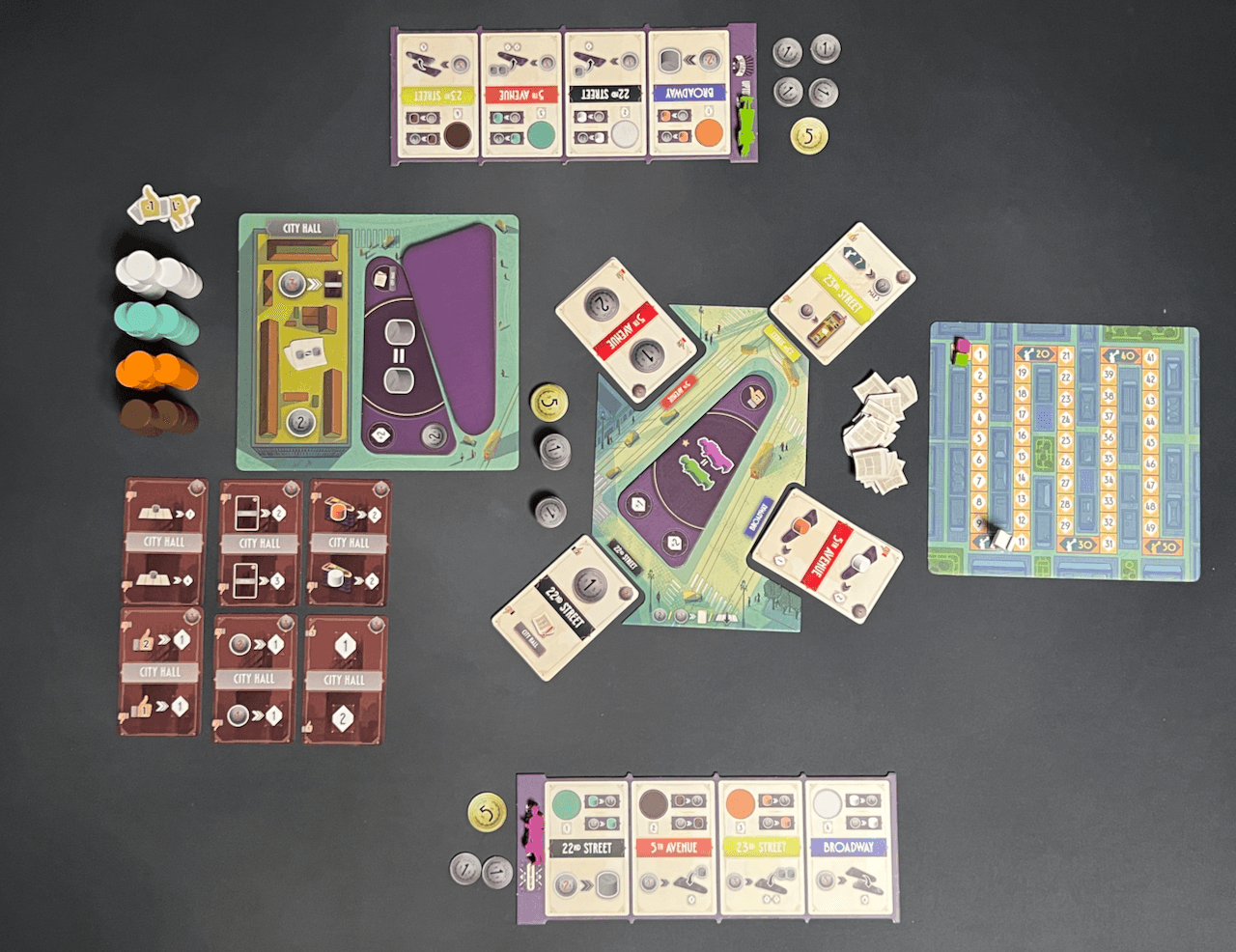
Setup takes only a few minutes. The rules describe it in the following steps:
- Place the Manhattan board in the middle of the table, the City Hall board on one side and the scoring board on the other.
- Place one of the starting floors at random in the middle of the Manhattan board – this is the first active floor. From the remaining floors, randomly make a stack of four and place it on the roof on the City Hall board. Reveal the top floor.
- Shuffle the newspaper tokens and reveal one on the City Hall board, then place the newsboy on space 10 of the scoring board.
- Shuffle the street card decks and place them face up next to their streets, then reveal six City Hall decrees next to the City Hall board.
- Money, columns and reputation tokens form the general supply.
- Each player gets two player boards and chooses one of them and the side they want – for your first games the rules recommend the purple side. Architects and score markers go on space 0.
Who goes first
Choose the first player at random. Because they have the advantage of the first turn, they start with 7 dollars and the second player with 9.
How a turn works
Each turn has two mandatory steps. First you move your architect to an empty location – you can't stay where you are, and you can't go where your opponent is standing. Then you do one of three things at that location:
- buy a card – on a street, the top card of the deck; at City Hall, a decree for 3 dollars;
- trigger the location's actions – on a street, all visible actions in its column on your board; at City Hall, the action of the active newspaper;
- take 2 dollars and do nothing else.
You place a street card in the column of its street on your board. If you place it at the top, the top action stays visible; if at the bottom, the bottom one. The other stays hidden until the end of the game. Each street on your board holds at most three cards and only one decree, which also counts towards the three-card limit. Cards you have placed can't be moved.
Columns and floors
Your board has three basic actions: buy or sell a column, build columns and build a floor. Column prices differ on each board, and you can keep only one column of each colour in your warehouse. When you place a column on a free spot of the active floor, you score the points shown by its warehouse and get that spot's bonus – money, points, a newspaper token or a card.
Two columns of the same colour can't stand on the active floor. Once there are three columns on it, you can build the floor: pay 5 dollars, place the new floor on the columns and score 6 points. The new floor brings its own effect, which applies to both players, and the top cards of all streets go to the bottom of their decks, so the offer is refreshed.
Newspaper tokens
When your or your opponent's score marker reaches the newsboy, you draw two newspaper tokens: you keep one and your opponent gets the other. The newsboy then moves to the next space (20, 30, 40, 50). You can spend the tokens at any time on your turn, but never in the middle of an action – each one gives you an extra action.
End of the game and scoring
The roof is also a floor and you build it the same way. When someone places it, the game ends right after their turn. To your in-game points you add reputation: each street on your board with positive reputation scores 5 points, and each with negative reputation costs 3. Finally you score points for City Hall decrees. The player with more points wins; in a tie, the player who placed the roof wins.
Common mistakes
- You must move your architect every turn – you can't stay at the same location, and you can't move it to where your opponent is standing.
- You can only build a floor once there are three columns on the active floor, and they must all be different colours.
- You can place at most three cards on a street on your board, only one of them a decree, and you never move the cards afterwards.
- After every new floor (except the roof), the top street cards go to the bottom of their decks and the next floor is revealed.
Flatiron tips and strategies
For your first games
With every card you buy, first ask yourself which action you will really need on that street. Place the card so that the one you will use stays visible, because you will never see the other one again. Since a street holds only three cards, every slot is valuable.
Don't forget the simple option: you can take 2 dollars at any location. Columns and floors cost money, and a player without money quickly runs out of good moves.
For experienced players
Where you place your architect counts twice: it chooses your own action and at the same time blocks a location for your opponent. If you know which street they need for their strongest column, a good choice can force them elsewhere for a turn.
Building a floor scores 6 points, but it costs 5 dollars, changes the effect that applies to both of you and refreshes the card offer. Before you build it, check whether the new floor will help you or your opponent more. Towards the end of the game, keep an eye on the roof: whoever places it ends the game and wins any tie.
Watch your reputation too. Cards carry reputation points, and each street with a negative result costs you 3 points at the end, while a positive one scores 5. And save your newspaper tokens for the turn when one extra action unlocks a whole chain.
Who is Flatiron for?
Officially, Flatiron is for 1 or 2 players aged 12 and up, and a game takes about 45 minutes. On BoardGameGeek it has a weight of 2.64 out of 5, which makes it a medium-weight game, and players recommend it most for two.
According to the rules, the basics are simple: move your architect and do one thing. The depth comes from the player board, where you build your own chain of actions, so the first turns take some thought. There is no reading during play, as there is no essential text in the game – but the rules are in English. There is little arithmetic: just money and points.
Luck plays a small role. The floors, decrees and newspaper tokens are shuffled, but the top street cards are face up and on every turn you choose the location and the action yourself. There are no direct attacks, but the two players constantly get in each other's way: an architect blocks a location for the other, both buy from the same decks and build the same building. Nobody is eliminated, and there is little waiting for your turn, since every turn is short.
Solo, you can take on Daniel Burnham, the building's architect, who is run by a deck of nine action cards. The game isn't suited to larger groups, nor to anyone looking for a quick game of luck – Flatiron rewards planning.
Games similar to Flatiron
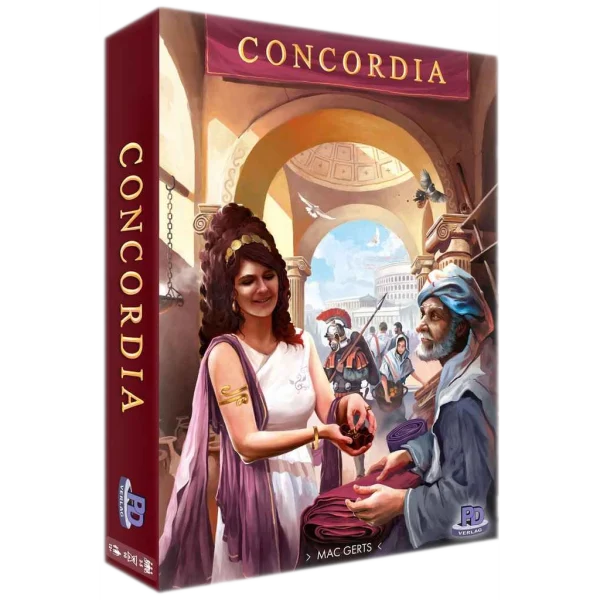
If what you like about Flatiron is that planning, not luck, decides the game, try Concordia – a strategy game of economic development in the time of the Roman Empire.
- Players: 2 - 5
- Age: 13+
- Duration: 100 min
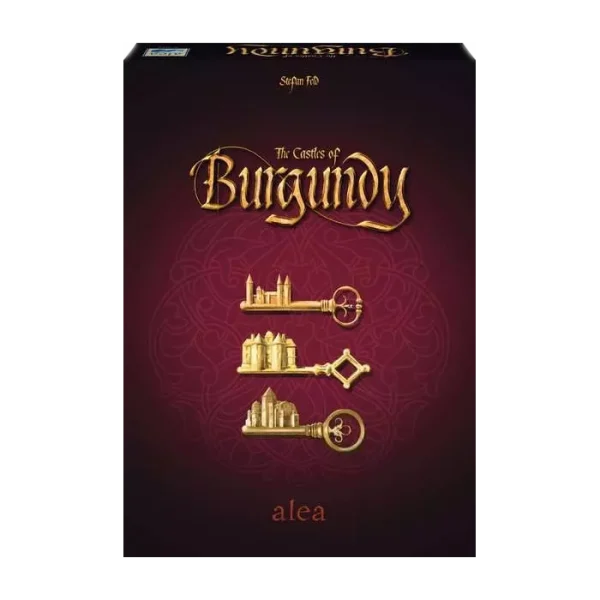
For a bigger challenge there is The Castles of Burgundy, a more complex strategy game in which you build up your principality and plan for the long term.
- Players: 2 - 4
- Age: 12+
- Duration: 30 - 90 min
The White Castle is by the same designers, Sheila Santos and Israel Cendrero. Here, too, you place workers, but at Himeji Castle in Japan, in a game for 1 to 4 players that takes longer and is somewhat more demanding.

- Players: 1 - 4
- Age: 12+
- Duration: 80 min
Flatiron FAQ
Sources
- Official Flatiron rules (PDF, English) – Ludonova
- Flatiron – BoardGameGeek
- The White Castle – BoardGameGeek