



Description
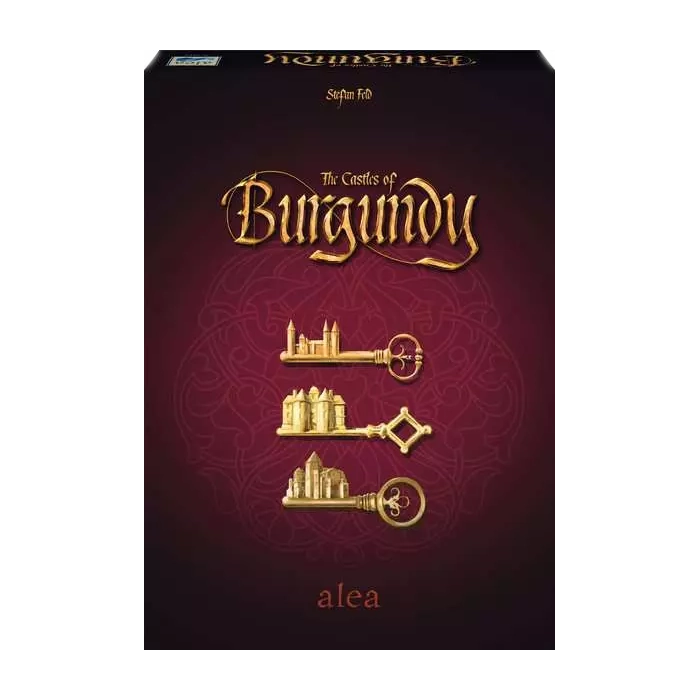
Trade, livestock farming, building or knowledge: every duke leads their estate to prosperity in their own way. The Castles of Burgundy is a strategy game with dice and tiles that has been among the highest-rated strategy games for years. This edition also includes several expansions.
How to play The Castles of Burgundy
The game has five phases of five rounds each. At the start of a round, everyone rolls their two dice at the same time. Each die is one action. With it you take a tile from the depot with that number on the shared board, place a tile on the space with that number in your estate, sell goods or take workers. Workers let you change a roll by one up or down.
A placed tile gives you something right away. A castle grants an extra action, a ship brings goods and a better place in turn order, livestock gives points, a mine gives silver at the end of each phase, and buildings and monasteries give special benefits. You also score points when you fill a whole region, and more if you manage it early. The player with the most points at the end wins.
Why you will love it
- A bad roll is never a wasted turn: workers fix it, and every number opens up some option.
- You may build each type of building only once in each city region, so you have to plan what goes where.
- A herd of the same kind on the same pasture scores again with every new tile.
- Sixteen estate boards with different layouts make sure no two games are the same.
Who is The Castles of Burgundy for
The game is for 2 to 4 players aged 12 and up and lasts 30 to 90 minutes. It is of medium difficulty, and players like it best with two. It suits couples and groups who enjoy calmly building their own estate and compete only for the tiles on the shared board.
There is no text on the components; everything is shown with symbols. The rules are in English.
The same designer also created The Druids of Edora.
What you might not like
If you are looking for attacks and direct conflict, you won't find them here: everyone builds their own estate. There are many symbols and rules for individual tiles, so the first game takes longer and requires some patience. With four players, the wait for your turn gets longer.
What's in the box
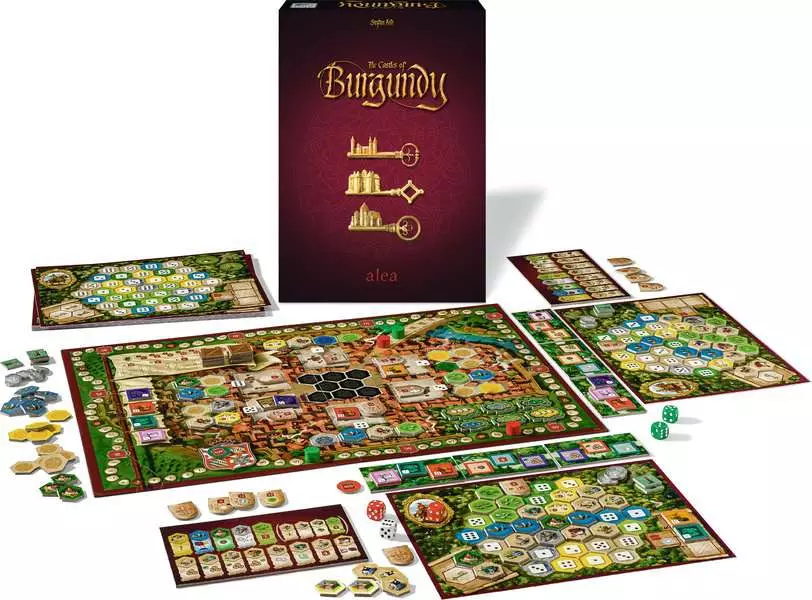
- double-sided game board
- 16 estate boards and 4 reference boards
- 164 hexagonal tiles: buildings, livestock, monasteries, castles, mines and ships
- 42 goods tiles and 12 bonus tiles
- 24 silverlings (silver coins) and 26 worker tokens
- 9 dice and 8 pawns
- 4 tiles for 100 and 200 points
- expansion pieces, including team play and a single-player mode
- rules in English