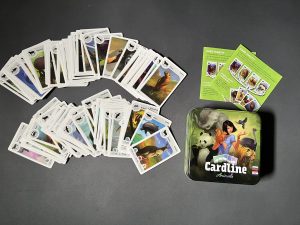




Description
Cardline: Animals is a card game in which you arrange animals in a line by one of three characteristics: average size, weight or lifespan. Is a lobster heavier than a rooster? Does a gorilla live longer than an otter? The answer is on the back of the card, and you only see it once you have already placed the card in the line.
How to play Cardline: Animals
Before the game, you choose together which characteristic you will compare. Each player gets four cards with the characteristics side face down and may not look at that side. The first card from the deck is turned over in the middle of the table to start the line.
On your turn, you choose one of your cards and place it to the left or right of the card on the table, and once the line grows, also between two cards. Then you flip it over. If it is in the right spot, it stays in the line. If not, the card goes back into the box and you draw a new one from the deck. With every correctly placed card there are more spots in the line, and the differences between neighbouring animals keep getting smaller.
The winner is the player who is the only one in a round to correctly place their last card. If several players correctly place their last card in the same round, the others are eliminated, and the remaining players each take one more card and keep playing until only one is left.
Why you will like it
- You can explain the rules in a minute, and a game lasts about 15 minutes.
- You also learn something while playing: the 110 cards cover ten animal groups, from amphibians and crustaceans to insects, birds and mammals.
- Since you can compare three different characteristics, the game is different every time with the same cards.
- Towards the end, the line gets more and more crowded and the tension peaks.
- Experienced players can deal more than four cards each at the start.
Who is Cardline: Animals for
It plays with two to eight players, and players like it best with four. It is simple and suits families with children aged 7 and up, schools and larger groups looking for a short game.
What might you not like?
There is little strategy: whoever knows animals well has an advantage, while the others often guess. Once you remember the figures for individual animals, there is less guessing, so it is a good idea to switch the characteristic you compare from time to time.
What is in the box
- 110 animal cards: the front shows the name and an illustration of the animal, the back also shows its average size, weight and lifespan
- rules