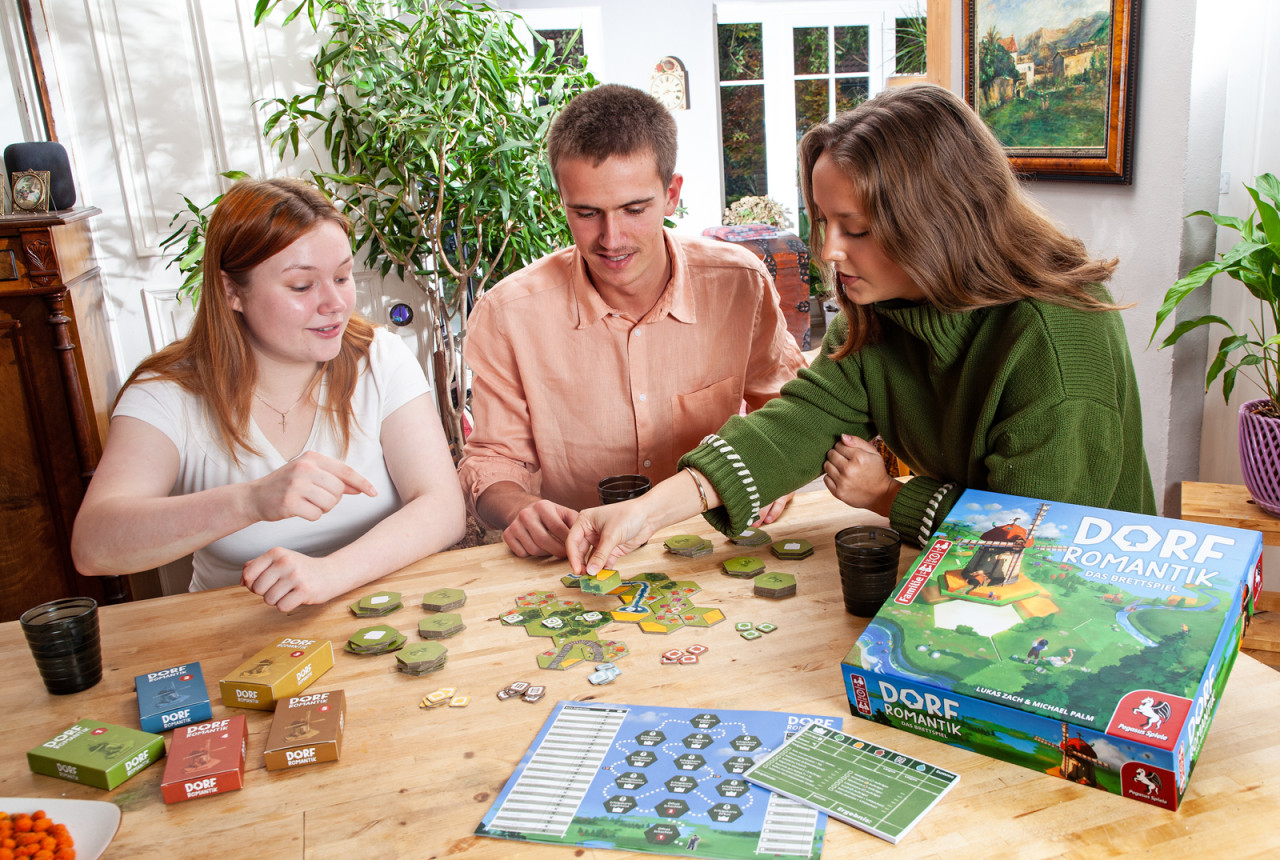
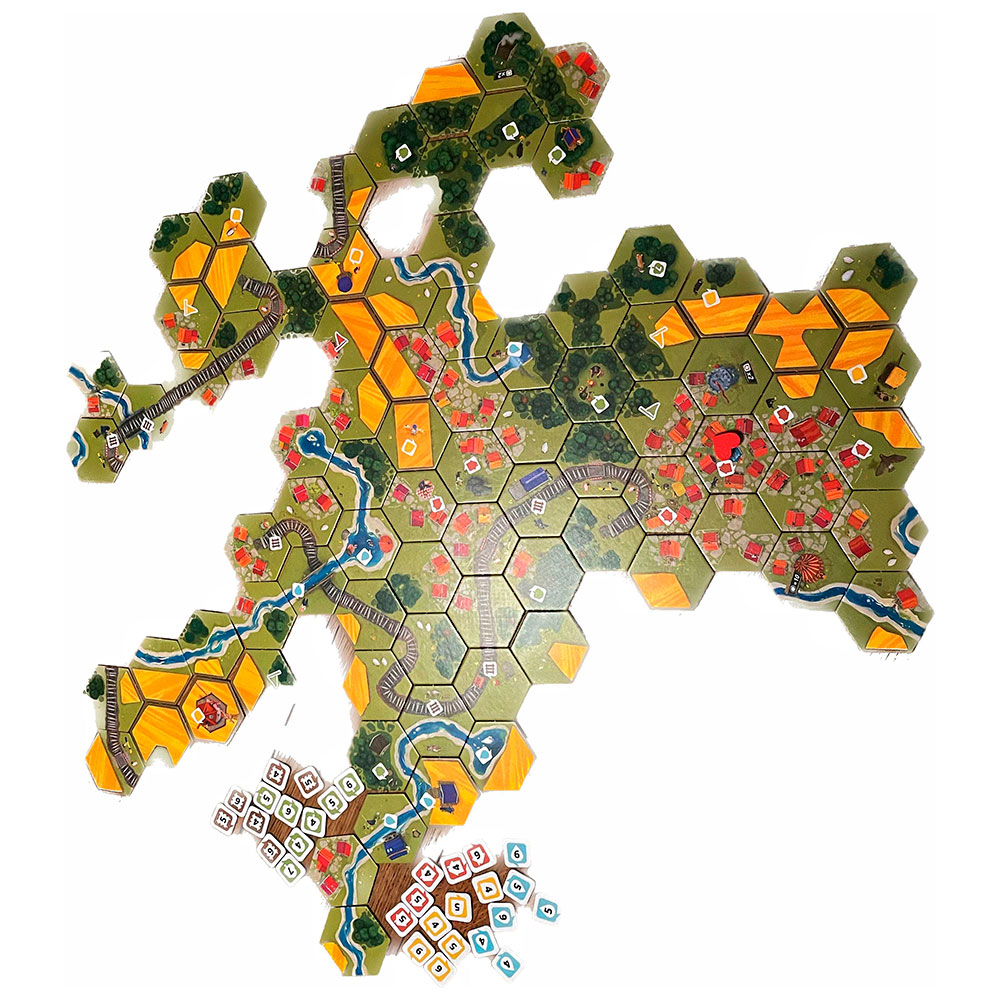
Dorfromantik – The Board Game is a cooperative family game inspired by the video game of the same name. Players lay hexagonal tiles together and build a peaceful, picturesque landscape with rivers, railways, forests and villages. Along the way, they try to fulfil the inhabitants’ wishes and create the longest possible connected structures and completed areas for points. The game also includes a campaign that unlocks new tiles, bringing extra challenges and gradually increasing complexity. Cooperation, planning and optimisation are the key to a high shared score and ever-new records.
Babbling rivers, rustling forests, wheat fields swaying in the wind and here and there a lovely little village – that's Dorfromantik! The gaming community has been thrilled by the video game from the small independent studio Toukana Interactive ever since its early access in March 2021. It has even won several well-known video game awards. Now, with Dorfromantik – The Board Game, Michael Palm and Lukas Zach have turned the popular landscape-building puzzle game into a family board game for all ages.In Dorfromantik – The Board Game, up to six players use hexagonal tiles to shape a beautiful landscape together and try to fulfil the wishes of its inhabitants. At the same time, they must lay the longest possible railway line and the longest possible river, and keep an eye on flags that score points for completed areas. The better the players shape their landscape, the more points they can score at the end of the game. During the replayable campaign, new tiles can be unlocked with the points scored in previous games. These tiles are initially hidden in small, closed boxes. They give players new, additional tasks and allow the high score in this cooperative game to keep rising.
Dorfromantik – an idyllic landscape that soothes the soul and brings players together
Imagine a Sunday afternoon, a cup of your favourite tea and a quiet table, on which a beautiful rural landscape gradually takes shape beneath your fingers. Vast green forests meet golden wheat fields, whilst blue rivers and railway lines wind their way through picturesque villages. No time pressure, no intense competition and no chance of another player ruining your carefully planned moves.
This is Dorfromantik: The Board Game (by Lukas Zach and Michael Palma, published by Pegasus Spiele), which has not conquered the world with wild action or intricate plots, but with its ability to completely relax you. The game offers a unique cooperative experience in which all players work together as a single team, brought to life by its soothing aesthetics and the immensely satisfying mechanics of stacking hexagonal tiles.
Why is the game so popular?
A sense of complete focus and calming gameplay
In today’s world, where most board games focus on aggressive competition, direct confrontation (‘take-that’ mechanics) or stressful resource management under time pressure, Dorfromantik offers something refreshingly different: a Zen-like experience.
The game operates on the principle of complete concentration. Every tile placement brings an immediate visual and tactical reward. As there are no wrong moves in the game that could destroy your landscape, players can play without pressure or fear of defeat. Instead of stress over a potential loss, the focus is on solving spatial puzzles and building an ever-expanding landscape.
Social aspect: fully cooperative play
Many co-operative games suffer from the so-called ‘alpha player’ problem, where one experienced player dictates all the moves to the others. Dorfromantik solves this problem in a very natural way:
Open discussion: As all the tiles and objectives are visible to everyone at the table, each round unfolds as a relaxed conversation. “Where should we put this river? If we place it here, we’ll block off the forest, but will that solve the railway challenge?”
Shared responsibility and success: There are no individual points in the game – the team either wins or sets a new record together. Success is shared, and the joy of completing a difficult task is all the greater for it.
Why has it become such a hit?
The community of board game enthusiasts is incredibly diverse, but there is a noticeable rise in demand for games that appeal to both experienced strategists and family members or partners who are just starting out in the world of board games. Dorfromantik has become a real hit for several reasons:
A bridge between generations: Children, teenagers, parents and grandparents all enjoy playing it equally. The rules are so simple that you can explain them in a few minutes, yet the strategic depth provides hours of fun.
The perfect game for couples: Couples love Dorfromantik as a way to unwind in the evening after a hard day’s work, over a cup of tea or a glass of wine.
A campaign element with a ‘legacy’ twist: The game includes locked boxes containing items that you unlock based on the points you’ve scored. This encourages players to return to the table time and time again.
Detailed instructions and gameplay
List of components: What’s in the box?
When you first open the Dorfromantik box, you’ll notice the superb organisation and high-quality cardboard components:
48 landscape tiles: Hexagonal tiles featuring motifs of forests, wheat fields, villages, rivers, railways and meadows.
25 task tiles: Tiles featuring specific task icons.
25 Task markers: Tokens with numerical values (4, 5 or 6) for five types of terrain (forest, wheat, village, river, railway).
Flags: Markers on certain tiles to denote the completion of areas.
1 score pad: Sheets for accurately recording points at the end of the game.
1 Campaign Pad: For tracking progress and unlocking new content.
5 Mystery Boxes: Contain additional components, cards and rules that you only open once you’ve reached certain milestones!
Note: The game does not destroy components! Although it features campaign elements and the unlocking of new content, you can fully reset the game to its initial state at any time.
Setting up the game
Setting up the game is quick and straightforward:
Separate the tiles: Shuffle all the task tiles and place them in a pile, face down. Do the same with the landscape tiles. (Randomly remove 3 landscape tiles and return them to the box – this preserves the element of surprise.)
Prepare the task tokens: Sort the task tokens by colour or icon and arrange them into 5 piles, face down.
The first three turns: As there must always be at least 3 active tasks on the table (if possible), the first player draws three task tiles one after the other, places the corresponding task tokens on them with the number facing up, and stacks them neatly in the centre of the table.
Game mechanics: Turns and placement rules
The game proceeds in a clockwise direction, but as this is a cooperative game, all players work together to decide on the best move.
Rule for drawing tiles
On their turn, a player draws one tile:
If there are fewer than 3 active tasks on the table, you must draw a task tile. You immediately attach the corresponding random task token of that type to this tile.
If there are already 3 active tasks on the table, you draw a standard landscape tile as usual.
Rules for placing tiles
You must place each new tile so that at least one side touches a tile already placed on the table.
General terrains (forest, wheat field, village, meadow): You may place these terrains anywhere you like. The edge of a forest may touch a village or a meadow. Stacking matching types together is, of course, desirable for scoring purposes, but it is not strictly required.
Strict connections (rivers and railways): A river must always connect to another river, and a railway line must always connect to another railway line! You must not place a river so that it flows into dry land or a house.
Completing tasks
The task token shows a number (4, 5 or 6). This number represents the exact size of the area you must achieve.
Once you have connected exactly that many tiles of the same type (e.g. a forest made up of exactly 5 tiles), the task is complete!
Remove the task token from the table and set it aside for scoring at the end of the game.
As you now have only 2 active tasks on the table, the next player will draw another task tile to fill the gap and bring the number of active tasks back up to 3.
Be careful not to go over the limit! If you accidentally connect the task area to form a zone that is too large (e.g. the task requires 4 forest tiles, but you immediately extend it to 6 with a new tile), the task has failed! Remove the token from the game and you will not receive any points for it.
Victory conditions
The game ends as soon as you need to draw a landscape tile but the pile of landscape tiles is completely empty.
The points are then totalled on the score sheet:
Completedtasks: Add up the values of all successfully completed task tokens.
Longest river and railway: You receive 1 point for each tile in the longest unbroken river and the longest unbroken railway line.
Flags: For each area with a flag (forest, village, field) that is completely enclosed by the end of the game (has no open edges of that type), you receive points for each tile in that area.
Unlocked elements: Points for special cards and mechanics from unlocked boxes.
You record your total score on a sheet that tells you how many spaces you’ve advanced along the track and which new box or achievement you’ve unlocked!
Analysis of strategies and tactics
Experience Level
Main focus
Key mistakes to avoid
Beginner
Completing the 3 current tasks on the board.
Accidentally blocking rivers or thoughtlessly merging large forests too early.
Advanced player
Planning space for future tasks and keeping edges open.
Blocking off river options and failing to observe the conditions for flags.
Master of Dorfromantika
Making the most of points from flags and optimising mechanics from unlocked boxes.
Focusing solely on basic tasks and ignoring long paths and rivers.
Strategy for beginners
Build modularly: Don’t just have one huge forest or field. Create several smaller areas. If you receive a task worth 4, it will be much easier to connect it to a small forest than to an existing huge forest consisting of 10 tiles.
Keep an eye on river and railway branches: Rivers and railways are the only tiles with strict placement rules. Be careful not to block the flow of a river into a ‘dead end’ in the middle of the map, as this will drastically limit your options for future river tasks.
Combining tasks of the same type: If you have active tasks for spaces 4 and 5 at the same time, build them close together. Once you’ve completed 4, you can use the next tile to extend this area to 5 and complete the second task straight away!
Advanced tactics for experienced players
Managing flags: Flags at the end of the game are worth a huge number of points, but only if the area is completely enclosed! Plan the end of the game so that you enclose the areas with flags in good time using meadows or other terrain types.
Controlling ‘empty’ edges: Create pockets on the map where the empty space is surrounded by 3 or 4 tiles that have already been placed. When you later draw the right tile, you’ll be able to enclose several terrains at once with a single move and complete multiple objectives.
Anticipating what’s left in the pile: You know there are 48 landscape tiles. As the deck nears the end, do not start new large-scale tasks, but focus on closing existing flags and extending the longest railway and river!
Overview of official expansions
Although the base game already includes 5 mystery boxes with extensive content within the campaign itself, the creators have also prepared additional treats for the biggest fans:
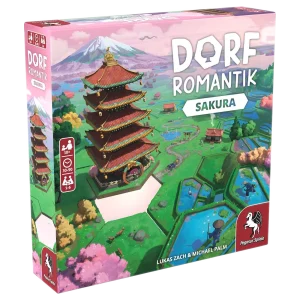
Shift the theme to picturesque Japan with cherry blossoms, new natural wonders and fresh quest mechanics. For anyone who has played the base game to the full and is looking for new visual and strategic challenges.
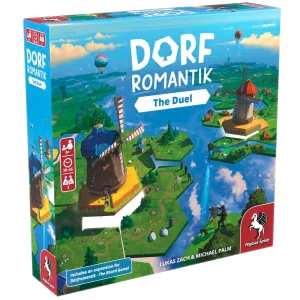
An expansion that introduces a competitive two-player mode to the game. Instead of jointly creating a landscape, players compete to build their own landscapes and try to score more points through more strategic tile placement. An excellent choice for couples and anyone looking for a slightly more competitive version of Dorfromantik.
Dorfromantik: Light Luggage
A small expansion that introduces new content and additional options for creating landscapes. It is primarily intended for players who wish to spice up the base game with new elements and further expand their gameplay options.
Frequently Asked Questions
Is Dorfromantik suitable for children?+
Yes! The game is officially suitable for players aged 8 and up, but younger children can also play it with some help from older players. Since Dorfromantik is a cooperative game, adults can help children understand the rules and advise them when placing tiles, while leaving the decisions up to them.
Is Dorfromantik language-independent?+
Yes. Dorfromantik is almost completely language-independent. The tiles and tokens mainly use symbols and numbers, so no knowledge of a foreign language is required to play. Some text appears in the instructions and in the content you unlock during the campaign, but this does not affect the gameplay itself.
How long does a game of Dorfromantik take?+
A game usually takes around 30 to 60 minutes. The playing time also depends on the number of players and how much time you spend planning each move together.
Can I play Dorfromantik solo?+
Yes! Dorfromantik can also be played in solo mode. The player makes all the decisions alone and tries to connect the landscape tiles as effectively as possible, complete objectives, and achieve the highest score possible. Solo mode is a great choice for anyone who enjoys calm and relaxing mental challenges.
Can I still play the game after unlocking all the boxes?+
Of course! Unlocking the boxes is part of the campaign, but completing it does not mean the game is over. Once you have unlocked all the additional content, you can continue playing with all the elements and mechanics you have acquired. If you want, you can also reset the campaign and experience the entire unlocking process again.
How is the Dorfromantik board game different from the computer game?+
The board game is based on the popular computer game Dorfromantik, but it has been adapted for tabletop play. The biggest difference is that the board game is cooperative – all players work together to build a single landscape, complete objectives, and try to achieve the best score possible. Instead of a screen, you have physical cardboard tiles and tokens in front of you, making the experience more social.
Conclusion
Dorfromantik is more than just a board game; it is a journey into a world of tranquillity, aesthetics and creative collaboration. Thanks to its unique balance between accessibility for beginners and depth for experienced strategists, it has earned the prestigious title of Spiel des Jahres (Game of the Year). If you’re looking for a game that lets you relax, connect with loved ones and create something wonderful every time you play, this is an essential addition to your collection.
Get your copy of Dorfromantik and create your own idyllic landscape today!