




Description
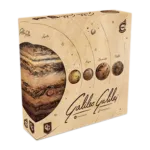
At the turn of the 16th and 17th centuries, Europe is embracing new scientific ideas, and astronomers are observing the sky through telescopes for the first time instead of with the naked eye. In Galileo Galilei you take on the role of one of four astronomers and try to become the most famous scientist of your time. The Church is watching closely, so heretical ideas can cost you dearly.
How to play Galileo Galilei
On your turn, you move the telescope on your board one to three spaces forward across the starry sky. Each space has a permanent action and an action tile that moves forward after every turn, so the available actions keep changing. You don't roll the dice: you gradually raise their value with actions and then spend them to observe the celestial bodies and constellations on discovery cards. An observation scores points, and the card goes into your library, where writing unlocks rewards. At the university, lectures move you up the tracks, while comets lower the cost of observing.
Some observations and lectures bring inquisitors into your cellar. If you don't convince them of your innocence, they damage your reputation at the trial and take points away from you at the end. The game ends when the last discovery card comes onto the board. You finish the round and then play one more final round. The astronomer with the most points wins.
Why you will like it
- The telescope only moves forward, so you plan ahead which actions you will reach in your next turns.
- Action tiles can be upgraded to their gold side, which is noticeably stronger.
- The inquisitors push you to take risks, but every fully convinced inquisitor earns you a point at the end.
- In the advanced rules each astronomer has their own special ability, and in the solo game you face the opponent Tycho Brahe.
Who is Galileo Galilei for
The game is for one to four players aged 12 and up and takes one to two hours. Players like it best with three. It is of medium difficulty, so it will suit players who already know a few strategy games and like to plan several moves ahead. Actions and rewards are shown on the components with symbols.
What you might not like
The rules have many symbols and small details, so the first game is slower, and it may not be the best fit for those who prefer quick and simple games. Players meet mainly over the discovery cards and the university goals; there are no direct attacks.
What's in the box
- game board
- 4 player boards with a telescope and 4 astronomer boards
- 33 discovery cards and 2 reference cards
- 30 observation dice (10 in each of three colours)
- 24 action tiles, 6 item tiles and 6 double-sided university track tiles
- 32 inquisitor figures
- 26 small and 8 large quadrants
- 28 comet tokens, 28 constellation tokens, 16 book tokens, 16 university tokens, 16 goal tokens, 4 court tokens and 4 point tokens
- first player token
- components for the solo game (Tycho Brahe) and for the advanced rules
- rules