




Description
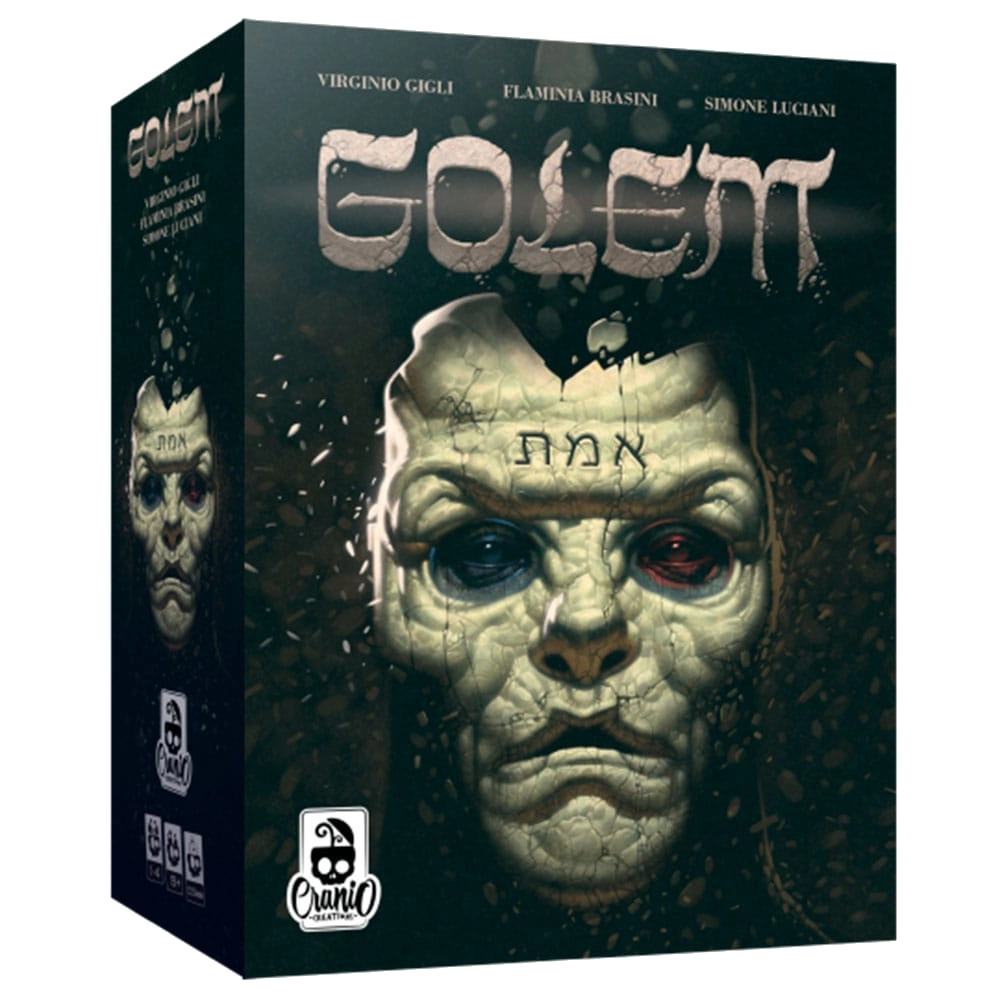
Prague, 1584. In the dark attic of the synagogue, Rabbi Loew writes the word “truth” on the forehead of a giant of clay, and the golem opens its eyes. In Golem you are scholars who want to repeat this feat: you study ancient books, melt gold for artefacts and bring golems to life to do work in the neighbourhoods of Prague. But you have to keep your golems in check with your students and the knowledge you have gathered.
How to play Golem
The game lasts four rounds. In each round, every player takes two actions with marbles and one with their rabbi. In the synagogue, the marbles are sorted into five rows, each belonging to one action: work, golems, artefacts, learning and mirror. The value of an action equals the number of marbles in its row, and the colour of the marble you take moves your student through one of the three districts of Prague. The rabbi occupies one of the action tiles and also sets the turn order for the next round.
At the end of each round, you pay knowledge for every golem that has got too far ahead of the student in its district; otherwise you lose points. You can also bury a golem in the cemetery and gain a reward. At the end of the game, you score points for goal cards and for golems, artefacts and columns of books. Points for golems are multiplied by the number of red candlesticks, points for artefacts by the yellow ones and points for books by the blue candlesticks.
Why you will love it
- Every marble you take lowers the value of that action for the next player, so the order in which you choose matters too.
- The colour of the marble also moves your student, so every choice opens up another decision.
- Golems work for you, but the further they get ahead of your student, the more knowledge they cost. Sometimes it pays to bury a golem.
- Golems, artefacts and books are multiplied by candlesticks at the end, so you look for the right balance between them.
Who is Golem for
Golem is for one to four players aged 14 and up and takes 90 to 120 minutes. It is a medium-difficulty game that experienced players who like to make long-term plans will enjoy. Players like it best with two or three. For the first game, the rules offer an introductory setup that makes getting started much easier.
What might you not like?
There are a lot of rules and symbols, so the first game needs quite a bit of explaining. It may not be the best fit for those who prefer quick games with simple rules.
What's in the box
- main board, synagogue board and cardboard synagogue with a plastic tray
- 15 coloured marbles, 12 action tiles and 4 skip-turn tiles
- 12 character cards, 27 goal cards and 38 book cards
- 30 neighbourhood tiles, 18 starting tiles, 4 artefact tiles and 3 candlestick tokens
- clay, coin and knowledge tokens and 40 gold pieces
- for each player: personal board, rabbi, 3 students, 6 golems, 4 markers, 6 development tiles each for golems, learning and artefacts, and a reference card
- rulebook