





Description
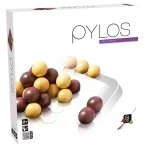
Thirty balls, one pyramid and only one winner. In Pylos you and your opponent take turns building a pyramid of light and dark balls. Whoever places the last ball on top wins, so you have to save your balls and not use them up too early.
How to play Pylos
On your turn, you place a ball from your supply into an empty hollow on the board. When four balls form a square, you can place a ball on top of it on the next level. You can also save a ball by raising one of your balls that isn't supporting anything from the board to a higher level. When you make a square of four balls of your own colour, you take one or two of your balls back into your supply.
Whoever runs out of balls loses, and whoever places the last ball on top wins. For beginners there is a children's version without squares of your own colour, and for experienced players a version in which lines of balls also count.
Why you'll like it
- You can explain the rules in a minute, yet the game gives you plenty to think about.
- Every ball you save counts, as it decides who reaches the top.
- A square of your own colour gives you balls back, so your opponent tries to block it.
- The wooden pyramid and balls also look lovely as a decoration on a shelf.
Who is Pylos for
The game is for 2 players aged 8 and up and takes 5 to 20 minutes. It is fairly easy and suits fans of abstract games such as chess or draughts, as well as children, who can start with the children's version. There is no text on the components. This is the Slovenian edition.
What you might not like
The game is for two players only and has no story, so anyone looking for a game for more players won't find what they want here. There is no luck, so an experienced player will usually beat a beginner.
What's in the box
- a pyramid-shaped board with 16 hollows
- 15 light and 15 dark balls
- rules