




Description
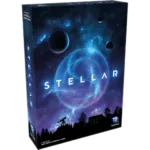
In Stellar, two stargazers calibrate their telescopes and gradually build a view of the night sky in them: planets, moons, asteroids, interstellar clouds and black holes. This two-player card game takes about 30 minutes, but every turn calls for some thought.
How to play Stellar
The game lasts 11 rounds. Each player has a telescope with 12 spaces in front of them and a notebook below it. On your turn, you first take one of the five cards lying in a row in the middle of the table into your hand. Then you play a card from your hand to your telescope or your notebook. The number on that card decides which card from the row you must play now, and it goes to the other part: if you placed the first card in your telescope, the second one goes to your notebook, and vice versa.
In the telescope, cards of the same type must sit next to each other, and the stars on them score points. In the notebook, you collect runs of numbers for each type, since the longest run multiplies the stars of that type in your telescope. At the end, you also compare the three sections of your telescope with your opponent's: whoever has the higher sum of numbers in a section scores 10 points. You score another 10 points if your telescope holds all five types of celestial bodies.
Why you'll love it
- The rules are short but the decisions are interesting, since every card works differently in the telescope and in the notebook.
- Because the card from your hand decides the card from the row, you're always planning two steps at once.
- The cards feature short, fun facts about space that don't affect the game.
- The game is small, quick to set up and perfect for an evening for two.
Who is Stellar for
The game is for two players aged 8 and up and takes about 30 minutes. It's a moderately easy game for couples and space lovers who like card games with few rules and lots of decisions. Its main mechanics include Hand Management, Drafting (you take cards from the shared row), Set Collection, Area Majority / Influence and Tile Placement (here you place cards in your telescope instead of tiles). No knowledge of English is needed to play. The game was designed by Ben Pinchback and Matt Riddle.
What might you not like?
Final scoring takes some adding and multiplying, which is why a score pad is included. Since you don't directly affect your opponent's play area, the game may not suit players who enjoy open confrontation.
What's in the box
- 60 celestial body cards
- 5 number cards
- 24 telescope cards (2 sets of 12)
- score pad (50 sheets)
- 2 turn summary cards
- rulebook