



Description
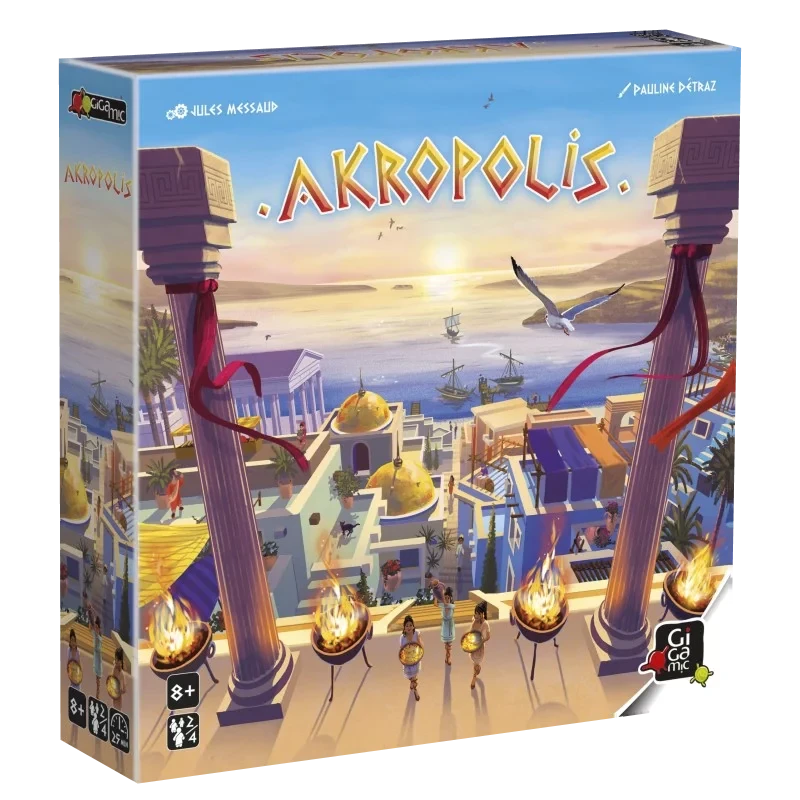
In the heart of the Mediterranean, rival cities compete for wealth and glory, built by the finest architects of ancient Greece. In Akropolis you are one of them: you build houses, markets, barracks, temples and gardens, and adorn your city with plazas that multiply the points of your districts. Don't forget about stone. Without enough quarries you won't be able to build higher, and it is the high districts that score the most points.
How to play Akropolis
A row of face-up tiles, the construction site, lies in the middle of the table. On your turn, you choose one tile and add it to your city. The first tile in the row is free, and for each tile before the one you choose, you pay one stone. You place the tile next to your city or on a higher level, where it must rest entirely on other tiles. When you cover a quarry, you gain a stone.
When only one tile is left on the construction site, you refill it with a new stack. When the stacks run out, the game ends. Districts score only if they are placed correctly and you have a plaza of their color in your city. A district on the first level is worth one point, on the second two, on the third three. You multiply the total by the stars on plazas of the same color, and each remaining stone scores one more point. The player with the most points wins.
Why you'll like it
- Each type of district has its own rule: houses count only in your largest group, a market must not stand next to another market, barracks stand on the edge of the city, temples must be completely surrounded, and gardens are welcome anywhere.
- Your city grows upward: you place a new tile over the old ones and cover a low district with a more valuable one.
- The construction site presents you with a choice every turn: do you take the first tile for free, or pay stones for the one that really fits your city?
- Plazas with more stars multiply the points of a whole type of district, so it pays to decide early which districts you will build.
Who is Akropolis for
Akropolis is suitable for players aged 8 and up and takes about 25 minutes. It plays with two to four players, and players like it best with three. In terms of difficulty, it is fairly easy: the rules are quick to explain, while building your city offers enough to think about even for experienced players. There is no text on the components, and the box contains Slovenian rules. In 2023 it was on the recommendation list of the German Spiel des Jahres award, and in France it won the As d'Or award for game of the year.
What might you not like?
Each player mainly builds their own city, so the game may not be the best fit for those who enjoy lots of direct conflict and negotiation.
What's in the box
- 61 city tiles
- 4 starting tiles
- 40 stone cubes
- 1 Chief Architect marker
- 4 player aid cards
- 1 scoring pad
- rules