Description
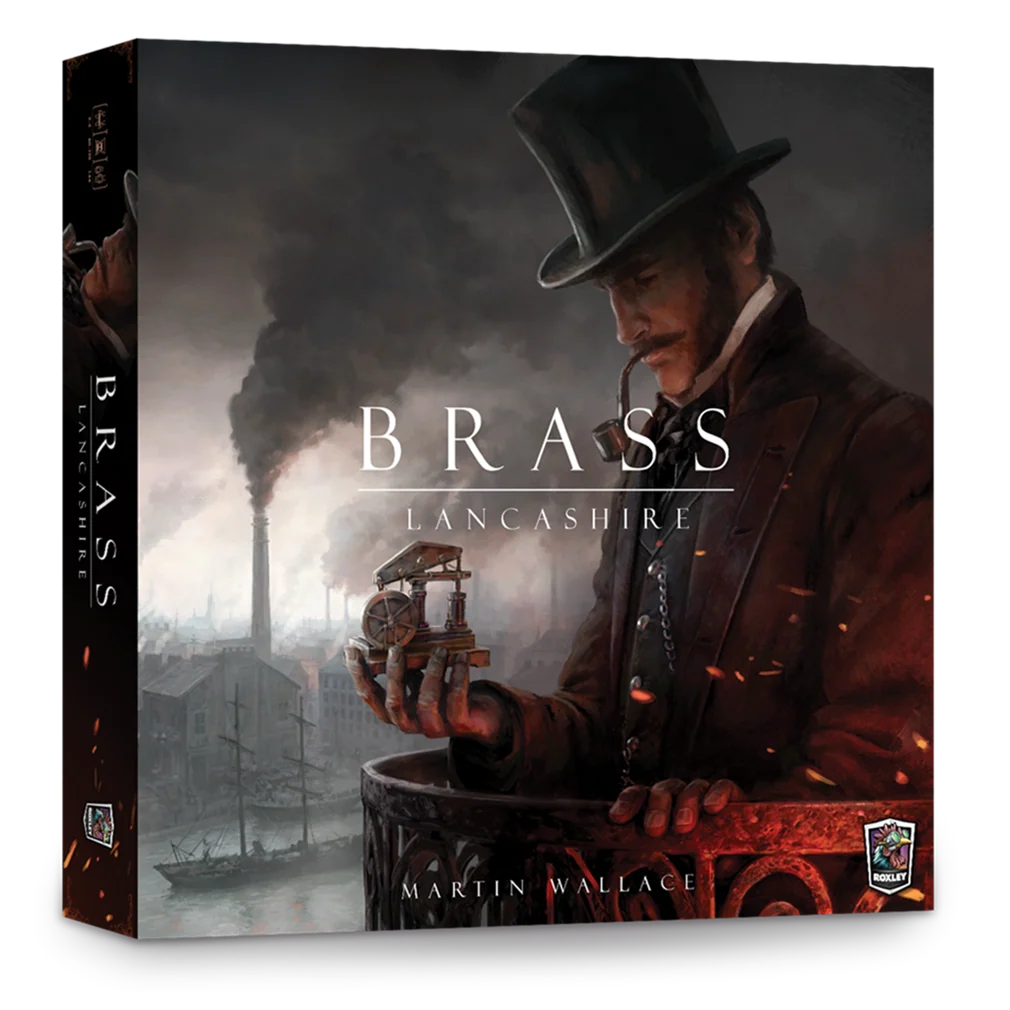
Brass: Lancashire – first published as Brass – is an economic strategy game that tells the story of competing cotton entrepreneurs in Lancashire during the industrial revolution. You must develop, build and establish your industries and network so that you can exploit the demand for iron, coal and cotton. The game is played over two halves: the canal era and the rail era. To win the game, score the most victory points (VP), which are counted at the end of each half. VPs are gained from your canals, rails and established (flipped) industry tiles. Each round, players take turns according to the turn order track and receive two actions to perform any of the following:
- Build an industry tile
- Build a rail or canal
- Develop an industry
- Sell cotton
- Take a loan
At the end of your turn, you replace the two cards you played with two more from the deck. Turn order is determined by how much money a player spent on the previous turn, with whoever spent the least going first. This turn order mechanism opens up some strategic options for players who go later in turn order, allowing the possibility of consecutive turns.Once all cards have been played for the first time (with the deck size adjusted to the number of players), the canal era ends and a scoring round takes place. After scoring, all canals and all lowest-level industries are removed from the game, new cards are dealt and the rail era begins. In this era, players may now occupy more than one location in a town, and double-link builds are possible (though expensive). At the end of the rail era, another scoring round takes place and the winner is crowned.Cards restrict where you can build your industries, sell cotton or establish links (although any card can be used to 'develop'). This leads to strategic timing and saving of cards. Resources are shared, so if you build a railway line (which requires coal), you must use coal from the nearest source, which may be an opponent's coal mine, in turn bringing that mine closer to scoring.