




Description
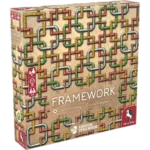
In front of you are tiles with coloured frames and numbers. Framework sets you a simple puzzle: build your own grid from the tiles so that frames of the same colour join up into long chains. The tiles show tasks, such as “at least 6 brown frames”, and you cover each one you complete with one of your markers. The first to place all 22 markers wins. The game was designed by Uwe Rosenberg and illustrated by Lukas Siegmon.
How to play Framework
Each round you draw one tile more than there are players from the bag and lay them face up in the middle of the table. In turn, everyone takes one and adds it to their grid right away, always horizontally or vertically next to a tile already placed. The last tile goes to the player who started the round, and then the bag passes to the next player.
A task is complete when enough frames of the required colour touch its tile. The whole chain of connected tiles with that colour counts, not just the neighbouring ones. The game ends immediately when someone places their last marker, or after the round in which the tiles run out. Then the player with the fewest markers left wins.
Why you will like it
- A tile at one end of your grid can complete a task at the other end, because the whole chain of the same colour counts.
- You decide which tasks on a tile you go for, since you don't have to complete them all.
- You pick from a shared display in turn, so someone may take the tile you were waiting for before you.
- There is also a solo mode: you draw tiles one by one, can store two on a card for later, and the goal is to stay as close as possible to a 5 × 5 grid.
Who is Framework for
The game is for one to four players aged 8 and up, and it takes about 30 minutes. It is simple and the rules can be explained in a few minutes, so it suits families and anyone who enjoys spatial puzzles. Players like it best with two. There is no text on the components, only colours and numbers. For your first game, the rules suggest a shorter variant with four markers fewer.
What you might not like
Everyone builds their own grid, and players can hardly harm each other. So it may not be the best fit for those who prefer games with more direct confrontation.
What's in the box
- 120 frame tiles
- 88 markers (22 in each of four colours)
- bag
- overview card with storage for the solo mode
- rules