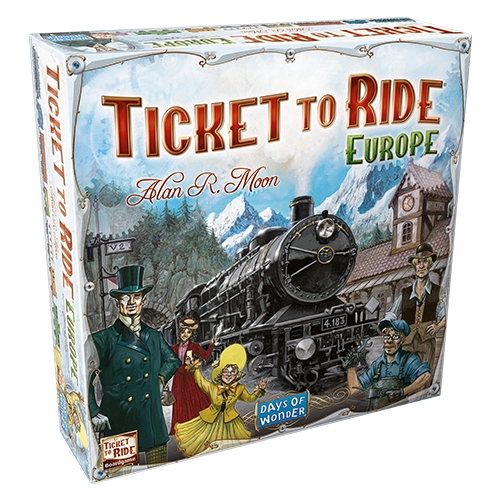
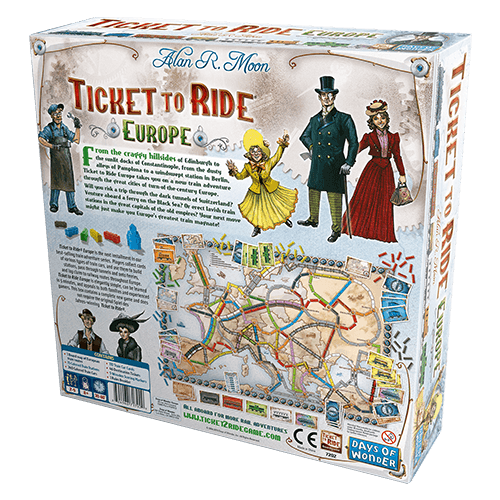
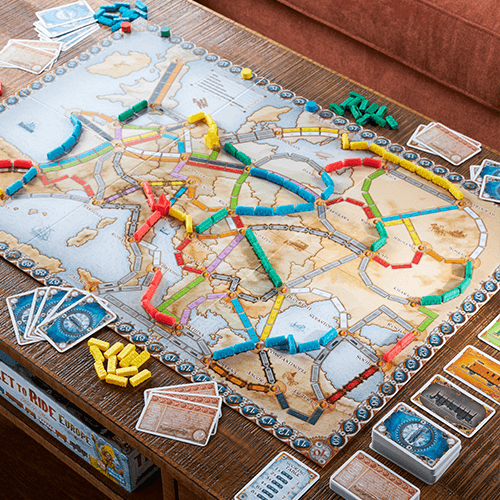
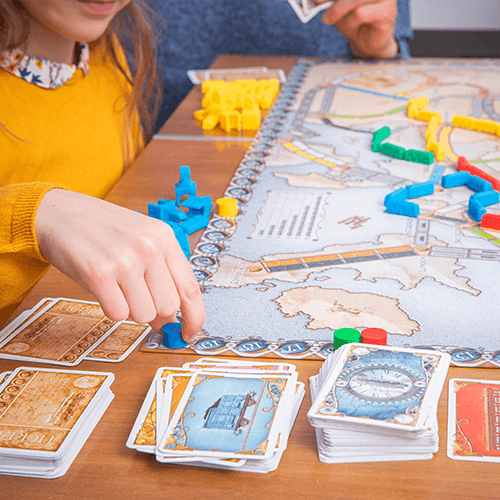
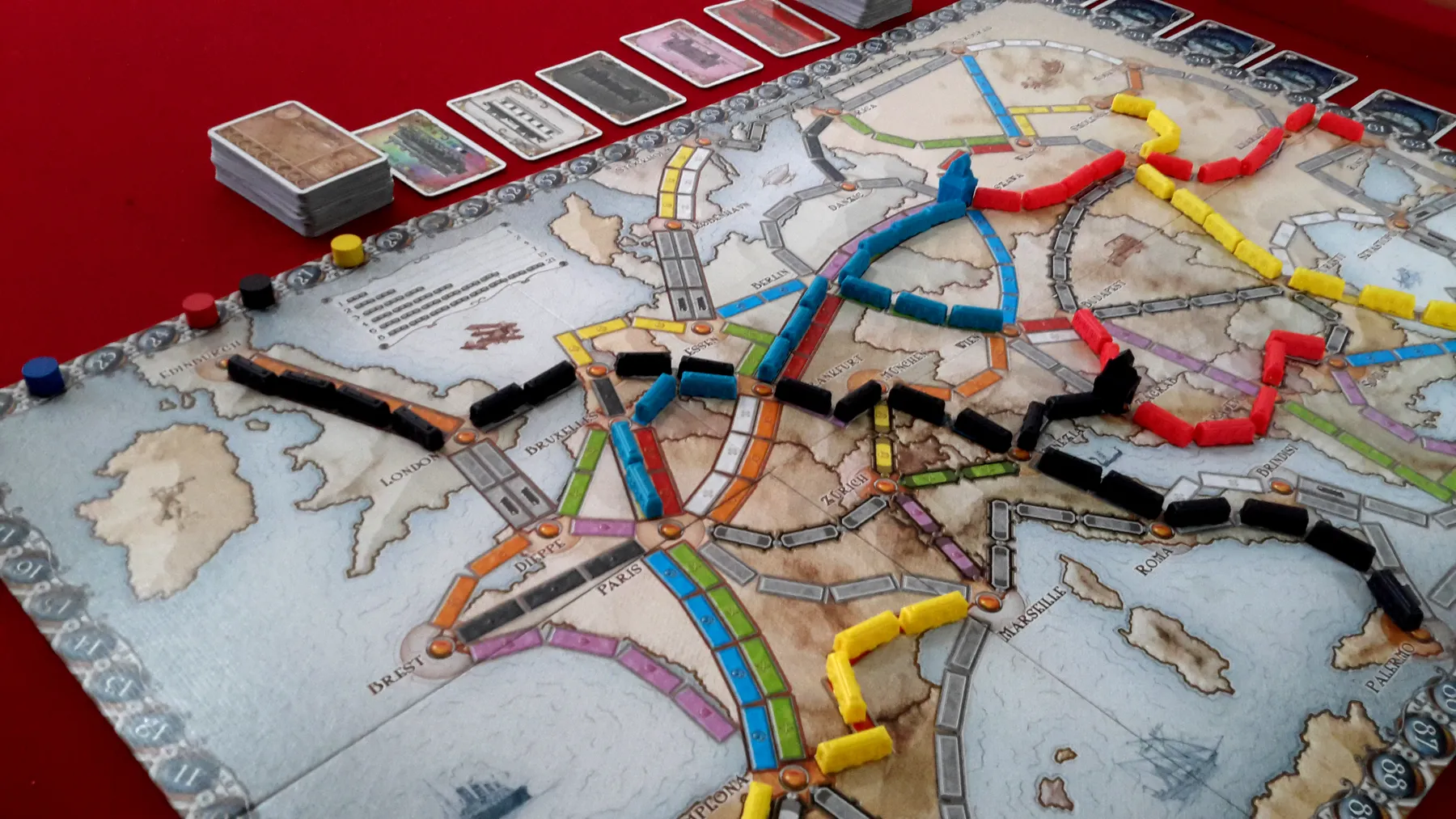
From Edinburgh to Constantinople and from Lisbon to Moscow: in Ticket to Ride: Europe you build railway routes across turn-of-the-century Europe and connect the cities on your secret destination tickets.
Tunnels, ferries and train stations add a pinch of risk and plenty of planning to the game.
Ticket to Ride: Europe invites you on a railway adventure through the great cities of turn-of-the-century Europe – from the craggy hills of Edinburgh to the sunny harbours of Constantinople, from Pamplona to Berlin. You collect train cards, build routes between neighbouring cities and try to connect the cities on your secret destination tickets. It is a standalone game, so you don't need the original Ticket to Ride to play.
How to play Ticket to Ride: Europe
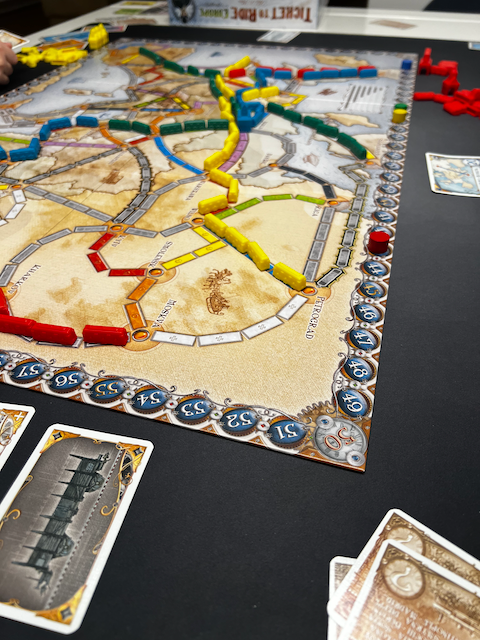
On your turn you do one of four things: take two train cards, claim a route, take new destination tickets or place a train station. To claim a route, you play as many cards of the right colour as it has spaces and place your trains on it. Longer routes score more points – a route of six spaces is worth 15, and one of eight spaces as much as 21.
When someone has only two trains or fewer left, everyone gets one final turn. Then you reveal your tickets: completed ones score points, incomplete ones lose them. The longest continuous route earns another 10 points, and each unused station is worth 4. The player with the most points wins.
Why you'll love it
With tunnels you never know in advance how many cards you'll need: you reveal three cards from the deck, and for each one in your colour you have to add one more.
Ferries across the sea require locomotives. But if you take a face-up locomotive from the table, it is your only card that turn – is it worth it?
A train station saves you when an opponent blocks your way: it lets you use one of their routes out of that city. Each unused station is worth 4 points at the end.
You choose your goals before the first turn: you get one long and three regular destination tickets and must keep at least two.
Who is Ticket to Ride: Europe for
The game is for 2 to 5 players aged 8 and up, and a game takes 30 to 60 minutes. It is fairly easy – according to the publisher you can learn it in a few minutes, and it appeals to families and experienced players alike. Players like it best with four. With only two or three players, just one track of each double route is open, so the map gets tighter.
What you might not like
Other players can claim a route you badly needed, so the game may not suit those who dislike having their plans thwarted. That is exactly what the train stations are there for.
What's in the box
a map of Europe
240 plastic trains in five colours (45 each plus a few spares)
15 train stations (three in each colour)
110 train cards (12 in each of eight colours and 14 locomotives)
46 destination tickets (6 long and 40 regular)
a longest route bonus card and a rules summary card
5 wooden scoring markers
rulebook
Frequently asked questions
Do I need the original Ticket to Ride to play Ticket to Ride: Europe?+
No. Ticket to Ride: Europe is a standalone game with its own map, trains and cards, so you don't need the original game.
How is Europe different from the original Ticket to Ride?+
Europe brings three new features: tunnels, where you may have to pay extra cards, ferries, which require locomotives, and train stations, which let you use another player's route. The cards are also larger than in the original.
How many players is the game for and how long does a game take?+
The game is for 2 to 5 players aged 8 and up, and a game takes 30 to 60 minutes. Players like it best with four.
Is Ticket to Ride: Europe suitable for beginners and families?+
Yes. On your turn you do just one of four things, so the rules are quick to learn, and the game is fairly easy in terms of complexity. It suits families as well as experienced players.
What happens to tickets I don't complete?+
The value of every ticket you haven't connected by the end of the game is subtracted from your score. That's why you keep at least two of your tickets at the start and take new ones only if you are confident you can complete them.
Can two players claim a double route in Ticket to Ride: Europe?+
With four or five players, yes: the two tracks of a double route can be claimed by different players, but one player can never claim both. With two or three players only one track is used – once someone claims it, the other is closed.
When does the game end and how is it scored?+
When a player has two trains or fewer left, everyone gets one final turn. You score points for claimed routes, completed tickets and unused stations, plus a 10-point European Express bonus for the longest continuous route.
Is Ticket to Ride: Europe in Slovenian?+
Yes, this is the Slovenian edition of the game. The train cards have no text, while the tickets and the board show the names of European cities.
Ticket to Ride Europe – A grand railway adventure on your table
Imagine the smell of a steam locomotive, the twinkling lights at a Parisian station and the excitement of looking at a map of the whole of Europe, just waiting for you to criss-cross it with your railway tracks. Ticket to Ride Europe is not just a board game; it’s a travel fever, captured in a beautifully designed box that has reigned supreme on the tables of Slovenian board game enthusiasts for years.
Whether you’re a complete beginner looking for a way into the world of modern board games, or a seasoned strategist who relishes blocking your opponents’ key routes, this game offers the perfect balance between simplicity and depth. In this comprehensive guide, we’ll take a detailed look at why this phenomenon has taken the world by storm, how to play it like a pro, and why it simply has to become part of your home collection.
Why is the game so popular?
When designer Alan R. Moon released the original version of the game, set in America, in 2004, he hit the nail on the head. But when the ‘Ticket to Ride Europe’ version was released a year later, the game became nothing short of legendary, particularly on the Old Continent. Why are we so irresistibly drawn to this gameplay mechanic?
The psychology of collecting and instant gratification
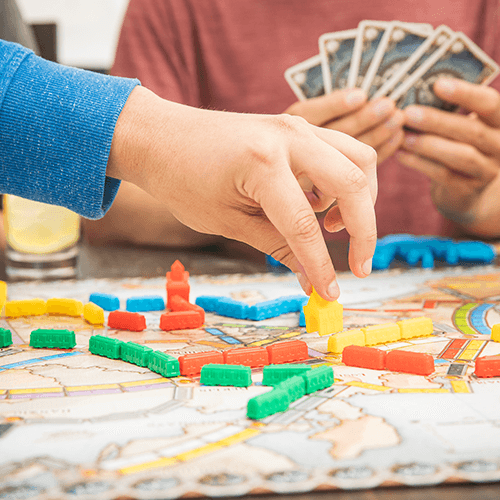
We humans are collectors by nature. The game exploits this psychological instinct through the highly satisfying ‘set collection’ mechanic. Every time you select a coloured train card, a small amount of dopamine is released in your brain – because you’re building something bigger. But the real highlight comes when you set aside a stack of matching cards and place your plastic train carriages on the game board. This physical sensation of placing the pieces on the map gives players an immediate sense of progress and power.
The social aspect: From relaxed chat to tense drama
Ticket to Ride Europe has the unique quality that its dynamics adapt perfectly to the atmosphere at the table. You can play it as an extremely relaxed family game over a cup of coffee, where everyone calmly builds their own routes. But when more players take to the board, or when you’re playing against someone who delights in deliberately thwarting others’ plans, the game transforms into a tense psychological battle. Silent agreements through glances, sighs when someone occupies your only free tunnel in Switzerland, and laughter at unexpected victories create memories that are talked about long after the game has ended.
Why has it become such a hit in Slovenia?
We Slovenians love travelling and going on trips, whilst at the same time we’re drawn to the concept of quality time spent together at home. The geographical proximity of the cities on the game board – as you connect Vienna, Venice, Budapest and even the outskirts of our own towns during the game – creates an immediate sense of familiarity. Furthermore, the game offers a high degree oflinguistic independence (there is no text on the components, only the names of the cities), which means that grandparents, parents and children can easily play it together without being held back by a lack of knowledge of foreign languages.
Detailed instructions and gameplay
List of components: What’s in the box?
When you open the large, high-quality box from publisher Days of Wonder, you’ll find a superbly organised plastic insert in which every component has its own place:
1 large game board featuring a map of Europe from the early 20th century and a scoring track around the edge.
225 coloured plastic carriages (45 each in five colours: blue, yellow, green, red and black, plus a few spares).
15 plastic railway stations (3 of each colour).
110 carriage cards (in eight different colours and multicoloured locomotives).
46 destination ticket cards (6 long routes with a blue background and 40 shorter routes).
5 wooden scoring markers (in the players’ colours).
1 ‘European Express’ bonus card (for the longest unbroken route).
1 rulebook.
Setting up the game
Setting up the game is quick and easy, which is one of the main reasons why it is played so often:
Setting up the board: Spread the map out in the centre of the table. Each player chooses their colour, takes 45 carriages and 3 stations, and places their wooden marker on the starting square (0) of the scoring track.
Preparing the train cards: Shuffle the carriage cards thoroughly. Deal 4 cards to each player as their starting hand. Place the remaining cards next to the board as a draw pile, and turn the top 5 cards face up in a row.
Distributing destination tickets: Separate the long routes (blue) from the short ones. Deal 1 long route and 3 short routes to each player. Each player looks at their cards in secret and decides which ones to keep. They must keep at least 2 cards, but may keep all 4. Unused tickets are returned to the box.
Gameplay
The game proceeds in a clockwise direction. When it is your turn, you must carry out exactly one of the four possible actions.
1. Drawing carriage cards
You may choose two cards. You may take them from the five face-up cards on the table or draw one face-down from the top of the pile (you may combine the two: one face-up, one face-down).
An important rule regarding locomotives: Locomotives act as ‘Jokers’ and can substitute for any colour. If you take a face-up locomotive from the table, that is your only card for this turn (you may not draw another). However, if you draw a locomotive face-down from the top of the pile, you are still entitled to a second card!
2. Occupying the track
With this action, you are effectively building your network on the board. You choose a track between two neighbouring towns and discard the same number of cards of the corresponding colour from your hand as the length of the track on the map (e.g. four red cards for a track four units long). You then place your plastic carriages on those spaces and immediately move your marker along the scoring track.
Grey routes: You may use any set of cards of the same colour to occupy them.
Ferries: These routes run across water and feature a locomotive icon on certain spaces. To claim them, you must play as many locomotive cards as indicated; fill the remaining spaces with the corresponding colour.
Tunnels: Tunnels (marked with a special border) are unpredictable. When you announce construction in a tunnel and reveal the relevant cards, turn over 3 cards from the top of the pile. For each card turned over that matches the colour of your line (or is a locomotive), you must pay an additional card of that colour from your hand. If you do not have any or do not wish to pay, your turn ends and the cards are returned to your hand.
3. Drawing new destination tickets
If you have successfully connected your cities or need more points, you may draw 3 new short destination tickets from the top of the pile. You must keep at least one, but you may keep two or all three. Be careful – unfinished routes will cost you points at the end!
4. Building a railway station
This is a key new feature of the European version, which solves the problem of occupied routes. You can build a station in any town where there isn’t already one. The first station costs you 1 card of any colour, the second two cards of the same colour, and the third three cards of the same colour. A station allows you, at the end of the game, to use one of your opponent’s routes leading from that town to complete your destination ticket.
Winning conditions
The game begins to wind down when a player has 2 or fewer plastic carriages left in their stock. At that point, everyone (including that player) plays one final round, followed by the final scoring.
Final scoring:
Points collected during the game by building tracks (marked on the track as you go).
+ (Plus): Points from all successfully completed destination tickets.
- (Minus): Points from any uncompleted destination tickets.
+ 4 points for each unused railway station remaining in your stock.
+ 10 points for the player with the longest unbroken route (European Express card).
The winner is the player who scores the most points. In the event of a tie, the winner is the player who has successfully completed the most destination tickets.
Analysis of strategies and tactics
To ensure you don’t just stand by helplessly whilst your opponents corner you, we’ve put together some key strategic tips that separate beginners from seasoned masters.
Strategy for beginners: Safe and steady
Start in the middle: Long routes (e.g. Edinburgh to Athens) are tempting, but if someone traps you in central Europe, you’ll lose a huge number of points. Try to secure the key hubs in the centre of the board first (e.g. Frankfurt, Munich, Vienna).
Stock up on cards: Don’t build a route of length 1 or 2 straight away on your first turn. Instead, for the first few rounds, just draw cards from the table and the pile. Once you have a strong ‘pool’ of cards in various colours, you can build an entire network in a few consecutive moves before your opponents even realise where you’re heading.
Don’t be afraid of stations: Beginners often hold back on stations because of the 4 points they’re worth at the end. However, a successfully completed route can earn you 12, 15 or even 20 points! Sacrificing 4 points and one card to place a station is, mathematically speaking, extremely profitable if it completes your entire route.
Advanced tactics for experienced players
Reading your opponents’ intentions: Keep a close eye on which cards your opponents are taking from the open market. If someone is frantically collecting yellow and black cards, check the map to see where these colours intersect. You can pre-emptively occupy a key grey route or tunnel, forcing them to take a huge detour or use up a station.
Bluffing with tunnels: If you want to confuse an opponent about your true objectives, sometimes deliberately build a shorter tunnel somewhere on the outskirts, where it doesn’t matter if it fails. This will create the impression that you have objectives in that region, whilst you quietly build your main route elsewhere.
Timing the end of the game: If you notice that your opponents are holding a lot of new destination tickets, whilst you have already completed yours, start frantically building short routes with the aim of using up your carriages as quickly as possible. This will allow you to end the game early and catch your opponents with a hand full of unfinished routes, which will result in catastrophic penalty points for them.
If you love the Ticket to Ride mechanics but don’t always have a whole hour to spare for a game, or if you’re looking for something more compact for travelling, Ticket to Ride Paris is the perfect alternative. It’s part of the exclusive ‘City Editions’ series.
Key differences and features:
Compactness and speed: Instead of a large board, you play on a smaller, beautifully illustrated map of Paris from the Roaring Twenties. A game lasts between 10 and 20 minutes and is suitable for 2 to 4 players.
Buses instead of trains: Instead of the classic train carriages, in this version you place beautiful, intricately designed Parisian open-top buses.
Bastille Day mechanic: Paris introduces a unique mechanic for collecting transport cards featuring the French tricolour. Whenever you occupy a route that uses a card with the flag, keep that card in front of you. When you collect a set of three cards in blue, white and red, you receive instant bonus points. This adds a whole new tactical layer to the fast-paced gameplay.
It’s the ideal choice for couples, students or as a quick ‘warm-up’ game before a longer evening of board games.
FAQ (Frequently Asked Questions)
Is the game suitable for children, and from what age?+
The official recommended age is 8+. The rules are really simple (you either draw cards or build), so children around the age of eight pick it up quickly. The game is excellent for developing spatial awareness, basic planning skills and learning about the geography of Europe.
What is the optimal number of players?+
The game supports between 2 and 5 players. It works brilliantly in all configurations, though the dynamics do change. With 2 players, the game is more strategic and less competitive, as there’s plenty of space on the board. With 4 or 5 players, however, the map becomes a real free-for-all, routes disappear quickly and the tension is at its peak.
How language-independent is the game?+
The game is exceptionally language-independent. All components (cards, board) use symbols and colours. The only text consists of the names of the towns on the map and the destination tickets. The Slovenian edition includes instructions in Slovenian, so you won’t need any knowledge of foreign languages whilst playing.
How long does a game last?+
The average playing time is between 30 and 60 minutes. Setting up the game takes less than 5 minutes, and the turns follow each other extremely quickly, as each player takes only one action per round. This means you won’t get bored whilst waiting for your turn, as you’re constantly watching what your opponents are doing.
What happens if I run out of plastic carriages?+
When a player has only 2, 1 or 0 carriages left in their stock, the final round of the game begins. You cannot retrieve carriages during the game – once you’ve placed them on the board, they remain there until the end of the game. The number of carriages is your main limitation, so use them sparingly.
Are double-track lines available to both players?+
When playing with 4 or 5 players, both tracks on a double-track line may be occupied by different players (one player may never occupy both tracks on the same line). However, if you are playing with just 2 or 3 players, a strict rule applies: as soon as someone occupies one track on a double-track line, the other track is locked and becomes unusable for everyone.
Conclusion
Ticket to Ride Europe remains, for good reason, one of the most popular board games of all time. It combines beautiful components, rules you can learn in five minutes, and enough tactical depth to ensure every game feels fresh and exciting. It’s the perfect birthday present, an indispensable companion on family holidays and the star of laid-back evenings with friends.
Would you like to embark on your own railway adventure or delight your loved ones with a gift that won’t just gather dust on a shelf?